Rejoignez-nous pour un voyage dans le monde des livres!
Ajouter ce livre à l'électronique
Grey
Ecrivez un nouveau commentaire Default profile 50px
Grey
Abonnez-vous pour lire le livre complet ou lisez les premières pages gratuitement!
All characters reduced
Sovereign State - The Power and Limits of Political Authority in Modern Governance - cover

Sovereign State - The Power and Limits of Political Authority in Modern Governance

Fouad Sabry

Maison d'édition: One Billion Knowledgeable

  • 0
  • 0
  • 0

Synopsis

In our interconnected world, understanding state sovereignty is key to international relations. "Sovereign State," part of the "Political Science" series, provides a detailed analysis of state sovereignty, its evolution, and current challenges. This essential read is perfect for anyone looking to deepen their grasp of global politics.
 
1-Foundational principles of sovereign states and their international roles.
 
2-Right of self-determination and its impact on sovereignty.
 
3-Concept and relationships of associated states with sovereign nations.
 
4-Current list and recognition of sovereign states.
 
5-Role of diplomatic recognition in sovereignty.
 
6-Challenges faced by states with limited recognition.
 
7-Causes and resolutions of territorial disputes.
 
8-Core concept and evolution of sovereignty.
 
9-Montevideo Convention’s criteria for statehood.
 
10-Characteristics and challenges of quasi-states.
 
11-Distribution of sovereign states and dependent territories by continent.
 
12-Political dynamics of sovereign states and territories in Asia.
 
13-Historical and current status of European sovereign states and territories.
 
14-Significance of maritime boundaries in international relations.
 
15-Geopolitical implications of land and maritime borders.
 
16-Sovereign states' landscape in the 1980s.
 
17-Developments in state sovereignty in the 2000s.
 
18-Political context of Eurasian states and territories.
 
19-Political status of the Cook Islands and Niue.
 
20-Contemporary state of sovereignty in the 2020s.
 
21-Concept and quest for recognition of aspirant states.
 
Readers will gain a robust understanding of state sovereignty and its role in global politics. Enrich your knowledge with "Sovereign State."
Disponible depuis: 04/09/2024.
Longueur d'impression: 169 pages.

D'autres livres qui pourraient vous intéresser

  • Profit over Privacy - How Surveillance Advertising Conquered the Internet - cover

    Profit over Privacy - How...

    Matthew Crain

    • 0
    • 0
    • 0
    In Profit over Privacy, Matthew Crain gives internet surveillance a much-needed origin story by chronicling the development of its most important historical catalyst: web advertising. 


    Profit over Privacy uses the 1990s as its backdrop to show how the massive data-collection infrastructure that undergirds the internet today is the result of twenty-five years of technical and political economic engineering. Crain considers the social causes and consequences of the internet's rapid embrace of consumer monitoring, detailing how advertisers and marketers adapted to the existential threat of the internet and marshaled venture capital to develop the now-ubiquitous business model called "surveillance advertising." He draws on a range of primary resources from government, industry, and the press and highlights the political roots of internet advertising to underscore the necessity of political solutions to reign in unaccountable commercial surveillance. 


    Surveillance advertising is the result of political choices—not the inevitable march of technology. Unlike many other countries, the United States has no internet privacy law. A fascinating prehistory of internet advertising giants like Google and Facebook, Profit over Privacy argues that the internet did not have to turn out this way and that it can be remade into something better.
    Voir livre
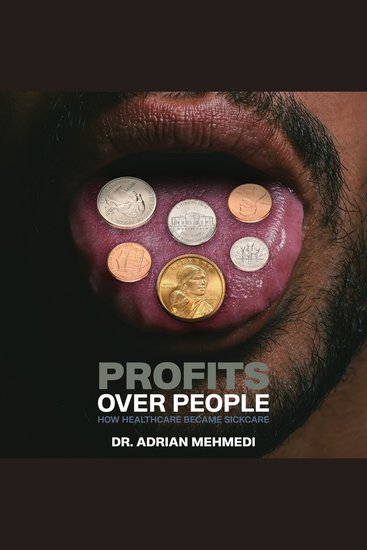
  • Profits Over People: How Healthcare Became Sickcare - cover

    Profits Over People: How...

    Dr. Adrian Mehmedi

    • 0
    • 0
    • 0
    What if everything you thought you knew about healthcare was wrong? 
    In Profits Over People: How Healthcare Became Sickcare, Dr. Adrian Mehmedi exposes the truth about a broken medical system that prioritizes profits over patient well-being. From the rise of Big Pharma’s influence to the suppression of alternative medicine, this book reveals how corporate greed, flawed policies, and a pharmaceutical-driven agenda have transformed healthcare into a business that thrives on illness rather than healing. 
    🔹 Why are prescription drugs the go-to solution, even when they cause harm? 
    🔹 Why is the U.S. healthcare system the most expensive in the world—yet ranks among the worst in health outcomes? 
    🔹 How did we move from natural, holistic healing to a profit-driven sickcare model?A Deep Dive Into the Past, Present & Future of Medicine 
    Dr. Mehmedi takes readers on a compelling journey through history, unveiling how theFlexner Report, medical monopolization, and pharmaceutical lobbying shaped the modern healthcare system. He explores today’s crises, from skyrocketing medical costs to the overprescription of drugs—and reveals how we can reclaim our health.A Roadmap for a Better Future 
    This book isn’t just an exposé—it’s a call to action. With insights into holistic medicine, decentralized healthcare, regenerative practices, and emerging innovations, Profits Over People offers a vision for a new paradigm of healing—one where people, not profits, come first. 
    If you care about your health, your family’s well-being, or the future of medicine, this book is a must-read.
    Voir livre
  • The Shortest History of Ancient Rome - A Millennium of Western Civilization from Kingdom to Republic to Empire--A Retelling for Our Times (The Shortest History Series) - cover

    The Shortest History of Ancient...

    Ross King

    • 0
    • 0
    • 0
    "For who is so indifferent or indolent as not to wish to know by what means the Romans succeeded in subjecting nearly the whole inhabited world to their sole government―a thing unique in history?"―Polybius, second century BCE 
    Ancient Rome gave rise to the Roman Empire, one of history's greatest civilizations. It flourished for roughly five hundred years and, at its height, made up at least twenty percent of the world's population. It left an indelible mark on the world, shaping politics, laws, philosophy, and architecture, and gave us Roman numerals, the calendar, aqueducts, and concrete. Alongside the Greeks, the Romans laid the groundwork for Western civilization. 
    In this fast-paced history, Ross King introduces the emperors and warriors, the madmen and upstarts, and the artists and gladiators responsible for the empire's rise, reign, and ruin. King's vivid narrative offers fresh context for key political and religious events and paints lively portraits of Rome's most formidable and notorious leaders. Spanning over one thousand years of Roman history, The Shortest History of Ancient Rome brings an ancient civilization to vibrant life, elucidating why the Romans still matter to us today.
    Voir livre
  • The Invented State - Policy Misperceptions in the American Public - cover

    The Invented State - Policy...

    Emily Thorson

    • 0
    • 0
    • 0
    In The Invented State, Emily Thorson argues that a problematic and understudied aspect of political misinformation reflects widespread public misperception about what the government does. Because much of public policy is invisible to the public, there is fertile ground for false beliefs to flourish, leading to what Thorson terms the "invented state": systematic misperceptions about public policy. However, people get the facts wrong not because they are stupid or blinded by partisan loyalty. Misperceptions are created when three conditions are met: when citizens have incomplete information about an issue, when their own biases color their understanding of it, and when they feel that the issue is important. The invented state is created by exposure to misinformation and by individuals' cognitive errors. 


    Correcting these policy misperceptions is highly effective at reducing false beliefs. Providing people with corrective information has downstream effects on attitudes. When they learn how policies really work, their approval increases and they also shift their policy priorities. Contrary to pundits' assumptions of a public who is largely indifferent to policy, there is a deep public desire to learn basic facts about how the government works. Thorson meets that desire with analysis on how the media can identify and correct substantive policy misperceptions.
    Voir livre
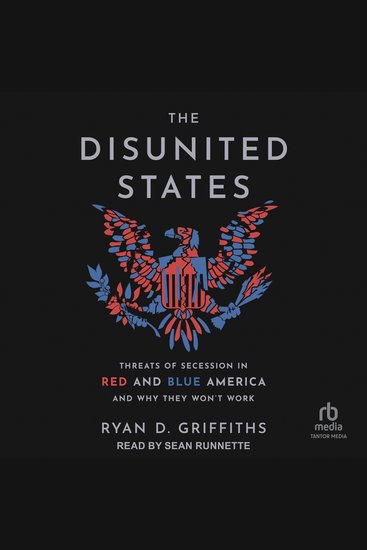
  • The Disunited States - Threats of Secession in Red and Blue America and Why They Won't Work - cover

    The Disunited States - Threats...

    Ryan D Griffiths

    • 0
    • 0
    • 0
    There is a growing interest in American secession. In February 2023, Marjorie Taylor Greene tweeted that "We need to separate by red states and blue states." Recent movements like Yes California have called for a national divorce along political lines. A 2023 Axios poll shows that 20 percent of Americans favor a national divorce. These trends show a sincere interest in American secession, and they will likely increase in the aftermath of the 2024 Presidential election.Proponents of secession make three arguments: the two sides have irreconcilable differences; secession is a legal right; and smaller political units are better. Through interviews with secessionist advocates in America, Ryan Griffiths explores the case for why Red America and Blue America should split up.But as The Disunited States shows, secession is the wrong solution to the problem of polarization. Red and Blue America are not neatly sorted and geographically concentrated. Splitting the two parts would require a dangerous unmixing of the population, one that could spiral into violence and state collapse. Drawing on his expertise on secessionism worldwide, he shows how the process has played out internationally—and usually disastrously. Ultimately, this book will disabuse listeners of the belief that secession will fix America's problems.
    Voir livre
  • The Architecture of Modern Empire - Conversations with David Barsamian - cover

    The Architecture of Modern...

    Arundhati Roy, Naomi Klein

    • 0
    • 0
    • 0
    A revelatory and wide-ranging series of interviews with award-winning writer Arundhati Roy, touching on United States empire, Indian nationalism, a writer's work, and more. 


    As a novelist, Arundhati Roy is known for her lush language and intricate structure. As a political essayist, her prose is searching and fierce. All of these qualities shine through in the interviews collected here by David Barsamian. 


    This newly reissued and expanded edition, featuring interviews from 2001 to 2022 and a moving foreword by Naomi Klein, explores Roy's evolving political thought and commitments across the tumultuous twenty-first entry. 


    The Architecture of Modern Empire is a searing reckoning with the mechanics of power, in all its forms, and the role of imagination and creative expression in envisioning a radically different world.
    Voir livre