Rejoignez-nous pour un voyage dans le monde des livres!
Ajouter ce livre à l'électronique
Grey
Ecrivez un nouveau commentaire Default profile 50px
Grey
Abonnez-vous pour lire le livre complet ou lisez les premières pages gratuitement!
All characters reduced
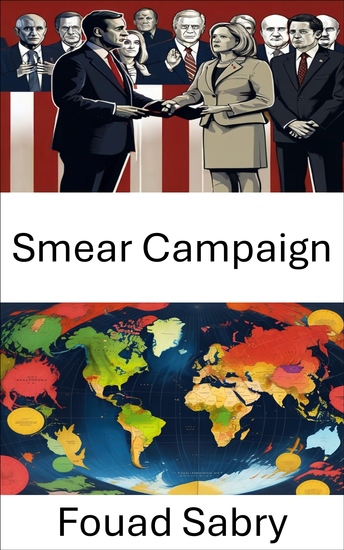
Smear Campaign - Manipulating Public Perception in Modern Politics - cover

Smear Campaign - Manipulating Public Perception in Modern Politics

Fouad Sabry

Maison d'édition: One Billion Knowledgeable

  • 0
  • 0
  • 0

Synopsis

Explore the intricate world of political maneuvering in "Smear Campaign," an essential examination of the tactics, impacts, and ethical implications of smear campaigns in modern politics. This book offers insights into how public perception and electoral outcomes can be manipulated through misinformation and character assassination.
 
1: Smear Campaign: Defines smear campaigns, tracing their evolution and prevalence in modern politics.
 
2: Tactic: Discusses diverse methods of smear campaigns, including fact distortion and selective quoting.
 
3: Character Assassination: Examines efforts to damage reputations through unfounded allegations and malicious narratives.
 
4: Negative Campaigning: Analyzes negativity in political messaging, contrasting legitimate critiques with manipulative tactics.
 
5: Propaganda Techniques: Highlights emotional appeals and misinformation used in smear campaigns to sway public opinion.
 
6: Informal Fallacy: Explores logical fallacies leveraged in smear campaigns to distort perceptions and mislead voters.
 
7: Whispering Campaign: Investigates the spread of damaging rumors that erode trust in political figures.
 
8: Swiftboating: Chronicles the Swift Boat Veterans for Truth campaign as a case study in electoral distortion.
 
9: Counterpropaganda: Examines strategies to respond to smear campaigns, emphasizing truth-telling to mitigate damage.
 
10: Whataboutism: Analyzes how whataboutism deflects legitimate criticism by creating false equivalences.
 
11: John Pilger: Profiles Pilger's work in exposing media manipulation and the role of independent journalism.
 
12: Pincer Movement: Explores coordinated smear tactics aimed at overwhelming political opponents.
 
13: Media Lens: Highlights the role of media watchdogs in exposing biased reporting and misinformation.
 
14: Chess Tactic: Draws parallels between chess strategy and political smear campaigns.
 
15: Push Poll: Investigates the deceptive use of polling to spread negative information.
 
16: False Flag: Analyzes historical false flag operations used to discredit adversaries.
 
17: Kompromat: Examines the use of compromising materials to blackmail political opponents.
 
18: Isolation: Explores isolation tactics that weaken opponents' support networks.
 
19: Internet Manipulation: Analyzes the rise of smear campaigns in digital spaces, including social media and bots.
 
20: Disinformation Attack: Investigates efforts to spread false information through digital channels.
 
21: Terruqueo: Explores the use of terror and intimidation in political smear campaigns.
 
This groundbreaking work is indispensable for professionals and enthusiasts, offering insights into the complex strategies of modern political discourse. Equip yourself with the knowledge to discern truth from manipulation and safeguard democracy in an era of information warfare.
Disponible depuis: 09/10/2024.
Longueur d'impression: 261 pages.
D'autres livres qui pourraient vous intéresser

  • Democracy Unmoored - Populism and the Corruption of Popular Sovereignty - cover

    Democracy Unmoored - Populism...

    Samuel Issacharoff

    • 0
    • 0
    • 0
    The 2016 election of Donald Trump focused people's minds on populism, and most of the attention paid to the subject since has been on the threat it poses to wealthy democracies. In Democracy Unmoored, Samuel Issacharoff takes a far wider-angle view of the phenomenon, covering countries from across the globe: Brazil, Poland, Argentina, Turkey, India, Hungary, Venezuela, and more. Just as importantly, he focuses on populism's attack on the institutions of governance. Democracy requires two critical features: first, a commitment to repeat play such that political actors understand that what goes around comes around; and, second, institutional constraints so that the majority can prevail, albeit not by too much. Democracies must avoid the doomsday scenario in which the contending parties see the next election as the final choice between salvation and perdition. Issacharoff shows how populist governance undermines each of these two critical underpinnings of stable democracy, first by compressing the time horizon to the immediate, and second by eroding institutional constraints on strongman rule. At the same time, Issacharoff highlights the fact that ascendent populists were pushing in an open door as they found democracies in states of disrepair in the post-2008 world.
    Voir livre
  • Spies in History - From the Ancient World to the Silver Screen - cover

    Spies in History - From the...

    Stephen Alford, Alastair Benn,...

    • 0
    • 0
    • 0
    The public appetite for spies, both real and fictional, seems inexhaustible. But where and when did spying begin and how has the art and craft of espionage developed over the centuries? Spies in History is a collection of portraits of some of the most famous spies we know, but it also includes some lesser known and more surprising names. A remarkable line-up of distinguished historians, scholars and writers examine the evolution of intelligence and counter-intelligence – from ancient times to the Cold War and the age of Putin, Trump and Xi Jinping – to reveal the truth about espionage and the myths that surround it.
    Voir livre
  • Obscurantism in power When Mainstream Thinking Hinders Knowledge - cover

    Obscurantism in power When...

    Brice Perrier

    • 0
    • 0
    • 0
    Over the last ten years or so, it has become commonplace to hear talk of an obscurantist threat linked to a rise in irrationality, manifested mainly by a mistrust of vaccination and conventional medicine. But obscurantism can also be found where we pride ourselves on fighting it. In this case, it is no longer the work of marginal or anti-establishment groups, but of a dominant way of thinking that presents itself as that of science and rationality. 
    The aim of this book is to lift the veil on this obscurantism in power. Through numerous examples, from impeded research into unexplained phenomena such as near-death experiences, to the vast field of medicine where the pharmaceutical industry has cornered the market on proving the usefulness of a treatment, Brice Perrier reveals how reason is transformed into dogmatism and hinders the advancement of knowledge. 
    The aim of the book is not to say what is true or false, nor to settle scientific controversies, but to understand why these debates, which have always been legitimate and even necessary in science, may simply no longer be allowed.
    Voir livre
  • Civil Wars - A Very Short Introduction - cover

    Civil Wars - A Very Short...

    Monica Duffy Toft

    • 0
    • 0
    • 0
    Civil wars are the most common form of large-scale political violence. In the past thirty years, the study of civil wars has been one of the largest growing segments of the international relations field. Their causes are complex, ranging from fights over access to housing, jobs, and land or other resources, to political contests over offices, rights, and representation. Groups form, collapse, coalesce, align and realign, and then fight amongst themselves. Governments themselves change through elections, coups, military defeats, or revolutions. Understanding the origins of civil wars and their trajectories therefore demands some appreciation of the economic, political, social, cultural, and geographic order of societies. If there is one factor that best predicts why a civil war erupts, it is a prior civil war. That is why knowledge of a country's history of political violence, and associated narratives about who is to blame and why, are critical to understanding where a civil war might next occur. We now have a better understanding of the conditions under which civil wars generally emerge, how the fighting evolves, and how civil wars end. However, historical understanding—the human dimensions—remain every bit as critical. This book explores current debates on civil wars and how the reasons for fighting (and the nature of belligerents themselves) are changing.
    Voir livre
  • Where Angels Fear to Tread: The Memoir of a Humanitarian Aid Worker - cover

    Where Angels Fear to Tread: The...

    Sally Becker

    • 0
    • 0
    • 0
    'I was filled with apprehension about crossing the front line, but I would have risked my life to save just one child. Ivan was giving me a chance to save them all…' 
    This is the extraordinary work of Sally Becker, a humanitarian aid worker who for over three decades has risked it all in order to help the children of war. 
    Where Angels Fear to Tread is a reminder that – with determination, unrelenting passion and drive – one person can change the lives of so many. 
    In May 1993, Sally Becker went to Bosnia to help the innocent victims of war. She started by delivering humanitarian aid to the region, and was soon hailed as the 'Angel of Mostar' for rescuing wounded children and their families from the besieged city. Sally continued her work throughout the conflict and is credited with saving many lives. 
    When President Milosevic ordered his troops into Kosovo, her missions continued, this time on foot across the mountains. While attempting to bring sick and wounded children and their families to safety, she was captured by Serb paramilitaries, but neither this nor being shot by masked gunmen in Northern Albania could make her abandon her task. 
    Bosnia was Sally's first mission and the beginning of her lifelong commitment to help rescue children caught up in some of the most horrific wars around the world, including missions to help children in Iraq, Ukraine and most recently Gaza. 
    Her account provides a rare and invaluable insight into the complexities of international aid work, the shocking reality of life on the front lines and the desperate race to save innocent children trapped in war zones. 
    This is her extraordinary story. 
    Sally Becker's autobiography, a compelling narrative of her life in the service of others, is set to be the latest bestseller in non-fiction. Her memoirs, steeped in tales of charity and social welfare, underscore the power of individual action amidst the often sluggish responses of government institutions. 
    nan 
    HarperCollins 2025
    Voir livre
  • My America - Langston Hughes on Democracy - cover

    My America - Langston Hughes on...

    Randal Maurice Jelks

    • 0
    • 0
    • 0
    Best known as the leader of the Harlem Renaissance, the celebrated poet and writer Langston Hughes believed in the power of art as resistance. What can we learn from his works today? 
    Randal M. Jelks delivers this revelatory portrait of the celebrated poet, essayist, playwright, and American artist Langston Hughes. My America traces Hughes's journey from a child captivated by the wonder of Kansas City to cosmopolitan witness in Paris, New York, Mexico City, and Madrid. We encounter Hughes as a young man discovering the pulse of modern life in a world on the verge of exploding metaphorically and literally. His experiences informed his work and his thinking on art, democracy, and activism. 
    Langston Hughes is one of the few American writers who consistently wrote about democracy from a joyous perspective, and My America explores how his works speak to the political anxieties and crises we face today. Jelks deftly examines the themes in Hughes's work, including creative expression, communal dignity, class struggle, and human suffering and what they mean for our inner well-being as democratic persons and political participants. 
    With care and no-holds-barred insight, My America removes the veneer of respectability often placed on Hughes's work and life to reveal his political adeptness. In a world threatened by fascism, Hughes's writing wasn't afforded the luxury of subtlety. He made a spiritual and political decision to stand on the side of the oppressed. He believed art should be practiced for the sake of justice. And democracy can be practiced with joy.
    Voir livre