Begleiten Sie uns auf eine literarische Weltreise!
Buch zum Bücherregal hinzufügen
Grey
Einen neuen Kommentar schreiben Default profile 50px
Grey
Jetzt das ganze Buch im Abo oder die ersten Seiten gratis lesen!
All characters reduced
Republic of Venice - Navigating Power and Influence in a Maritime Empire - cover

Republic of Venice - Navigating Power and Influence in a Maritime Empire

Fouad Sabry

Verlag: One Billion Knowledgeable

  • 0
  • 0
  • 0

Beschreibung

Explore the Republic of Venice through this essential addition to the Political Science series. "Republic of Venice" offers a comprehensive analysis of this influential maritime republic, revealing its political structure, governance, and historical impact.
 
Chapters Highlights:
 
1. Republic of Venice: Origins and evolution of Venice’s political and social systems.
 
2. Doge of Venice: Role, power, duties, and electoral process of the Doge.
 
3. Republic of Genoa: Comparison of political structures with Venice.
 
4. Pietro Loredan: Contributions and impact of this influential figure.
 
5. History of Dalmatia: Dalmatia's significance under Venetian rule.
 
6. Military History: Venice's military strategies and campaigns.
 
7. Pietro IV Candiano: Life and political maneuvers shaping Venetian governance.
 
8. Maritime Republics: Role of maritime republics, including Venice, in European history.
 
9. History of the Republic: Key events and turning points in Venice’s history.
 
10. Domenico Selvo: Contributions to Venetian politics and development.
 
11. Domenico Morosini: Impact on Venetian governance.
 
12. Venetian–Genoese Wars: Analysis of conflicts between Venice and Genoa.
 
13. Stato da Màr: Venice’s maritime empire and its impact.
 
14. House of Loredan: Role and legacy in Venetian politics.
 
15. Timeline: Detailed timeline of significant events in Venice’s history.
 
16. Venetian Rule in the Ionian Islands: Governance and strategic importance.
 
17. Venetian Dalmatia: Role in the Republic’s expansion.
 
18. Venetian Navy: Structure and impact on military and economic power.
 
19. Croatian–Venetian Wars: Effects on regional politics.
 
20. Fall of the Republic: Factors leading to Venice’s decline.
 
21. Corno Ducale: Symbolism of Venetian authority.
 
This book is a valuable resource for anyone interested in the Republic of Venice, offering deep insights into one of Europe's most captivating political entities.
Verfügbar seit: 10.08.2024.
Drucklänge: 433 Seiten.


Weitere Bücher, die Sie mögen werden

  • The Last Best Hope - A History of American Realism - cover

    The Last Best Hope - A History...

    John Hulsman

    • 0
    • 0
    • 0
    In this brilliant exploration of American history and contemporary conservative politics, foreign policy expert John Hulsman draws on his years at the heart of Washington to present a compelling new vision of conservative realism. 
    In our current Age of Insecurity, Hulsman suggests, there has never been a bigger need for the re-ascendance of realist principles in conservative circles. By drawing on U.S. history to illustrate realist precepts at the heart of the American story, The Last Best Hope provides a practical, realist foreign policy for a new age of American politics. 
    There has never been a greater time to re-claim the primacy of conservative thought. By fusing the populist Jacksonian base of the GOP with the more libertarian Jeffersonian school of thought, this cogently argued manifesto hopes to grasp that opportunity, and to act as a clarion call for a new dominant realist foreign policy.
    Zum Buch
  • Small Power - How Local Parties Shape Elections - cover

    Small Power - How Local Parties...

    David Doherty, Conor M. Dowling,...

    • 0
    • 0
    • 0
    An insider's look into the largely anonymous volunteers in local party organizations who make decisions in elections with profound implications for American democracy. 


    Although scholars have long recognized that local American parties play an important role in elections, surprisingly little is known about the individuals who lead these typically small, volunteer-based organizations. As David Doherty, Conor M. Dowling, and Michael G. Miller show in Small Power, local party leaders influence the electoral process in myriad ways: They recruit and support candidates, interface with state-wide and federal campaigns, and get out the vote in their communities. Drawing from a survey of over 850 Democratic and Republican local party chairs, a nationally representative sample of voters, and dozens of in-depth interviews, the authors describe how parties are organized, who party chairs are, and how they serve the party. Leveraging novel experiments that illuminate how chairs make choices about which individuals to recruit as candidates—as well as whether those choices reflect voters' preferences—Small Power sheds new light on how seemingly mundane local decisions can shape party goals, influence candidate pipelines, and affect who ends up winning elections.
    Zum Buch
  • Stories are Weapons - Psychological Warfare and the American Mind - cover

    Stories are Weapons -...

    Annalee Newitz

    • 0
    • 0
    • 0
    In Stories Are Weapons, Annalee Newitz traces the way disinformation, propaganda, and violent threats have evolved from military weapons deployed against foreign adversaries into tools in domestic culture wars. Newitz delves into America's deep-rooted history with psychological operations, beginning with Benjamin Franklin's Revolutionary War–era fake newspaper and nineteenth-century wars on Indigenous nations, and reaching its apotheosis with the Cold War and twenty-first-century influence campaigns online. America's secret weapon has long been coercive storytelling. And there's a reason for that: operatives who shaped modern psychological warfare drew on their experiences as science fiction writers and in the advertising industry. 


    Now, through a weapons-transfer program long unacknowledged, psyops have found their way into the hands of culture warriors, transforming democratic debates into toxic wars over American identity. Newitz zeroes in on conflicts over race and intelligence, school board fights over LGBT students, and campaigns against feminist viewpoints, revealing how, in each case, specific groups of Americans are singled out and treated as enemies of the state. Crucially, Newitz delivers a powerful counternarrative, speaking with the researchers and activists who are outlining a pathway to achieving psychological disarmament and cultural peace.
    Zum Buch
  • A Journey Through America - Patriotic Observations and Commentary - cover

    A Journey Through America -...

    Lawrence Kadish

    • 0
    • 0
    • 0
    A Journey Through America introduces insightful commentary on our American democracy. Author Lawrence Kadish draws from over eighty-five years of lived experience, allowing him to celebrate our nation's strengths, reflect on our self-inflicted errors, and draw attention to the challenges of a nation that remains humanity's last hope. 


    An astute and insightful observer of our nation's political experience, Lawrence Kadish draws on his decades of advocacy on behalf of a nation he loves to advance its founding principles. A Journey Through America offers cautionary advice, inspiring words, and a reminder that a great nation needs to remain strong and united in the face of challenges from within and abroad.
    Zum Buch
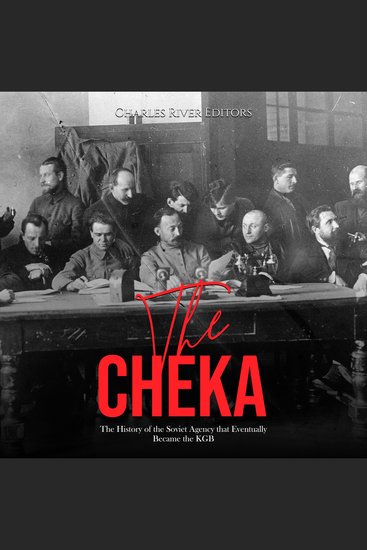
  • Cheka The: The History of the Soviet Agency that Eventually Became the KGB - cover

    Cheka The: The History of the...

    Editors Charles River

    • 0
    • 0
    • 0
    The KGB is one of the most famous abbreviations of the 20th century, and it has become synonymous with the shadowy and often violent actions of the Soviet Union’s secret police and internal security agencies. In fact, it is often used to refer to the Soviet state security agencies throughout its history, from the inception of the inception of the Cheka (Extraordinary Commission) in 1917 to the official elimination of the KGB in 1992. Whether it’s associated with the Russian Civil War’s excesses, Stalin’s purges, and even Vladimir Putin, the KGB has long been viewed as the West’s biggest bogeyman during the second half of the 20th century. 
    	However, the KGB did not appear out of thin air. Naturally, the earliest Soviet leaders utilized intelligence agencies that collected information both abroad and within the Soviet Union, targeting foreign opponents and domestic opponents alike. Lenin did not imagine the scale of the opposition he would have to face after the revolution, and he quickly came to the conclusion that "a special system of organized violence" must be created to implement the dictatorship of the proletariat. 
    	Thus, from nearly the beginning of the Bolshevik takeover of Russia, Lenin and his successors established and relied on a particularly ruthless agency: the All-Russian Extraordinary Commission for Combating Counter-Revolution and Sabotage, later abbreviated to the Extraordinary Commission. Known colloquially as the Cheka (Extraordinary Commission), it soon became as feared by non-socialists as the Tsar’s secret police had ever been. The main means approved by the Council of People's Commissars on December 20, 1917, which the Cheka had to use to fight the counter-revolution, were "seizure of property, resettlement, deprivation of cards, publication of lists of enemies of the people, etc."
    Zum Buch
  • Defectors - How the Illicit Flight of Soviet Citizens Built the Borders of the Cold War World - cover

    Defectors - How the Illicit...

    Erik R. Scott

    • 0
    • 0
    • 0
    Defectors fleeing the Soviet Union seized the world's attention during the Cold War. Their stories were given sensational news coverage and dramatized in spy novels and films. Upon reaching the West, they were entitled to special benefits, including financial assistance and permanent residency. In contrast to other migrants, defectors were pursued by the states they left even as they were eagerly sought by the United States and its allies. Taking part in a risky game that played out across the globe, defectors sought to transcend the limitations of the Cold War world. 


    Defectors follows their treacherous journeys and looks at how their unauthorized flight via land, sea, and air gave shape to a globalized world. It charts a global struggle over defectors that unfolded among rival intelligence agencies operating in the shadows of an occupied Europe, in the forbidden border zones of the USSR, in the disputed straits of the South China Sea, on a hijacked plane 10,000 feet in the air, and around the walls of Soviet embassies. 


    Although defection all but disappeared after the Cold War, this innovative work shows how it shaped the governance of global borders and helped forge an international refugee system whose legacy and limitations remain with us to this day.
    Zum Buch