Rejoignez-nous pour un voyage dans le monde des livres!
Ajouter ce livre à l'électronique
Grey
Ecrivez un nouveau commentaire Default profile 50px
Grey
Abonnez-vous pour lire le livre complet ou lisez les premières pages gratuitement!
All characters reduced
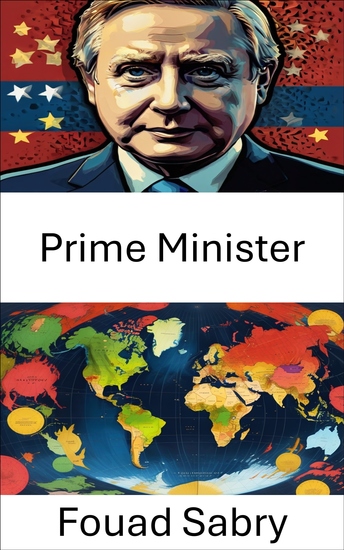
Prime Minister - Leadership and Influence in Modern Democracies - cover

Prime Minister - Leadership and Influence in Modern Democracies

Fouad Sabry

Maison d'édition: One Billion Knowledgeable

  • 0
  • 0
  • 0

Synopsis

Discover the pivotal role of the Prime Minister in "Prime Minister," a vital addition to the "Political Science" series. This book offers an in-depth exploration of executive leadership, emphasizing the Prime Minister's crucial functions and their influence on national and international stages.
 
1: Prime Minister - Uncover the essence of a Prime Minister, focusing on powers, responsibilities, and significance.
 
2: Head of State - Explore how the Prime Minister and Head of State interact within governance frameworks.
 
3: Prime Minister of the United Kingdom - Delve into the UK Prime Minister's history and insights into the Westminster system.
 
4: Separation of Powers - Analyze the separation of powers in political systems and its effect on the Prime Minister's authority.
 
5: Westminster System - Understand how the Westminster system shapes the role and effectiveness of the Prime Minister.
 
6: Head of Government - Comprehend the implications of the Prime Minister as both Head of Government and leader.
 
7: President of the Executive Council of the Irish Free State - Examine the historical evolution of this role into the modern Prime Minister.
 
8: Parliamentary System - Gain insights into parliamentary systems and their influence on the Prime Minister's role.
 
9: Reserve Power - Discover reserve powers and their impact on the Prime Minister's decision-making.
 
10: Presidency - Learn about the President's role in various systems and its relationship with the Prime Minister.
 
11: Constitutional Convention (Political Custom) - Explore customs that shape the Prime Minister's duties and authority.
 
12: List of Countries by System of Government - Review global governmental systems to understand different Prime Ministerial roles.
 
13: President of Sri Lanka - Compare the President's responsibilities in Sri Lanka with the Prime Minister's position.
 
14: Advice (Constitutional Law) - Analyze how constitutional advice shapes the Prime Minister's decisions.
 
15: President of Trinidad and Tobago - Explore unique aspects of the Prime Minister's role in Trinidad and Tobago.
 
16: Australian Government - Investigate the Australian Prime Minister's role in its governmental context.
 
17: Governor-General of Ceylon - Delve into the historical influence of the Governor-General on the Prime Minister.
 
18: Prime Minister of Tunisia - Learn about the Prime Minister's role in Tunisia's political landscape.
 
19: Prime Minister of Brazil - Examine unique features of Brazil's Prime Minister role in governance.
 
20: Government of Georgia (Country) - Understand the Prime Minister's role in Georgia and its political structures.
 
21: Constitution of Somalia - Review Somalia's Constitution and its effects on the Prime Minister's powers.
 
"Prime Minister" is an essential resource for professionals and students eager to understand executive leadership's complexities.
Disponible depuis: 02/10/2024.
Longueur d'impression: 382 pages.
D'autres livres qui pourraient vous intéresser

  • The Great Transition - ISPI Report 2022 - cover

    The Great Transition - ISPI...

    Alessandro Colombo, Paolo Magri

    • 0
    • 0
    • 0
    While the pandemic has monopolised attention over the past two years, it's far from the only story, as tectonic changes continue on the world stage and the "great transition" picks up pace.
    As well as the traditional dynamics of international power, torn between US-China bipolarism and the ambitions of old and new regional actors, this Report explores the other major transitions taking place. Firstly, the economic transition of a world deeper and deeper in debt and now seeing the return of state intervention. Secondly, the transition of the democracies and international law, or more precisely, their dual "crisis" in the face of contrasting models. And thirdly, the environmental and digital transitions, which will be key features of the decades to come. Intertwining inextricably with each other, these transitions will shape the major trends in regional politics and, in turn, be shaped by them. That's why Italy and Europe are facing momentous challenges, which the ISPI Report 2022 strives to outline, to equip readers with a compass for a changing world.
    Voir livre
  • Critique of Interventionism - cover

    Critique of Interventionism

    Ludwig Von Mises

    • 0
    • 0
    • 0
    In "Critique of Interventionism," Ludwig von Mises delves into the economic consequences and philosophical underpinnings of government intervention in the market. Mises argues that interventionism, which involves state interference in economic affairs while maintaining private ownership, inevitably leads to unintended consequences, distortions, and economic inefficiencies. The book is a critical analysis of interventionist policies, examining their impact on individual freedom, economic coordination, and the overall functioning of a market economy.
    Voir livre
  • The Hidden Face of Pope Francis - cover

    The Hidden Face of Pope Francis

    Paul Ariès

    • 0
    • 0
    • 0
    Why did Pope Francis canonize a priest responsible for the genocide of the Indians?
    Why does he wish to beatify the anti-Semitic French priest, Leon Dehon?  
    What are the unmentionable reasons for his papal election? 
    Pope Francis is presented as progressive and sensitive to the interests of the people, but underneath his smiles and his good words hides an authoritarian and dogmatic pope. This pope relies on very conservative movements such as Communion and Liberation or the Order of the Knights of Columbus, which are close to Opus Dei. 
    The good Pope Francis is beginning to drop his mask when he declares that Europe is undergoing a new Arab invasion (sic), when he calls on "Catholics with a sense of identity" to take to the streets, when he fights against republican secularism and demonizes atheists.
    After an overview of the financial, political and sexual scandals, Paul Ariès proceeds to a very detailed and documented analysis of the "Church of Francis," particularly in the areas of ecology and sexuality. This clear book offers a surprising insight into the best communicator the Church has known in a long time.
    Voir livre
  • Reagan-Carter Debate - cover

    Reagan-Carter Debate

    Ronald Reagan, Jimmy Carter

    • 0
    • 0
    • 0
    The only debate between Ronald Reagan and Jimmy Carter was held in Cleveland, Ohio on October 28, 1980, just days before the election on November 4, 1980. The debate, broadcast live on radio and television, was one of the most-watched presidential debates. 
    Questions by four journalists focused on the following topics: U.S. armed forces, the nation’s economy, urban policies, international terrorism, strategic arms limitation, energy, social security, each candidate’ s assessment of his opponent, and closing statements. 
    Search online for “Ronald Reagan major speeches” to see both a text version and a video version of this debate. 
    Audio recording courtesy of the Ronald Reagan Presidential Library. 
    AspenLeafMedia.com
    Voir livre
  • Albert Einstein’s "Why Socialism?" - The Enduring Relevance of His Classic Essay - cover

    Albert Einstein’s "Why...

    Albert Einstein

    • 0
    • 0
    • 0
    A contemporary look at Albert Einstein's classic call for socialism 


    First published more than seventy-five years ago in the inaugural issue of Monthly Review: An Independent Socialist Magazine, Albert Einstein's "Why Socialism?" is an unheralded classic. Written during the McCarthyite witch-hunt in the United States, it constituted an act of defiance, making a case for socialism unrivaled in its time or ours. Yet, its very existence has been an embarrassment to an establishment which has continually sought to downplay the significance of his iconoclastic essay, together with Einstein's socialism itself. 


    This volume includes Einstein's essay along with a detailed commentary on his essay by Monthly Review editor, John Bellamy Foster. Foster's introduction tells the story of Einstein's life-long commitment to socialism and the events leading to the publication of "Why Socialism?" and contextualizes the importance of his essay as we enter a time of planetary crisis and new threats of world war. Over the three-quarters of century since its publication, "Why Socialism?" is one of those rare statements whose power has only grown, reaching untold numbers of readers over the years. It is of crucial importance that―for the sake of the future of humanity―Einstein's message continues to proliferate.
    Voir livre
  • The Rule of Law - A Very Short Introduction - cover

    The Rule of Law - A Very Short...

    Aziz Z. Huq

    • 0
    • 0
    • 0
    Politicians, judges, and citizens commonly use the phrase "rule of law" to describe some good that flows from a legal system. But what precisely is that good? Even in Aristotle's time, there was no agreement on either its nature, and on whether it counted as an unqualified good. Even now, a core rule-of-law aspiration is that law can constrain how power is flexed. But how or when? Disagreement persists as to whether the rule of law is a matter of how law is used or why it is deployed. In consequence, the World Bank, the leaders of Singapore's one-party state, and the Communist Party in China can all offer their own spins on the concept. 


    By charting these disagreements and showing the overlap and the conflicts between different understandings of the concept, Aziz Z. Huq shows how the rule of law can still be used as an important tool for framing and evaluating the goals and functions of a legal system. He traces the idea's historical origins from ancient Greece to the constitutional theorist Albert Venn Dicey to the economist and political philosopher Friedrich Hayek. And he explores how that value is coming under pressure from terrorist threats, macroeconomic crisis, pandemics, autocratic populism, and climate change.
    Voir livre