Rejoignez-nous pour un voyage dans le monde des livres!
Ajouter ce livre à l'électronique
Grey
Ecrivez un nouveau commentaire Default profile 50px
Grey
Abonnez-vous pour lire le livre complet ou lisez les premières pages gratuitement!
All characters reduced
Power Transition Theory - Analyzing Shifts in Global Power Dynamics - cover

Power Transition Theory - Analyzing Shifts in Global Power Dynamics

Fouad Sabry

Maison d'édition: One Billion Knowledgeable

  • 0
  • 0
  • 0

Synopsis

Power Transition Theory offers essential insights into global power shifts and their impact on international relations, exploring the mechanisms that predict conflict or cooperation based on changes in national hierarchies.
 
1-Power Transition Theory-Introduces the theory's core concepts, emphasizing its role in global power dynamics.
 
2-Hegemony-Discusses the role of hegemony in maintaining or disrupting international order.
 
3-Balancing (International Relations)-Covers strategies nations use to balance power and prevent dominance.
 
4-Hegemonic Stability Theory-Explores the theory that a single dominant power can stabilize the global system.
 
5-Balance of Power (International Relations)-Examines the principle's historical and modern applications.
 
6-Anarchy (International Relations)-Looks at the anarchic nature of the international system and its effects on state actions.
 
7-Offensive Realism-Details aggressive strategies for state survival in an anarchic world.
 
8-Defensive Realism-Contrasts offensive realism with the concept of maintaining, not expanding, power.
 
9-Polarity (International Relations)-Analyzes the effects of different power distributions on global stability.
 
10-Neorealism (International Relations)-Focuses on the influence of the international system on state behavior.
 
11-Empire-Investigates the impact of empires on global power structures.
 
12-International Relations-Provides an overview of the field's theoretical foundations.
 
13-National Power-Discusses the components and significance of national power in global politics.
 
14-Collective Security-Explores the concept and its role in preventing conflicts.
 
15-Status Quo State-Examines the behaviors of states that aim to maintain the current international order.
 
16-Liberal Institutionalism-Discusses how international institutions promote cooperation and stability.
 
17-Jacek Kugler-Highlights Jacek Kugler's contributions to Power Transition Theory.
 
18-International Trade and State Security-Analyzes the link between international trade and national security.
 
19-Bargaining Model of War-Explains why wars occur despite their high costs.
 
20-Richard Lachmann-Explores Richard Lachmann's work in relation to Power Transition Theory.
 
21-Territorial Peace Theory-Investigates how territorial changes can lead to peace or conflict.
 
This book is indispensable for those looking to deepen their understanding of Power Transition Theory and its implications for global politics. Its insights are invaluable, making it a key resource for professionals, students, and enthusiasts alike.
Disponible depuis: 30/08/2024.
Longueur d'impression: 242 pages.
D'autres livres qui pourraient vous intéresser

  • Britain’s Secret Defences - Civilian Saboteurs Spies and Assassins During the Second World War - cover

    Britain’s Secret Defences -...

    Andrew Chatterton

    • 0
    • 0
    • 0
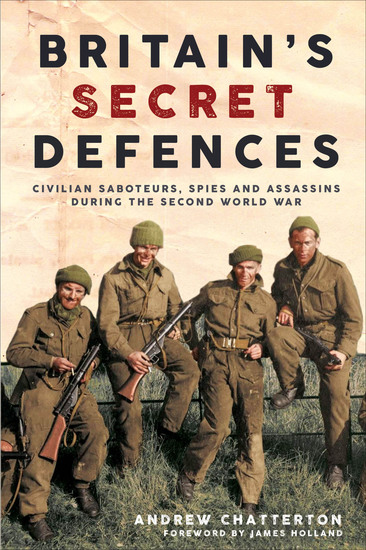
    The first full history of the highly trained and ruthless civilian volunteers secretly trained across Britain to be deployed in the case of a German invasion.The narrative surrounding Britain’s anti-invasion forces has often centered on ‘Dad’s Army’-like characters running around with pitchforks, on unpreparedness and sense of inevitability of invasion and defeat. The truth, however, is very different.  Top-secret, highly trained and ruthless civilian volunteers were being recruited as early as the summer of 1940. Had the Germans attempted an invasion they would have been countered by saboteurs and guerrilla fighters emerging from secret bunkers, and monitored by swathes of spies and observers who would have passed details on via runners, wireless operators and ATS women in disguised bunkers.  Alongside these secret forces, the Home Guard were also setting up their own ‘guerrilla groups’, and SIS (MI6) were setting up post-occupation groups of civilians – including teenagers – to act as sabotage cells, wireless operators, and assassins had the Nazis taken control of the country.  The civilians involved in these groups understood the need for absolute secrecy and their commitment to keeping quiet meant that most went to their grave without ever telling anyone of their role, not even their closest family members. There has been no official and little public recognition of what these dedicated men and women were willing to do for their country in its hour of need, and after over 80 years of silence the time has come to highlight their remarkable role.
    Voir livre
  • Rights of Man - cover

    Rights of Man

    Thomas Paine

    • 0
    • 0
    • 0
    Written by political activist and revolutionary Thomas Paine, Rights of Man defends the French Revolution and argued for written constitutions, welfare, and widespread education for all. Published in two parts in 1791 and 1792, it was a direct response to Edmund Burke's attack in Reflections on the Revolution in France that was released in 1790. Born in England, Thomas Paine became an avid American activist who inspired patriots to declare independence to create the United States of America. Rights of Man advocates for political revolution when the government fails to safeguard the natural rights of its people.
    Voir livre
  • Common Sense - cover

    Common Sense

    Thomas Paine

    • 0
    • 0
    • 0
    The explosive essay that sparked a revolution.
    
    When Common Sense hit the streets in 1776, it ignited the American colonies like never before. With bold, plain-spoken language, Thomas Paine challenged the authority of the British monarchy and made the urgent case for American independence. More than just a political argument, this short but powerful work gave everyday people the words to demand freedom—and the courage to fight for it.
    
    Radical, rebellious, and razor-sharp, Common Sense remains a landmark of political writing. Its message still resonates today: real change begins when ordinary people dare to speak truth to power.
    Voir livre
  • Rise and Decline of Nations The: Book Summary & Analysis - cover

    Rise and Decline of Nations The:...

    Briefly Summaries

    • 0
    • 0
    • 0
    This is a concise summary and analysis of The Rise and Decline of Nations, by Mancur Olson.
     
    It is not the original book and is not affiliated with or endorsed by Mancur Olson.
     
    Ideal those seeking a quick and insightful overview.
     
    The Rise and Decline of Nations explores the intricate relationship between economic growth, political stability, and the institutional frameworks that govern societies. Drawing from history, economics, and sociology, the book examines how entrenched interest groups and collective actions shape the prosperity—or stagnation—of nations. With thought-provoking insights, it challenges conventional wisdom about power dynamics, providing a groundbreaking perspective on why some nations thrive while others falter.
    Voir livre
  • Liberalism - Individual Liberty and the Modern State - cover

    Liberalism - Individual Liberty...

    Hector Davidson

    • 0
    • 0
    • 0
    Liberalism is a political and philosophical ideology rooted in the principles of individual liberty, equality, and limited government. At its core, liberalism emphasizes the autonomy of the individual, arguing that each person has the right to pursue their own life and happiness, free from unnecessary interference by the state or society. Emerging in the Enlightenment period, liberalism challenged the traditional structures of monarchies and feudal systems, advocating for the rights of the individual and the importance of reason, tolerance, and democratic participation. 
    The roots of liberal thought can be traced back to the works of early modern philosophers such as John Locke, whose ideas on natural rights and government by consent laid the foundation for liberal political theory. Locke’s assertion that individuals possess inherent rights to life, liberty, and property formed the basis for much of liberal thought, influencing the development of constitutionalism and democratic governance. Over time, thinkers like Montesquieu, Rousseau, and later John Stuart Mill contributed to the evolution of liberalism, expanding its focus to issues of civil liberties, political freedoms, and social equality. 
    A defining characteristic of liberalism is its emphasis on individual freedom. This includes both personal liberty—the freedom to make choices about one’s own life—and political liberty—the right to participate in the democratic process and have a say in the laws and policies that govern society. Classical liberals advocated for minimal government interference in the economy and individual affairs, emphasizing free markets, private property, and limited state power. The role of the state, in this view, is to protect the rights of individuals and maintain social order, but not to intervene in the private lives or economic transactions of citizens.
    Voir livre
  • Understandable Economics - Because Understanding Our Economy Is Easier Than You Think and More Important Than You Know - cover

    Understandable Economics -...

    Howard Yaruss

    • 0
    • 0
    • 0
    In this entertaining and informative guide, author Howard Yaruss breaks down our economic system in a straightforward way, avoiding jargon, formulas, graphs, and other technical material so common in books on this subject. Instead, he creates a compelling and comprehensive picture of our economy using accessible analogies, real-world observations, and entertaining anecdotes. 


    Understandable Economics will enable listeners to answer questions such as: Why is inequality soaring and what can we do about it?; Do tax cuts for the wealthy create jobs or just create more inequality?; Where does money come from, why does it have value, and who controls it?; What does the Fed do and how does it affect our lives?; Could alternative currencies like Bitcoin replace the dollar?; Is our national debt a threat?; Why do so many people believe free trade is good if it causes some people to lose jobs?; Why does the economy regularly turn down and how can we get it back on track?; and many more. 


    Understandable Economics provides the context, tools, and foundational knowledge listeners need to thoroughly understand our economy, determine which policies would work best, and champion those policies effectively.
    Voir livre