Begleiten Sie uns auf eine literarische Weltreise!
Buch zum Bücherregal hinzufügen
Grey
Einen neuen Kommentar schreiben Default profile 50px
Grey
Jetzt das ganze Buch im Abo oder die ersten Seiten gratis lesen!
All characters reduced
Power Politics - Mastering Influence and Strategy in Modern Governance - cover

Power Politics - Mastering Influence and Strategy in Modern Governance

Fouad Sabry

Verlag: One Billion Knowledgeable

  • 0
  • 0
  • 0

Beschreibung

Discover Power Politics, a critical addition to the Political Science series. This book explores political power dynamics, how power is gained, exercised, and its influence on governance and international relations. Suitable for professionals, students, and enthusiasts, it enhances your understanding of key political concepts and their real-world applications.
 
1: Power Politics: Defining power politics and its impact on political theory and practice.
 
2: Neorealism: Explore how states seek power and security in an anarchic global system.
 
3: Realpolitik: Focuses on pragmatic, strategic politics over ideological concerns.
 
4: International Relations: Power’s influence on nation interactions—cooperation or conflict.
 
5: Hard Power: Use of military and economic force to influence other states.
 
6: Power in IR: Examines political, economic, and military power dimensions.
 
7: National Security: Understand strategies to protect nations from external threats.
 
8: Proxy War: States using third parties in conflicts to achieve objectives.
 
9: Deterrence Theory: Prevent aggression via the potential for retaliatory force.
 
10: National Interest: How state interests drive foreign policy and behavior.
 
11: Fourth-Generation Warfare: Warfare with irregular tactics and non-state actors.
 
12: Collective Security: Maintaining peace through international cooperation.
 
13: Realism in IR: Power and national interest as drivers of international politics.
 
14: Cyberwarfare: Implications of cyber conflicts for national and global security.
 
15: Wolfowitz Doctrine: U.S. foreign policy strategy with global political impacts.
 
16: English School IR Theory: Focuses on international society, norms, and institutions.
 
17: Foreign Internal Defense: Strategies for stabilizing and defending nations from within.
 
18: Hybrid Warfare: Combines conventional and unconventional warfare tactics.
 
19: Chinese Information Warfare: China’s strategic use of information in conflicts.
 
20: International Trade & Security: Links between economic exchanges and state security.
 
21: Political Warfare: Political tactics aimed at influencing and undermining adversaries.
 
Power Politics offers critical insights into these topics, making it a key resource for understanding modern political power. It equips readers with knowledge of today's power structures and international relations.
Verfügbar seit: 08.10.2024.
Drucklänge: 299 Seiten.
Weitere Bücher, die Sie mögen werden

  • Roman Law and Governance - Foundations of Western Legal Systems - cover

    Roman Law and Governance -...

    Rogan Fish

    • 0
    • 0
    • 0
    The foundation of Roman law was deeply rooted in the customs and traditions of early Roman society. Before formal legal codification, Roman law was based on unwritten customs passed down through generations. These customs, known as mos maiorum or "the way of the ancestors," guided legal practices and social norms. However, as Rome expanded, the need for a more structured and consistent legal system became evident. This led to the development of one of the earliest recorded legal codes, the Twelve Tables, which became the cornerstone of Roman law. 
    The Twelve Tables, established around 450 BCE, were a response to demands from the plebeians for greater legal transparency. Prior to this, laws were primarily controlled by the patrician class, leaving the lower classes vulnerable to arbitrary decisions. The Twelve Tables provided a written and publicly displayed set of laws that covered various aspects of daily life, including property rights, contracts, family matters, and criminal offenses. While these laws were often harsh by modern standards, they were crucial in establishing the principle that law should be known and applied equally to all citizens. 
    Legal interpretation played a crucial role in the early Roman legal system, and the pontiffs, a group of religious and legal authorities, were responsible for explaining and applying the laws. Since early Roman law was closely linked to religious practices, the pontiffs held significant influence over legal matters. Over time, however, legal decision-making shifted from religious authorities to magistrates and elected officials, paving the way for a more secular and systematic approach to governance.
    Zum Buch
  • Underdogs of Japanese History - 11 tales of iconic characters who prevailed against the odds or didn’t - cover

    Underdogs of Japanese History -...

    Kyota Ko

    • 0
    • 0
    • 0
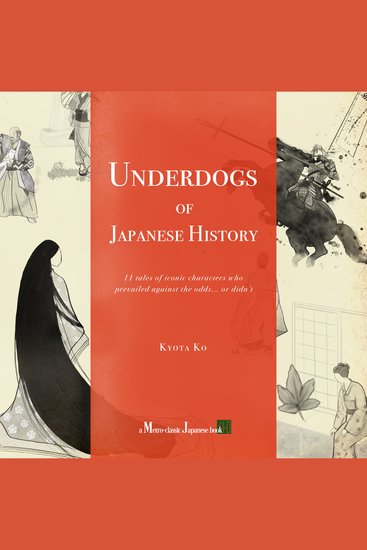
    A samurai prison guard who saw the humanity in even the most savage prisoners, an untalented warlord relentlessly obsessed with protecting his people, a lady-in-waiting of ancient Japanese court who turned herself from a single-mom bookworm into a best-selling author and savior of the ruler of Japan, an impoverished samurai clan that overthrew two centuries of oppression… 
    Japanese history holds a wealth of underrated figures, each with an inspiring story of perseverance and determination that remains untold. Embark on a journey to relive eleven life stories of resilience and triumph of eleven remarkable underdogs. 
    A fascinating collection of new perspectives for understanding Japanese values and traditions through underdog stories.
    Zum Buch
  • To (M)others from the Hood - Conquering fear uncertainty chaos and division in life's most difficult hood - cover

    To (M)others from the Hood -...

    Shannon McGuire

    • 0
    • 0
    • 0
    For Mothers and Others 
    Your life is unique, but we bet you can relate to Shannon's story. You might not have grown up in South Central LA during the crack epidemic and riots. You might not have lost your little brother to a tragic accident when you were nine years old. You might not have started AdultHood as a teen mom on welfare. But your experiences have likely left you with some of the same problematic patterns and challenges Shannon had to overcome.Do you make decisions based on fear, uncertainty, chaos, or division? (Yes, that spells FUCD.)Do you find yourself worrying about worst-case outcomes?Do you ever feel like others are holding you back? 
    If you're nodding your head right now, then you're in VictimHood—and that's a tough place to be. Shannon spent plenty of time there herself, and it took her many years and a lot of self-exploration and hard work to leave it behind. And she wants to share the how with you. 
    In this book, Shannon gives you the tools that have worked for her and shows you that everything you need to live a joyful life is already inside you. She invites you to learn from her experiences, gain from her growth, and join her on her Conqueror's Journey.
    Zum Buch
  • Gavin at War - The World War II Diary of Lieutenant General James M Gavin - cover

    Gavin at War - The World War II...

    Lewis Sorley

    • 0
    • 0
    • 0
    Lieutenant General James Gavin, commander of the 82nd Airborne Division during WWII, is one of the best-known figures of the war. Beginning as the commander of the 505th Parachute Combat Team that spearheaded the American assault on Sicily in July 1943, Gavin advanced to division command and finally command of US forces in Berlin. He kept a wartime diary that starts in April 1943, as the unit was preparing to go to northern Africa and continues through to his final entry on September 1, 1945, during the occupation of Berlin. 


    During the war years, Gavin came into close contact with virtually all the leading airborne commanders and many others who would advance to the top levels of Army leadership. His diary includes observations on fellow military and political leaders, army operations, and the general's personal life. Gavin was an officer who led by example: on four combat jumps, he was the first man out the door. 


    For decades, Gavin kept the existence of the journal a secret; the general's family discovered it among his belongings after his death. Editor Lewis "Bob" Sorley has worked closely with the Gavin family and the Army Heritage Center to prepare the diary for publication. His edited and annotated version includes a prologue and epilogue to frame the entries within the wider scope of the general's life.
    Zum Buch
  • The Russian Famine of 1921-1922 - Aftermath of War and Revolution - cover

    The Russian Famine of 1921-1922...

    Sarah Willards

    • 0
    • 0
    • 0
    The Russian Famine of 1921-1922 did not occur in isolation; it was the result of a complex set of conditions that had been building over several years, particularly following the immense strain caused by World War I and the subsequent Russian Revolution. In the years leading up to the famine, the Russian Empire had been subjected to a series of crises, both external and internal, that would lead to an agricultural disaster of unprecedented proportions. 
    World War I, which had raged from 1914 to 1918, devastated Russia. The country’s military and civilian populations were ravaged by the conflict, and the war placed immense pressure on the economy. Agriculture, which was the backbone of Russia’s economy, was particularly affected. Many of the country’s able-bodied men had been conscripted into the army, leaving the fields untended and the production of food drastically reduced. Additionally, the war led to widespread shortages of basic supplies such as fuel, equipment, and fertilizers. The agricultural sector, already fragile, was further crippled by the lack of resources, leaving the country’s population vulnerable to the consequences of famine. 
    The Russian Revolution of 1917, which brought the Bolsheviks to power, intensified the situation. The overthrow of the Romanov dynasty and the subsequent civil war between the Red and White factions created further instability. The Bolsheviks, under the leadership of Vladimir Lenin, implemented policies that would have significant implications for food production. War Communism, introduced as an emergency measure, included grain requisitioning from the peasantry to supply the Red Army and urban centers. However, these policies were deeply unpopular and led to widespread resentment. The forced seizure of grain and foodstuffs left many rural areas without enough resources to sustain their own populations, further exacerbating food shortages.
    Zum Buch
  • Spring and Autumn & Warring States Periods The: A History of China - cover

    Spring and Autumn & Warring...

    Hui Wang

    • 0
    • 0
    • 0
    "The Spring and Autumn & Warring States Periods, PART TWO" takes you deep into one of the most extraordinary periods in Chinese history, where legendary figures clashed and kingdoms rose or fell by the stroke of a pen or the swing of a sword. Discover the bold reforms of Shang Yang, the artful diplomacy of Su Qin, and the cunning strategies of Zhang Yi. Their brilliance shaped the destinies of states like Qin and Wei, while Sun Bin and Pang Juan's tactical genius inspired generations of military thinkers. Gui Gu Zi, the enigmatic master of strategy, and Lü Buwei, the ambitious merchant-turned-statesman, add intrigue to a world driven by power and opportunity. 
    This book also brings the kings of the era vividly to life. Meet King Wu Ling of Zhao, who revolutionized his military with nomadic tactics; King Hui Wen of Qin, who laid the foundations of an empire; and King Zhao Xiang of Qin, whose leadership propelled Qin toward dominance. The narrative culminates with King Zheng of Qin, better known as Qin Shi Huang, the unifier who swept through the six warring states to forge the first Chinese empire. Alongside these rulers, Lü Buwei's audacious rise and influence serve as a testament to how individuals could shape the fate of nations. 
    Through gripping storytelling, this book explores alliances, betrayals, and the extraordinary vision that redefined the course of history. Packed with tales of reformers, tacticians, and warrior kings.
    Zum Buch