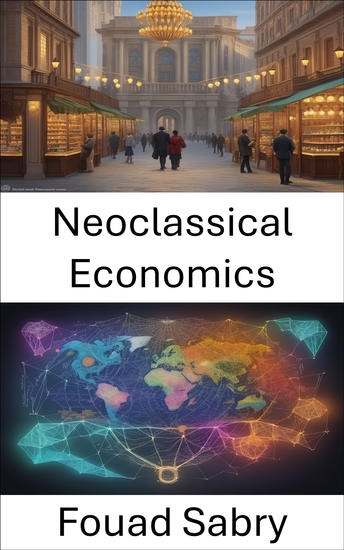
Neoclassical Economics - Demystifying Neoclassical Economics Navigating Modern Markets with Clarity
Fouad Sabry
Verlag: One Billion Knowledgeable
Beschreibung
What is Neoclassical Economics

In the field of economics, neoclassical economics refers to an approach that observes the production, consumption, and valuation (price) of commodities and services as being driven by the supply and demand model. According to this school of thinking, the value of a product or service is established by a hypothetical process that involves the maximization of utility by individuals with limited incomes and of profits by businesses that are confronted with production costs and make use of the information and factors of production that are accessible. By making reference to rational choice theory, this strategy has frequently been defended as being appropriate.

How you will benefit

(I) Insights, and validations about the following topics:

Chapter 1: Neoclassical economics

Chapter 2: Economics

Chapter 3: Keynesian economics

Chapter 4: Microeconomics

Chapter 5: Perfect competition

Chapter 6: General equilibrium theory

Chapter 7: New Keynesian economics

Chapter 8: Index of economics articles

Chapter 9: Classical economics

Chapter 10: Economic efficiency

Chapter 11: Welfare economics

Chapter 12: Steve Keen

Chapter 13: Heterodox economics

Chapter 14: Sonnenschein-Mantel-Debreu theorem

Chapter 15: Schools of economic thought

Chapter 16: Dynamic stochastic general equilibrium

Chapter 17: Microfoundations

Chapter 18: Neoclassical synthesis

Chapter 19: New classical macroeconomics

Chapter 20: Macroeconomics

Chapter 21: History of macroeconomic thought

(II) Answering the public top questions about neoclassical economics.

(III) Real world examples for the usage of neoclassical economics in many fields.

Who this book is for

Professionals, undergraduate and graduate students, enthusiasts, hobbyists, and those who want to go beyond basic knowledge or information for any kind of neoclassical economics.
Verfügbar seit: 16.01.2024.
Drucklänge: 316 Seiten.