Begleiten Sie uns auf eine literarische Weltreise!
Buch zum Bücherregal hinzufügen
Grey
Einen neuen Kommentar schreiben Default profile 50px
Grey
Jetzt das ganze Buch im Abo oder die ersten Seiten gratis lesen!
All characters reduced
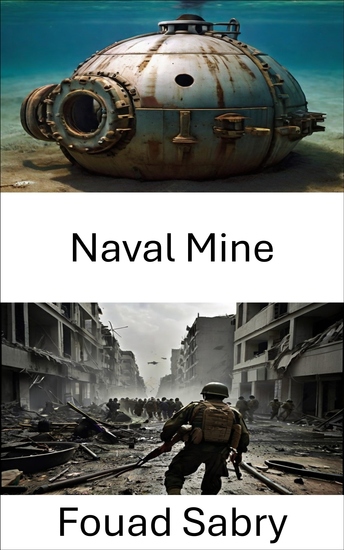
Naval Mine - Underwater Peril The Stealth Threat Below - cover

Naval Mine - Underwater Peril The Stealth Threat Below

Fouad Sabry

Verlag: One Billion Knowledgeable

  • 0
  • 0
  • 0

Beschreibung

What is Naval Mine
 
A naval mine is a self-contained explosive device placed in water to damage or destroy surface ships or submarines. Unlike depth charges, mines are deposited and left to wait until they are triggered by the approach of, or contact with, any vessel or a particular vessel type, akin to anti-infantry or anti-vehicle mines. Naval mines can be used offensively, to hamper enemy shipping movements or lock vessels into a harbour; or defensively, to protect friendly vessels and create "safe" zones. Mines allow the minelaying force commander to concentrate warships or defensive assets in mine-free areas giving the adversary three choices: undertake an expensive and time-consuming minesweeping effort, accept the casualties of challenging the minefield, or use the unmined waters where the greatest concentration of enemy firepower will be encountered.
 
How you will benefit
 
(I) Insights, and validations about the following topics:
 
Chapter 1: Naval mine
 
Chapter 2: Torpedo
 
Chapter 3: Depth charge
 
Chapter 4: Minesweeper
 
Chapter 5: Finnish Navy
 
Chapter 6: Minehunter
 
Chapter 7: Minelayer
 
Chapter 8: Anti-submarine weapon
 
Chapter 9: Minesweeping
 
Chapter 10: Baltic Sea campaigns (1939-1945)
 
(II) Answering the public top questions about naval mine.
 
Who this book is for
 
Professionals, undergraduate and graduate students, enthusiasts, hobbyists, and those who want to go beyond basic knowledge or information for any kind of Naval Mine.
Verfügbar seit: 18.06.2024.
Drucklänge: 142 Seiten.

Weitere Bücher, die Sie mögen werden

  • Mary’s Secret Gospel - Apocryphal Writings on the Mother of Jesus—Lost Texts Beyond the New Testament - cover

    Mary’s Secret Gospel -...

    Various Early Christian Writers,...

    • 0
    • 0
    • 0
    What if the lost stories of Mary revealed her divine mission from birth to assumption? 
    Mary’s Secret Gospel collects ancient Christian texts once revered but long hidden—revealing a tender and mystical vision of the Virgin Mary, from miraculous birth to her glorified departure. 
    What you'll hear inside: 
    •	Protoevangelium of James – Mary’s birth, temple upbringing, and miraculous selection. 
    •	Infancy Gospel of Thomas – Young Jesus' wonders and Mary’s steady presence. 
    •	Gospel of Pseudo-Matthew – Expanded scenes of the Holy Family’s early life. 
    •	Dormition Texts – Heavenly visions of Mary’s final days and peaceful assumption. 
    Explore Mary as the early Church once did—a sacred woman of vision, courage, and divine grace.
    Zum Buch
  • And a Dog Called Fig - Solitude Connection the Writing Life - cover

    And a Dog Called Fig - Solitude...

    Helen Humphreys

    • 0
    • 0
    • 0
    An artist's solitude is a sacred space, one to be guarded from the chaos of the world, where the sparks of inspiration can be kindled into fires of creation. But within this quiet also lie loneliness, self-doubt, the danger of collapsing too far inward. An artist needs a familiar, a companion with emotional intelligence, innate curiosity, an enthusiasm for the world beyond, but also the capacity to rest contentedly for many hours. What an artist needs, Helen Humphreys would say, is a dog. 


    And a Dog Called Fig is a memoir of the writing life told through the dogs Humphreys has lived with and loved over a lifetime, including Fig, her new Vizsla puppy. Interspersed are stories of other writers and their own irreplaceable companions: Virginia Woolf and Grizzle, Gertrude Stein and Basket, Thomas Hardy and Wessex—who walked the dining table at dinner parties, taking whatever he liked—and many more. 


    A love song to the dogs who come into our lives and all that they bring—sorrow, mayhem, reflection, joy—this is a book about steadfast friendship and loss, creativity and craft, and the restorative powers of nature. Every work of art is different; so too is every dog, with distinctive needs and lessons. And if we let them guide us, they will show us many worlds we would otherwise miss.
    Zum Buch
  • Mrs Kaye is Sunny Side Up - cover

    Mrs Kaye is Sunny Side Up

    Lana Citron

    • 0
    • 0
    • 0
    Join Mrs Kaye on her way back to dear old dirty Dublin, and to her very first love. Irish jewish Annie Kaye is not in the best of health, it's Christmas Day and she has a dreadful aul cough on her and a harsh yearning for a time that was and thoughts of her first love rush upon her. Still there's a goose to be stuffed and himself to be seen to and she really doesn't know whether she's coming or going...
    Zum Buch
  • For Life - cover

    For Life

    Ailsa Piper

    • 0
    • 0
    • 0
    For fans of Julia Baird's Phosphorescence, Heather Rose's Nothing Bad Ever Happens Here or Indira Naidoo's The Space Between the Stars comes an unforgettable and moving insight into loss, hope and starting again, aided by the incredible healing power of nature and a community of unexpected angels. 
     
    I landed in this place six years ago in a welter of panic, pain and instinct. I'd been in fight-or-flight mode for twelve months, wanting only to keep on flying – or fleeing. I brought almost nothing of my previous life. Grief had made me ruthless; I threw and threw. (And yes, I knew how appalled you'd have been, Pete.) 
     
    My father implored me to stay with the familiar. Constants, he said, would give me scaffolding. Decades ago, when his second wife, my stepmother, died suddenly, habits were his protection and rituals his comfort - along with a packet or two of cigarettes a day. Friends, too, urged me to wait, to slow, to keep, to stay, but instead, I discarded and flew – or fled? - to this harbour… 
     
    A place of shelter or refuge.
    Zum Buch
  • Rahel Varnhagen - The Life of a Jewish Woman - cover

    Rahel Varnhagen - The Life of a...

    Hannah Arendt

    • 0
    • 0
    • 0
    Rahel Varnhagen: The Life of a Jewish Woman is the biography of a remarkable, complicated, troubled, passionate woman, an important figure in German romanticism, the person who in a sense founded the Goethe cult that would become central to German cultural life in the nineteenth century, as well as someone who confronted with unusual determination and bore the burden of being both a woman in a man's world and an assimilated Jew in Germany. 


    Rahel Levin Varnhagen was, Arendt writes, "neither beautiful nor attractive . . . and possessed no talents with which to employ her extraordinary intelligence and passionate originality." Arendt sets out to tell the story of Rahel's life as Rahel might have told it and, in doing so, to reveal the way in which intellectual and social assimilation works out in one person's destiny. 


    On her deathbed Rahel is reported to have said, "The thing which all my life seemed to me the greatest shame, which was the misery and misfortune of my life—having been born a Jewess—this I should on no account now wish to have missed." Only because she had remained both a Jew and a pariah, Arendt observes, "did she find a place in the history of European humanity."
    Zum Buch
  • A Quest for the Hidden Lands - Synchronicity Serendipity Spirituality - cover

    A Quest for the Hidden Lands -...

    Norman Levine

    • 0
    • 0
    • 0
    My budding career as a literary scholar was suddenly hijacked by a singular seemingly random event. It was 1976 when I tiptoed into a tiny Buddhist shrine room in a farmhouse nestled into the Black Mountains of Wales and there beheld a Tibetan master, the 16th Karmapa, sitting on a throne performing a ceremony known as The Black Hat. My mind came to an immediate stop, suspended. It felt familiar, like the secret garden of childhood.I can still remember every detail like it was yesterday:Karmapa occupies the throne completely. He has a spiritual dignity that makes it his rightful seat, just as the lion proclaims his natural dominion. The force of his presence alone brings a hushed silence to the room. It feels like it has expanded into a cathedral. Two monks blow long Tibetan horns in a haunting wail so loud and long it startles thought patterns, blowing them away like clouds. The Karmapa slowly opens the Black Hat-box, takes the black silk crown in his hand, and puts it on his head holding it down with one hand. With the other hand he fingers a crystal rosary moving it deftly, twirling the beads around three times. The horns continue while he gazes with eyes that seem to dissolve the fiction of time and the boundaries of space. Time is standing still.That glimpse into enlightened mind became embedded like a seed and grew into a quest over the next decades to find the key places on our planet called the Hidden Lands.The legend came alive while I was living in a Tibetan Buddhist monastery in the Himalayas. I met Tibetans who had been to the supreme Hidden Land of Pemako while escaping from the Chinese invasion of Tibet. They made it sound like the ‘promised land’ with streams flowing with milky water. There were certain plants that could induce enlightenment.Why did it take decades to get there? What made the right ingredients emerge to penetrate this sacred sanctuary?  And the big question: Who hid it and why?
    Zum Buch