¡Acompáñanos a viajar por el mundo de los libros!
Añadir este libro a la estantería
Grey
Escribe un nuevo comentario Default profile 50px
Grey
Suscríbete para leer el libro completo o lee las primeras páginas gratis.
All characters reduced
Nanorobotics - Advancing Molecular Engineering Through Structural DNA Design - cover

Nanorobotics - Advancing Molecular Engineering Through Structural DNA Design

Fouad Sabry

Editorial: One Billion Knowledgeable

  • 0
  • 0
  • 0

Sinopsis

In the evolving world of nanotechnology, "Nanorobotics" stands as a beacon of innovation and potential. This book is an essential resource for professionals, students, and enthusiasts who wish to delve deep into the convergence of robotics and nanotechnology, specifically focusing on the groundbreaking field of DNA Origami. Discover how nanobots, molecular machines, and biohybrid systems can revolutionize various industries, from medicine to engineering.
 
Chapters Brief Overview:
 
1: Nanorobotics: An introduction to the revolutionary field of nanorobotics and its connection to DNA Origami, highlighting the potential for nanoscale machines.
 
2: K. Eric Drexler: A deep dive into Drexler’s pioneering work in molecular nanotechnology and how his vision influences the realm of nanorobotics.
 
3: Simone SchürleFinke: Exploration of SchürleFinke’s contributions to bioengineering and her work with nanorobots in medical applications.
 
4: Robert Freitas: An overview of Freitas' research on nanomedicine and his proposals for nanorobots within the human body for therapeutic purposes.
 
5: Nanobiotechnology: The intersection of nanotechnology and biotechnology, emphasizing the role of DNA Origami in creating nanostructures for biomedical applications.
 
6: Nanomotor: A study of molecular motors at the nanoscale, their construction using DNA Origami, and their potential to power nanobots.
 
7: Joseph Wang: Insights into Joseph Wang’s work on nanomotors, sensors, and their integration into medical diagnostics and treatment.
 
8: Ambarish Ghosh: Examination of Ghosh’s contributions to micro and nanorobotics, particularly in the context of biohybrids.
 
9: Nanocapsule: An overview of nanocapsules for drug delivery, discussing how DNA Origami can be used to create precise drug delivery systems.
 
10: Nanotechnology: A broad look at the fundamentals of nanotechnology and its various applications, connecting theory to practical implementations in nanorobotics.
 
11: Molecular machine: A focused discussion on molecular machines, exploring their design, function, and future applications in fields like medicine and manufacturing.
 
12: Nanoscale plasmonic motor: Exploration of the role of plasmonics in powering nanoscale motors and how DNAbased systems can enable their functionality.
 
13: DNA nanotechnology: A detailed look at the principles of DNA nanotechnology and its pivotal role in building nanorobots and other nanoscale devices.
 
14: Biohybrid microswimmer: The concept of biohybrids, combining living cells with synthetic materials, and their potential in medical diagnostics and treatments.
 
15: Applications of nanotechnology: Examining the realworld applications of nanotechnology in sectors like healthcare, energy, and materials science.
 
16: Nanomedicine: Focusing on the cuttingedge use of nanotechnology in medicine, including targeted drug delivery and diagnostics, leveraging DNA Origami structures.
 
17: DNA origami: A comprehensive analysis of DNA Origami as a tool for building nanoscale structures and its significance in the development of nanorobots.
 
18: Molecular nanotechnology: A discussion on the promises and challenges of molecular nanotechnology, particularly in the context of building machines at the atomic scale.
 
19: Nanoelectronics: How DNA Origami and nanotechnology can revolutionize electronics, from creating smaller components to enabling new types of devices.
 
20: Nanotechnology in fiction: A look at how nanotechnology has been portrayed in fiction, offering insights into how these ideas are shaping public perception and future innovations.
 
21: Microswimmer: The future of microrobots, particularly those that can move through liquids, and how DNA Origami is used to construct these intelligent swimmers.
Disponible desde: 07/03/2025.
Longitud de impresión: 258 páginas.

Otros libros que te pueden interesar

  • Silurian Period The: The History of the Prehistoric Era When Life Formed on Land - cover

    Silurian Period The: The History...

    Editors Charles River

    • 0
    • 0
    • 0
    The early history of Earth covers such vast stretches of time that years, centuries, and even millennia become virtually meaningless. Instead, paleontologists and scientists who study geochronology divide time into periods and eras.  
    The Silurian Age occurred during the mid-Paleozoic, and despite its relative brevity, the era developed some interesting features that promulgated life on Earth. Roderick J. Murchison, a British geologist, named a sequence of rocks after a group of indigenous people called the Silures living in Wales during the mid-19th century. Despite their absence in the Silurian Age, the name was bestowed to honor the tribe. 
    Murchison was inspired by close friend Adam Sedgwick, who named the Cambrian Age, employing the Latin word for Wales. In 1835, the two presented a paper together entitled On the Silurian and Cambrian Systems. Their separate categorizing systems caused a serious enough disagreement over chronology that the friendship ended bitterly. The alternative name for Siluria was Gotlandia after the Baltica island of Gotland. 
    What ultimately precipitated these subdivisions in the chronology was a “famous unconformity” on the River Onny in Shropshire. It indicated a natural break within “classic Silurian on its own home territory.” The timeline for beginning and end dates has remained imprecise, but the order of fossilized discoveries has proven correct. Joachim Barrande, a French paleontologist, geologist, and botanist, pursued the same issue in the Prague Basin of Bohemia. Studying the Paleozoic trilobite for a period of 10 years, his extensive work was published in his Silurian System of Central Bohemia. Altogether, he identified and analyzed over 4,000 new fossil species, producing the enormous Encyclopedia of Fossils, numbering over 6,000 pages.
    Ver libro
  • Kickstart Quantum Computing and Communication Fundamentals - Master Quantum Computing Principles Unlock Cutting-Edge Communication Protocols and Build Future-Ready Solutions with Quantum Algorithms - cover

    Kickstart Quantum Computing and...

    Paras Barwal

    • 0
    • 0
    • 0
    Unlock tomorrow's tech revolution with quantum computing and communication.
    Book Description
    As quantum computing continues to reshape industries, learning its nuances is crucial for staying ahead in fields like cryptography, computing, and communication. Kickstart Quantum Computing and Communication Fundamentals is an essential guide for anyone eager to explore quantum technology. Designed for readers at all levels, especially academia, it starts with an accessible introduction to quantum computing and communication, explaining key concepts like superposition, entanglement, and measurement.
    The book covers quantum algorithms, including Shor’s and Grover’s algorithms, and dives into quantum circuits, gates, and the technologies behind quantum hardware like superconducting qubits and trapped ions. It also explores secure quantum communication protocols such as quantum key distribution and teleportation, providing hands-on examples with tools like Qiskit.
    Table of Contents
    1. Introduction to Quantum Computing
    2. Quantum Bits, Quantum States, and Quantum Gates
    3. Quantum Circuits and Quantum Algorithms
    4. Quantum Error Detection and Correction
    5. Quantum Hardware and Quantum Complexity Theory
    6. Introduction to Quantum Communication
    7. Quantum Key Distribution (QKD)
    8. Quantum Entanglement and Quantum Teleportation
    9. Quantum Cryptography and Secure Communication
    10. Quantum Channels, Protocols, and Communication Technologies
    11. Quantum Authentication and Quantum Cryptanalysis in Practice
    12. Ethical-Legal Considerations and Quantum Communication Challenges      
    
    Index
    Ver libro
  • PCCN Study Guide 2024-2025 - Review Book with 375 Practice Questions and Answers for the Progressive Care Certified Nurse Exam - cover

    PCCN Study Guide 2024-2025 -...

    Shawn Blake

    • 0
    • 0
    • 0
    Why 1 in 4 nurses fail the PCCN exam on their first try (and what you can do differently)... 
    Success on the PCCN exam requires more than just rote memorization or sharp test-taking skills. 
      
    It requires strategy. A systematic approach that helps you break down and translate each question into familiar terms, so you can make full use of your clinical judgment and silence exam anxiety. 
      
    This book provides you with that strategy. 
       
    Inside, you’ll discover: 
      
    ●     A simple 4-step approach that lets you dissect each question on the exam and narrow down your options by tapping into your clinical expertise 
    ●     Which biological systems and diseases make up the most significant portion of the exam 
    ●     The core components of the AACN’s Synergy Model, and which aspects you’re likely to be tested on 
    ●     What to know before you start studying — this is vital to helping you squeeze the most out of your study prep 
    ●     Three full-length practice test that includes 125 unique questions and detailed answer explanations, plus 50 extra practice questions to help reinforce your knowledge for each section on the PCCN 
      
    And much more! 
      
    By the end, you’ll know what to expect on every section of the exam, including the most critical points many nurses forget about. So even if you’re still starting to build out your career, you’ll have a winning strategy that can help maximize your chances of passing the PCCN on your first try. 
      
    Take the next step toward earning your PCCN certification
    Ver libro
  • The Book Of Earths - cover

    The Book Of Earths

    Edna Kenton

    • 0
    • 0
    • 0
    This is a compendium of theories of the shape of the Earth, along with a great deal of 'Earth Mystery' lore. Richly illustrated, the Book of Earths includes many unusual theories, including Columbus' idea that the Earth is literally pear-shaped, modern theories that the Earth was originally tetrahedral, and so on. Kenton also covers many traditional theories including the ancient Babylonians and Egyptians, Hindu and Buddhist cosmology, and those of the Peruvians, Aztecs and Mongols. She also discusses modern alternative theories such as that of Reed and Koresh. Strangely enough, she misses or ignores the modern flat earth theory of Rowbotham. This is the only apparent omission in this definitive study. Kenton has no apparent axe to grind: this is simply a very readable survey of the literature if you have any interest in 'Earth mysteries"
    Ver libro
  • The Future of AI & Robotics – The Next Invention Boom - How Artificial Intelligence and Robots Are Transforming the World - cover

    The Future of AI & Robotics –...

    Cody Moore

    • 0
    • 0
    • 0
    The rise of Artificial Intelligence and Robotics is no longer science fiction—it’s happening now. But what’s next? How will AI evolve, and what role will robots play in our future? Will they be our assistants, co-workers, or even our competitors? 
    This audiobook explores the cutting-edge advancements in AI and robotics, shedding light on the potential breakthroughs, challenges, and ethical dilemmas that come with this technological revolution. Discover: 
    ✅ How AI is revolutionizing industries, from medicine to finance 
    ✅ The rise of autonomous robots, self-driving cars, and humanoid machines 
    ✅ The ethical debate: Will AI replace human jobs or enhance productivity? 
    ✅ What the future holds for Artificial General Intelligence (AGI) and superintelligent AI 
    The Future of AI & Robotics – The Next Invention Boom is a must-listen for tech enthusiasts, futurists, entrepreneurs, and anyone fascinated by the next wave of innovation
    Ver libro
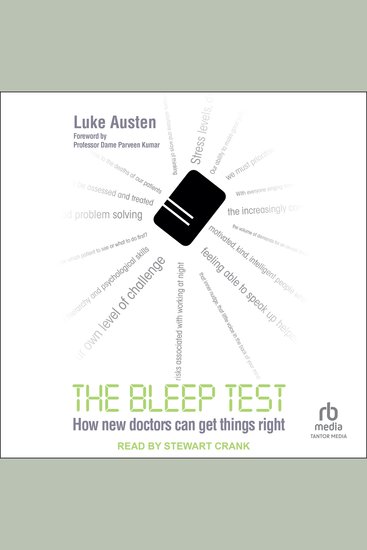
  • The Bleep Test - How New Doctors Can Get Things Right - cover

    The Bleep Test - How New Doctors...

    Luke Austen, Professor Dame...

    • 0
    • 0
    • 0
    What does it mean to help save someone's life? How does it feel to nearly kill a patient? Can we keep our patients safe at night? In the face of overwhelming pressures, can we thrive or only survive? And is a happy life as a doctor still possible? 


    In the early months and years of work, it is these kinds of questions, rather than any technical or knowledge-based queries, which preoccupy many new doctors. This elusive, hidden curriculum is pervasive within departments, around hospitals, and across health systems, but is rarely, if ever, explicitly examined and discussed. At its core is the issue that should matter above all others—how we can keep our patients as safe as possible. 


    The Bleep Test combines gripping and startlingly vulnerable recollections of early experiences on the wards with an array of research findings, from psychology and human biology to anthropology, business, and behavioral economics. Acknowledging that the truly complex challenges facing new doctors lie far beyond the realms of the traditional medical sciences in which they were trained, the book explains that the shift to being a doctor depends on first understanding how we think, reason, and behave as someone we have been all our lives—a human amongst humans.
    Ver libro