Begleiten Sie uns auf eine literarische Weltreise!
Buch zum Bücherregal hinzufügen
Grey
Einen neuen Kommentar schreiben Default profile 50px
Grey
Jetzt das ganze Buch im Abo oder die ersten Seiten gratis lesen!
All characters reduced
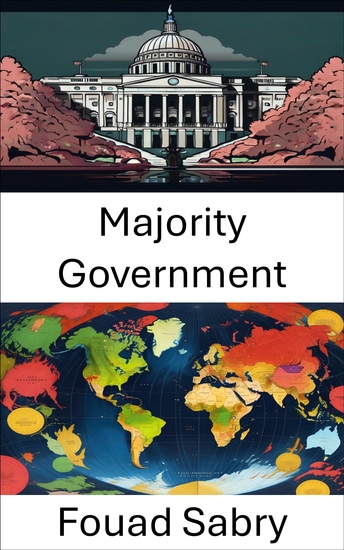
Majority Government - Understanding the Dynamics and Impact of Legislative Dominance - cover

Majority Government - Understanding the Dynamics and Impact of Legislative Dominance

Fouad Sabry

Verlag: One Billion Knowledgeable

  • 0
  • 0
  • 0

Beschreibung

Understanding Majority Governments is vital in Political Science. This book explores their stability, decision-making, and global impact. It provides essential insights for professionals, students, and enthusiasts, answering key questions about how majority rule shapes governance and enhances comprehension of political systems.
 
1: Majority Government: Explore the concepts, benefits, and challenges of maintaining stable Majority Governments.
 
2: Coalition Government: Understand coalition formation and functioning, contrasting it with majority rule complexities.
 
3: Plurality Voting: Examine how plurality voting achieves a majority and influences political outcomes.
 
4: First-Past-the-Post Voting: Learn about the first-past-the-post mechanism, its support for majority governments, and its democratic impact.
 
5: Minority Government: Investigate minority governments' vulnerabilities and survival strategies in a majority context.
 
6: Crossbencher: Understand crossbenchers' roles in parliamentary systems and their interaction with majority and minority governments.
 
7: Political Realignment: Analyze shifts in political allegiances and their effects on majority rule and stability.
 
8: Dominant-Party System: Study dominant-party systems and compare their governance with traditional majority governments.
 
9: Hung Parliament: Explore the circumstances and consequences of hung parliaments without an outright majority.
 
10: Wipeout (Elections): Investigate decisive election victories that create overwhelming majority governments and their political impact.
 
11: Politics of the United Kingdom: Gain insights into the UK’s political structure and the role of majority governments.
 
12: Politics of Norway: Examine Norway’s parliamentary framework and the influence of majority governments.
 
13: By-Election: Understand the importance of by-elections in maintaining or shifting majority control.
 
14: Politics of Scotland: Study Scotland's political landscape and majority governments in its devolved system.
 
15: Folketing: Learn about Denmark’s Folketing and how majority governments operate there.
 
16: Lib–Lab Pact: Investigate historical agreements like the Lib-Lab Pact between major and minor parties.
 
17: Confidence and Supply: Explore how minority governments rely on other parties’ support to function effectively.
 
18: Balance of Power (Parliament): Analyze how parliamentary power balances affect majority government stability.
 
19: Minor Party: Discover the influence of minor parties in majority-dominated political systems.
 
20: Landslide Victory: Examine landslide victories and their impact on dominant majority governments.
 
21: 2017 Norwegian Parliamentary Election: Review the 2017 election as a case study of majority government formation and consequences.
 
Gain comprehensive insights into Majority Governments and their role in shaping global political systems.
Verfügbar seit: 30.09.2024.
Drucklänge: 457 Seiten.

Weitere Bücher, die Sie mögen werden

  • How to Save a Constitutional Democracy - cover

    How to Save a Constitutional...

    Tom Ginsburg, Aziz Z. Huq

    • 0
    • 0
    • 0
    Democracies are in danger. Around the world, a rising wave of populist leaders threatens to erode the core structures of democratic self-rule. In the United States, the tenure of Donald Trump has seemed decisive turning point for many. What kind of president intimidates jurors, calls the news media the “enemy of the American people,” and seeks foreign assistance investigating domestic political rivals? Whatever one thinks of President Trump, many think the Constitution will safeguard us from lasting damage. But is that assumption justified?How to Save a Constitutional Democracy mounts an urgent argument that we can no longer afford to be complacent. Drawing on a rich array of other countries’ experiences with democratic backsliding, Tom Ginsburg and Aziz Z. Huq show how constitutional rules can both hinder and hasten the decline of democratic institutions. The checks and balances of the federal government, a robust civil society and media, and individual rights—such as those enshrined in the First Amendment—often fail as bulwarks against democratic decline. The sobering reality for the United States, Ginsburg and Huq contend, is that the Constitution’s design makes democratic erosion more, not less, likely. Its structural rigidity has had unforeseen consequence—leaving the presidency weakly regulated and empowering the Supreme Court conjure up doctrines that ultimately facilitate rather than inhibit rights violations. Even the bright spots in the Constitution—the First Amendment, for example—may have perverse consequences in the hands of a deft communicator who can degrade the public sphere by wielding hateful language banned in many other democracies. We—and the rest of the world—can do better. The authors conclude by laying out practical steps for how laws and constitutional design can play a more positive role in managing the risk of democratic decline.
    Zum Buch
  • Blowing up Ukraine - The Return of Russian Terror and The Threat of World War III - cover

    Blowing up Ukraine - The Return...

    Yuri Felshtinsky, Michael Stanchev

    • 0
    • 0
    • 0
    Presciently researched before the invasion of Ukraine, Blowing up Ukraine is the first comprehensive investigation into the lethal methods Russia has used since 1999 to take over Ukraine – culminating in full-blown unprovoked war in 2022 and mounting atrocities. In this chilling, riveting and alarming narrative the authors cite ample evidence, draw historical analogies, and marshal sources that are new, little known, or anonymous by necessity.Over twenty years, Vladimir Putin skilfully manipulated Ukraine's self-serving politicians and oligarchs, only to be thwarted time and again by peaceful revolutions of ordinary Ukrainians – the Maidan – against government corruption and being pushed into Russia's arms. As Putin became obsessed with conquering Ukraine, Blowing up Ukraine shows how the Kremlin has become a threat to global stability and Ukraine is almost certain to be the first battleground of World War III if the West is not careful to take a stance
    Zum Buch
  • Total Resistance - cover

    Total Resistance

    H Von Dach

    • 0
    • 0
    • 0
    Total Resistance by Major H. von Dach Bern is a practical and detailed manual on guerrilla warfare and resistance tactics, originally written for the Swiss Army during the Cold War. Designed as a guide for citizens facing enemy occupation, it provides step-by-step instructions on sabotage, ambushes, intelligence gathering, and survival techniques. The book emphasizes the importance of organized resistance and adaptability in unconventional warfare scenarios. Though intended for Switzerland's defense strategy, its insights have since been studied worldwide by those interested in military strategy, survival, and resistance movements. Total Resistance remains a unique historical document, offering both practical advice and a compelling perspective on national resilience during times of crisis.
    Zum Buch
  • Getting China Wrong - cover

    Getting China Wrong

    Aaron L. Friedberg

    • 0
    • 0
    • 0
    The West's strategy of engagement with China has failed. More than three decades of trade and investment with the advanced democracies have left that country far richer and stronger than it would otherwise have been. But growth and development have not caused China's rulers to relax their grip on political power, abandon their mercantilist economic policies, or accept the rules and norms of the existing international system. To the contrary: China today is more repressive at home, more aggressive abroad, and more obviously intent on establishing itself as the world's preponderant power than at any time since the death of Chairman Mao. What went wrong? 


    Put simply, the democracies underestimated the resilience, resourcefulness, and ruthlessness of the Chinese Communist Party. For far too long, the United States and its allies failed to take seriously the Party's unwavering determination to crush opposition, build national power, and fulfill its ideological and geopolitical ambitions. In this powerfully argued study, Friedberg identifies the assumptions underpinning engagement, describes the counterstrategy that China's Communist Party rulers devised in order to exploit the West's openness while defeating its plans, and explains what the democracies must do now if they wish to preserve their prosperity, protect their security, and defend their common values.
    Zum Buch
  • The Magic and Mayhem of Donald Trump - cover

    The Magic and Mayhem of Donald...

    Gretchen Wollert

    • 0
    • 0
    • 0
    In today’s deeply divisive political environment, the constant media storm pits Democrats against Republicans and liberals against conservatives, and drives narratives that describe Donald Trump as the worst president in American history who should be incarcerated forever for high crimes against society. But another segment of America believes Trump is the savior of the nation and worthy of sainthood. 
    What is the truth? Is there an acceptable reality somewhere within these two extremes? Can we know what actually guides Trump’s larger than life political persona? What really makes him tick? Is he worthy of the support of an American people desperately seeking the best for a nation in turmoil? 
    The Magic and Mayhem of Donald Trump lays out with uncommon clarity the reality of the Trump enigma. Known for his supreme self-confidence, inexhaustible ambition, braggadocio, arrogance, vanity, and knack for thriving amid conflict, Trump, who fights opponents with a fierce intensity that is often cruel and harsh, also possesses a firm but realistic sense of right and wrong influenced by a simple faith and bears a serious connection to everyday common people that springs from his past. 
    You will confidently discover, amidst the magic and the mayhem, the real man behind the myth. And in the process, you just might acquire a renewed or even novel appreciation for this American original.
    Zum Buch
  • Cheka The: The History of the Soviet Agency that Eventually Became the KGB - cover

    Cheka The: The History of the...

    Editors Charles River

    • 0
    • 0
    • 0
    The KGB is one of the most famous abbreviations of the 20th century, and it has become synonymous with the shadowy and often violent actions of the Soviet Union’s secret police and internal security agencies. In fact, it is often used to refer to the Soviet state security agencies throughout its history, from the inception of the inception of the Cheka (Extraordinary Commission) in 1917 to the official elimination of the KGB in 1992. Whether it’s associated with the Russian Civil War’s excesses, Stalin’s purges, and even Vladimir Putin, the KGB has long been viewed as the West’s biggest bogeyman during the second half of the 20th century. 
    	However, the KGB did not appear out of thin air. Naturally, the earliest Soviet leaders utilized intelligence agencies that collected information both abroad and within the Soviet Union, targeting foreign opponents and domestic opponents alike. Lenin did not imagine the scale of the opposition he would have to face after the revolution, and he quickly came to the conclusion that "a special system of organized violence" must be created to implement the dictatorship of the proletariat. 
    	Thus, from nearly the beginning of the Bolshevik takeover of Russia, Lenin and his successors established and relied on a particularly ruthless agency: the All-Russian Extraordinary Commission for Combating Counter-Revolution and Sabotage, later abbreviated to the Extraordinary Commission. Known colloquially as the Cheka (Extraordinary Commission), it soon became as feared by non-socialists as the Tsar’s secret police had ever been. The main means approved by the Council of People's Commissars on December 20, 1917, which the Cheka had to use to fight the counter-revolution, were "seizure of property, resettlement, deprivation of cards, publication of lists of enemies of the people, etc."
    Zum Buch