Begleiten Sie uns auf eine literarische Weltreise!
Buch zum Bücherregal hinzufügen
Grey
Einen neuen Kommentar schreiben Default profile 50px
Grey
Jetzt das ganze Buch im Abo oder die ersten Seiten gratis lesen!
All characters reduced
Majoritarianism - Democratic Complexity Unveiled - cover

Majoritarianism - Democratic Complexity Unveiled

Fouad Sabry

Verlag: One Billion Knowledgeable

  • 0
  • 0
  • 0

Beschreibung

Unlock a deeper understanding of democracy with "Majoritarianism," a vital addition to the "Political Science" series-In an era dominated by governance and majority rule, this book offers a comprehensive exploration of the principles and challenges of majoritarianism-Whether you’re a professional, a student, or simply passionate about political theory, this book provides insights that extend far beyond basic knowledge.
 
1-Majoritarianism-Dive into the core concept of majoritarianism, examining its roots, principles, and implications for democratic governance.
 
2-Democracy-Explore the broader context of democracy to understand how majoritarianism fits within the democratic framework.
 
3-Election-Understand the critical role elections play in expressing the will of the majority and serving as the cornerstone of democratic legitimacy.
 
4-First-Past-the-Post Voting-Delve into this electoral system that exemplifies majoritarian principles, analyzing its advantages and potential pitfalls.
 
5-Tyranny of the Majority-Examine the dark side of majoritarianism, where unchecked majority rule can threaten the rights of minorities.
 
6-Majority Rule-Gain insights into the mechanisms and justifications of majority rule, balancing governance with fairness.
 
7-Minoritarianism-Contrast majoritarianism with minoritarianism, exploring scenarios where minority rights prevail in decision-making.
 
8-Concurrent Majority-Investigate this alternative approach to decision-making, where consensus across multiple groups challenges pure majoritarianism.
 
9-Politics (Aristotle)-Discover Aristotle’s foundational views on politics and how they influence modern interpretations of majority rule.
 
10-History of Democracy-Trace the evolution of democracy, identifying key moments where majoritarian principles shaped political systems.
 
11-Landsgemeinde-Learn about this ancient form of direct democracy, offering a unique historical perspective on majoritarian practices.
 
12-Majoritarian Democracy-Analyze the specific characteristics and outcomes of political systems built on majoritarian principles.
 
13-Counter-Majoritarian Difficulty-Explore the tension between majoritarianism and judicial review, and how this impacts democratic governance.
 
14-Liberal Democracy-Compare majoritarianism with liberal democracy, where individual rights and checks on majority power are emphasized.
 
15-Criticism of Democracy-Engage with critiques that highlight potential flaws in majoritarian approaches.
 
16-Electoral System-Review different electoral systems, evaluating how they support or challenge majoritarian principles.
 
17-Types of Democracy-Broaden your understanding by exploring various forms beyond majoritarianism, such as deliberative and participatory democracies.
 
18-Majoritarian Representation-Focus on how majoritarian principles shape policy and law in representative government.
 
19-Outline of Democracy-Get an overview of key elements that define democratic systems, providing context for understanding majoritarianism’s role.
 
20-Epistemic Democracy-Explore where decision-making is informed by expertise rather than just majority opinion.
 
21-Mixed-Member Majoritarian Representation-Examine this hybrid system that combines majoritarian and proportional representation, offering a balanced approach to governance.
Verfügbar seit: 13.08.2024.
Drucklänge: 311 Seiten.

Weitere Bücher, die Sie mögen werden

  • How To Raise A Citizen (And Why It's Up to You to Do It) - cover

    How To Raise A Citizen (And Why...

    Lindsey Cormack

    • 0
    • 0
    • 0
    An essential guide to nurturing the next generation of responsible, informed citizens 


    Lindsey Cormack's book, How to Raise a Citizen (And Why It's Up to You to Do It), speaks directly to an America in which civic knowledge is alarmingly sparse and many people dread politics. It's a tool for parents, educators, and anyone eager to fill this gap. In the book, Cormack offers an engaging and practical approach to discussing political issues and the inner workings of the US government with children. She explains why our schools can no longer be the sites of civic education that they used to be and provides parents with strategies and necessary know-how to be able to impart these lessons to their children. From the intricacies of the voting process to the foundational principles of democracy and the significance of key government documents like the Constitution, the author demystifies complex topics with clarity and insight. 


    How to Raise a Citizen is a roadmap to a future where political dialogue and civic engagement are not just encouraged but celebrated in our homes. With actionable advice and easy-to-understand explanations, it empowers listeners to instill a sense of civic responsibility and curiosity in the young minds they influence.
    Zum Buch
  • Conspiracy - Why the Rational Believe the Irrational - cover

    Conspiracy - Why the Rational...

    Michael Shermer

    • 0
    • 0
    • 0
    Best-selling author Michael Shermer presents an overarching theory of conspiracy theories—who believes them and why, which ones are real, and what we should do about them. 
     
    Nothing happens by accident, everything is connected, and there are no coincidences: that is the essence of conspiratorial thinking. Long a fringe part of the American political landscape, conspiracy theories are now mainstream: 147 members of Congress voted in favor of objections to the 2020  
    presidential election based on an unproven theory about a rigged electoral process promoted by the mysterious group QAnon. But this is only the latest example in a long history of ideas that include the satanic panics of the 1980s, the New World Order and Vatican conspiracy theories, fears about  
    fluoridated water, speculations about President John F. Kennedy's assassination, and the notions that the Sandy Hook massacre was a false-flag operation and 9/11 was an inside job. 
     
    In Conspiracy, Michael Shermer presents an overarching review of conspiracy theories—who believes them and why, which ones are real, and what we should do about them. Trust in conspiracy theories, he writes, cuts across gender, age, race, income, education level, occupational status—and even  
    political affiliation. One reason that people believe these conspiracies, Shermer argues, is that enough of them are real that we should be constructively conspiratorial: elections have been rigged (LBJ's 1948 Senate race); medical professionals have intentionally harmed patients in their care (Tuskegee); your  
    government does lie to you (Watergate, Iran-Contra, and Afghanistan); and, tragically, some adults do conspire to sexually abuse children. But Shermer reveals that other factors are also in play: anxiety and a sense of loss of control play a role in conspiratorial cognition patterns, as do certain personality traits. 
     
    This engaging book will be an important read for anyone concerned about the future direction of American politics, as well as anyone who's watched friends or family fall into patterns of conspiratorial thinking. 
     
    A supplemental PDF is included with this audiobook.
    Zum Buch
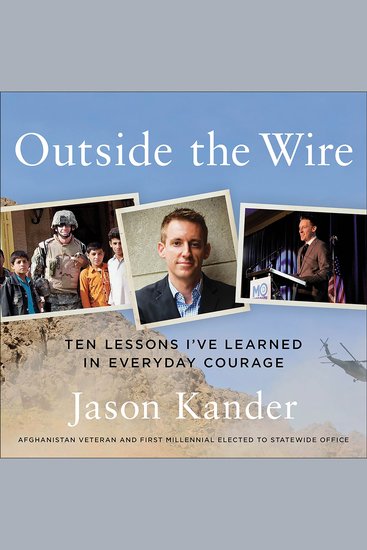
  • Outside the Wire - Ten Lessons I've Learned in Everyday Courage - cover

    Outside the Wire - Ten Lessons...

    Jason Kander

    • 0
    • 0
    • 0
    A smart and revealing political memoir from a rising star of the Democratic Party. "In life and in politics, the most important work is often that which happens outside the wire."  Going "outside the wire" -- military lingo for leaving the safety of a base -- has taught Jason Kander to take risks and make change rather than settling for the easy option. After you've volunteered to put your life on the line with and for your fellow Americans in Afghanistan, cynical politics and empty posturing back home just feel like an insult.  Kander understands that showing political courage really just means doing the right thing no matter what. He won a seat in the Missouri Legislature at age twenty-seven and then, at thirty-one, became the first millennial in the country elected to statewide office. An unapologetic progressive from the heartland, he rejected conventional political wisdom and stood up to the NRA in 2016 with a now-famous Senate campaign ad in which he argued for gun reform while assembling a rifle blindfolded.  That fearless commitment to service has placed him at the forefront of a new generation of American political leaders. In his final interview as President, Barack Obama pointed to Kander as the future of the Democratic Party.  "...do something rather than be something..."In Outside the Wire, Jason Kander describes his journey from Midwestern suburban kid to soldier to politician and details what he's learned along the way: lessons imparted by his dad on the baseball diamond, wisdom gained outside the wire in Kabul, and cautionary tales witnessed under the Missouri Capitol dome. Kander faced down petty tyrants in Jefferson City -- no big deal after encountering real ones in Afghanistan. He put in 90,000 miles campaigning for statewide office in 2012 -- no sweat compared to the thirty-seven miles between Bagram Air Base and Camp Eggers. When confronted with a choice between what's easy and what's right, he's never hesitated.Outside the Wire is a candid, practical guide for anyone thinking about public service and everyone wishing to make a difference. It's a call to action, an entertaining meditation on the demands and rewards of civic engagement, and, ultimately, a hopeful vision for America's future -- all seen through the eyes of one of its most dedicated servants.
    Zum Buch
  • Economic Recovery Program - cover

    Economic Recovery Program

    Ronald Reagan

    • 0
    • 0
    • 0
    On February 18, 1981, Reagan laid out his economic recovery program before a Joint Session of Congress. Reagan had previously outlined his recovery program in an Oval Office address on February 5, 1981, in which he displayed a dollar bill and 36 cents to show how inflation had reduced the value of a dollar since 1960.  
    Reagan made a further plea for enactment of his recovery program on April 28, 1981, following the assassination attempt on his life. Many economists credit this recovery program for reducing the inflation rate and igniting one of the longest and most robust economic expansions in U.S. history. 
    Reagan paints a grim picture of inflation, the national debt, and lagging productivity plaguing the economy. $41.4 billion of reduced spending is proposed with no reduction for “the poverty stricken, the disabled, the elderly, [and] all those with true need”. Subsidies of the synthetic fuel program, the Export-Import Bank, and the Economic Development Administration are targeted.  
    Block grants to states are proposed, along with changes to Medicaid, the space program, the Postal Service, and the Department of Energy. To counter the Soviet Union’s military build-up, defense is the one department with an increased budget. 
    A 10-percent tax cut for individual taxpayers is proposed for each of the next 3 years, along with increased depreciation allowances to allow business the capital needed to modernize.  
    We “must come to grips with inefficient and burdensome regulations, eliminate those we can and reform the others.”  
    To reduce inflation and interest rates, we need to slow the growth of our money supply. 
    This is our proposal for America’s new beginning. “I'm here tonight to ask you to join me in making it our plan.” Government “must not be used to regulate the economy or bring about social change.” 
    Audio recording courtesy of the Ronald Reagan Presidential Library. 
    AspenLeafMedia.com
    Zum Buch
  • In the Lion's Den - Israel and the World - cover

    In the Lion's Den - Israel and...

    Danny Danon, Nikki Haley

    • 0
    • 0
    • 0
    In the Lion's Den is a book about the life events that encouraged Danny Danon to pursue his chosen career path and take his distinct and direct approach during his time as Knesset Member and later on in his political career. It is a book that tells the story of his journey to the United Nations and the key events that occurred during the five years he served as Israel's 17th Permanent Representative to the UN. 


    In the Lion's Den draws on the unique perspective of a man who has spent his entire career in his nation's public service. Danon shares his experiences on the front lines of Israel's global presence—the successes as well as the disappointments. Danon makes a compelling case for an Israel that must be proud of its identity and faith; forge relationships with diverse peoples; make autonomous domestic decisions; and determine its own foreign policy. 


    In this book, Danon lays out a roadmap for Israel’s future on the regional and global stage and outlines the path Israel must follow in order to continue to make a positive contribution to global prosperity and peace and ensure its safety in a fraught region. As the Jewish state enters the next phase of its existence, Danon's inspiring vision will help Israel fulfill the noble vision of its founders.
    Zum Buch
  • The Decisive Decade - American Grand Strategy for Triumph Over China - cover

    The Decisive Decade - American...

    Jonathan D.T. Ward

    • 0
    • 0
    • 0
    In The Decisive Decade, Dr. Jonathan D. T. Ward offers a comprehensive framework for how the US can, and must, defeat China on the world stage economically, diplomatically, militarily, and ideologically. International security and American supremacy are at stake—and now is the time for the US to take action. China's global power and influence grows every day. Working from a deep sense of national identity, the Chinese Communist Party is leading its country toward what it deems "the great rejuvenation of the Chinese Nation," and executing a long-term Grand Strategy to topple over its chief adversary, the US. As China becomes increasingly repressive domestically and aggressive overseas, it threatens to upend America's global dominance at every turn. 


    Ward provides novel and practical strategies that our government, as well as our businesses and our citizens, can utilize to undermine our adversary. Exhaustive campaigns in the economic, diplomatic, military, and ideological arenas, he argues, must be taken to achieve victory. With expert analysis of the history of US-China relations, as well as insight into how the Russia-Ukrainian war can inform our strategic thinking, The Decisive Decade presents a unique toolkit for our triumph over China. We can succeed, but it won't be easy; it will take all of our nation's ingenuity, confidence, and willpower to win.
    Zum Buch