Begleiten Sie uns auf eine literarische Weltreise!
Buch zum Bücherregal hinzufügen
Grey
Einen neuen Kommentar schreiben Default profile 50px
Grey
Jetzt das ganze Buch im Abo oder die ersten Seiten gratis lesen!
All characters reduced
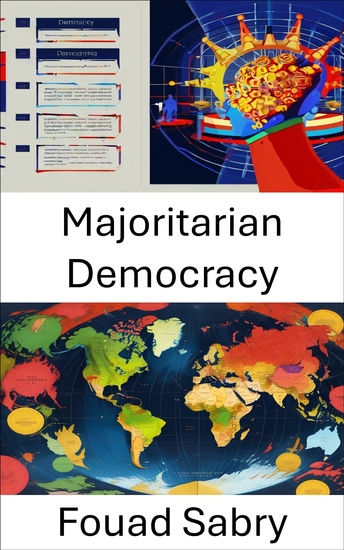
Majoritarian Democracy - Exploring the Power Dynamics of Popular Rule - cover

Majoritarian Democracy - Exploring the Power Dynamics of Popular Rule

Fouad Sabry

Verlag: One Billion Knowledgeable

  • 0
  • 0
  • 0

Beschreibung

Discover the transformative power of majoritarian democracy with "Majoritarian Democracy," a vital addition to the "Political Science" series. This book offers an in-depth exploration of majoritarian democracy, its principles, challenges, and impact on governance. Understand how majority rule interacts with minority rights and how different electoral systems shape democratic outcomes.
 
1-Majoritarian Democracy-Explore foundational concepts and core principles.
 
2-Democracy-Situate majoritarian democracy within broader democratic theory.
 
3-Election-Investigate the role of elections in reflecting the majority's will.
 
4-Proportional Representation-Contrast proportional representation with majoritarian systems.
 
5-First-past-the-post Voting-Understand this voting system and its implications.
 
6-Tyranny of the Majority-Recognize the risks of majority dominance over minorities.
 
7-Parallel Voting-Learn how parallel systems balance majoritarian and proportional elements.
 
8-Majoritarianism-Delve into majoritarianism as a political ideology.
 
9-Majority Rule-Examine the principle of majority rule in democratic decisions.
 
10-Majority Criterion-Investigate criteria ensuring fair majority rule.
 
11-Minoritarianism-Explore the role of minoritarianism in protecting minority interests.
 
12-Geniocracy-Discuss the implications of geniocracy on majoritarian democracy.
 
13-How Democratic Is the American Constitution?-Assess the Constitution's alignment with majoritarian principles.
 
14-Elections in Georgia (Country)-Review Georgia's electoral systems for a comparative perspective.
 
15-Liberal Democracy-Explore the relationship between majoritarian and liberal democratic principles.
 
16-Semi-proportional Representation-Analyze systems that balance majority rule with minority representation.
 
17-Electoral System-Explore various electoral systems shaping political outcomes.
 
18-Majoritarian Representation-Understand majoritarian representation in different frameworks.
 
19-Outline of Political Science-Get an overview of political science concepts relevant to majoritarian democracy.
 
20-Mixed Electoral System-Examine systems integrating majoritarian and proportional elements.
 
21-Mixed-member Majoritarian Representation-Explore balanced democratic outcomes through mixed-member majoritarian representation.
 
"Majoritarian Democracy" is your key to unlocking the complexities of democratic governance. Its clear explanations offer invaluable insights for professionals, students, and enthusiasts. The understanding gained from this book offers lasting benefits and a deeper appreciation for democracy's dynamics.
Verfügbar seit: 04.09.2024.
Drucklänge: 301 Seiten.

Weitere Bücher, die Sie mögen werden

  • The Shocking Truth about International Relations - cover

    The Shocking Truth about...

    Zoey Fraisers

    • 0
    • 0
    • 0
    International relations is a complex and ever-evolving field that shapes the global political landscape. The relationships between countries, organizations, and individuals influence everything from trade and diplomacy to security and human rights. Understanding the history, theories, and modern-day dynamics of international relations is essential for anyone seeking to grasp the intricacies of global affairs. The study of international relations has evolved from a niche academic discipline into a vital framework for analyzing global conflicts, cooperation, and power struggles. 
      
    The modern world has been profoundly shaped by the forces of globalization, which have made international relations more interconnected than ever before. Advances in communication, transportation, and technology have blurred the lines between domestic and international issues. Countries can no longer afford to operate in isolation; they must cooperate on matters of shared concern, such as climate change, terrorism, economic crises, and public health. However, the globalized world also comes with challenges. Increasingly, nations must navigate a complex web of relationships and competing interests, where power dynamics and the quest for dominance can create conflict. 
      
    Globalization has had a profound impact on international relations, but it has also revealed the limits of traditional diplomacy. In the past, diplomacy was primarily conducted between states, often in secret negotiations behind closed doors. Today, international diplomacy involves a wider range of actors, from multinational corporations and non-governmental organizations to grassroots movements and individual leaders. This shift has led to both opportunities and challenges for international cooperation, as diverse interests often clash in the pursuit of a global agenda.
    Zum Buch
  • Emotional Justice - A Roadmap for Racial Healing - cover

    Emotional Justice - A Roadmap...

    Esther A. Armah, Brittney...

    • 0
    • 0
    • 0
    It is time for an emotional reckoning on our path to racial healing, sustainable equity, and the future of DEI. Here's the tool to help us navigate it. 


    In this groundbreaking book, Esther Armah argues that the crucial missing piece to racial healing and sustainable equity is emotional justice—a new racial healing language to help us do our emotional work. This work is part of the emotional reckoning we must navigate if racial healing is to be more than a dream. We all—white, Black, Brown—have our emotional work that we need to do. But that work is not the same for all of us. 


    This emotional work means unlearning the language of whiteness, a narrative that centers white people, particularly white men, no matter the deadly cost and consequence to all women and to global Black and Brown people. That's why a new racial healing language is crucial. 


    Emotional Justice grapples with how a legacy of untreated trauma from oppressive systems has created and sustained dual deadly fictions: white superiority and Black inferiority that shape—and wound—all of us. These systems must be dismantled to build a future that serves justice to everyone, not just some of us.
    Zum Buch
  • Our Common Cause - Establishing the Political Power We Lack - cover

    Our Common Cause - Establishing...

    Étienne Chouard

    • 0
    • 0
    • 0
    I want to talk to you about democracy. The real one. The one that does not exist, and the one we really need today. My research method is that of Hippocrates, who said, look for the cause of causes. In other words, to cure a disease, to solve a problem, it is useless to attack the consequences, it is useless to attack the different causes. There is always a determining cause (the one that determines all the others)—and that is our common cause.
    The first decisive battle is to push the important words "right side up":
    First. I am not a "citizen" (a citizen is autonomous; he votes himself his laws). I am only a "voter;" that is to say, a political child—because I am subject to the law voted into existence by someone other than me.
    Second. My "parents" in politics, the elected officials, do not want me to emancipate myself from them—they do not allow me to vote for or against the laws to which I have to submit myself.
    We are "the incompetents." They treat us like children. But it is our fault, because children also believe in "Santa Claus," and so voters believe in "universal suffrage," which we accept to call "democracy" (demos kratos, power belongs to the people). The so-called modern "democracy".
    Zum Buch
  • The Decisive Decade - American Grand Strategy for Triumph Over China - cover

    The Decisive Decade - American...

    Jonathan D.T. Ward

    • 0
    • 0
    • 0
    In The Decisive Decade, Dr. Jonathan D. T. Ward offers a comprehensive framework for how the US can, and must, defeat China on the world stage economically, diplomatically, militarily, and ideologically. International security and American supremacy are at stake—and now is the time for the US to take action. China's global power and influence grows every day. Working from a deep sense of national identity, the Chinese Communist Party is leading its country toward what it deems "the great rejuvenation of the Chinese Nation," and executing a long-term Grand Strategy to topple over its chief adversary, the US. As China becomes increasingly repressive domestically and aggressive overseas, it threatens to upend America's global dominance at every turn. 


    Ward provides novel and practical strategies that our government, as well as our businesses and our citizens, can utilize to undermine our adversary. Exhaustive campaigns in the economic, diplomatic, military, and ideological arenas, he argues, must be taken to achieve victory. With expert analysis of the history of US-China relations, as well as insight into how the Russia-Ukrainian war can inform our strategic thinking, The Decisive Decade presents a unique toolkit for our triumph over China. We can succeed, but it won't be easy; it will take all of our nation's ingenuity, confidence, and willpower to win.
    Zum Buch
  • Civil War by Other Means - America's Long and Unfinished Fight for Democracy - cover

    Civil War by Other Means -...

    Jeremi Suri

    • 0
    • 0
    • 0
    In 1865, the Confederacy was comprehensively defeated, its economy shattered, its leaders in exile or in jail. Yet in the years that followed, Lincoln's vision of a genuinely united country never took root. Apart from a few brief months, when the presence of the Union army in the South proved liberating for newly freed Black Americans, the military victory was squandered. Old white supremacist efforts returned, more ferocious than before. 


    In Civil War by Other Means, Jeremi Suri shows how resistance to a more equal Union began immediately. From the first postwar riots to the return of Confederate exiles, to the impeachment of Andrew Johnson, to the highly contested and consequential election of 1876, Suri explores the conflicts and questions Americans wrestled with as competing visions of democracy, race, and freedom came to a vicious breaking point. 


    What emerges is a vivid and at times unsettling portrait of a country striving to rebuild itself, but unable to compromise on or adhere to the most basic democratic tenets. What should have been a moment of national renewal was ultimately wasted, with reverberations still felt today. The recent shocks to American democracy are rooted in this forgotten, urgent history.
    Zum Buch
  • A Realistic Path to Peace - From Genocide to Global War and How We Can Stop It - cover

    A Realistic Path to Peace - From...

    Dee Charles Knight

    • 0
    • 0
    • 0
    This book delves into genocide in Palestine, and the war crisis in eastern Europe, West Asia and East Asia. It examines the role of the Big Lie in blunting popular opposition, and describes ways countries around the world and the general public are pressing for peace.  
    The world is in a crisis now. As its empire declines toward collapse, the United States leadership is making a series of disastrous errors. The “neocons” in Washington, DC, are determined to maintain U.S. global domination regardless of what it might take. The stakes are high for them. They seem to believe that if they “allow” any other 
    country to challenge their global leadership, their whole system could fall apart. 
    So they are prepared to do whatever it takes. Supporting genocide in Israel—by providing weapons, money, and a bizarre “moral justification” for horrific genocidal bombing—is a sign of what it takes. Blowing up the Nord Stream pipeline was another sign of what it can take. 
    Western European leaders have been rounded up and bludgeoned into a unified NATO alliance against Russia, and in support of Israeli genocide against Palestinians. This alliance—originally composed of “north Atlantic” countries under U.S. leadership at the end of World War II—is now also being extended to Asia. It’s a quest to curb China’s historic economic success, which threatens Western domination of global trade. 
    A new peace movement is emerging. It faces enormous obstacles, including a gigantic wave of war hysteria engineered in Washington, magnified exponentially by a captive mainstream media that seems to have abandoned all pretense of critical journalistic independence and objectivity. But as facts emerge and truth surfaces, the movement for peace will intensify. 
    Combined with the horrific results of sanctions and war, these facts and truths can be expected to bring ever greater waves of opposition and resistance into the fray.
    Zum Buch