Begleiten Sie uns auf eine literarische Weltreise!
Buch zum Bücherregal hinzufügen
Grey
Einen neuen Kommentar schreiben Default profile 50px
Grey
Jetzt das ganze Buch im Abo oder die ersten Seiten gratis lesen!
All characters reduced
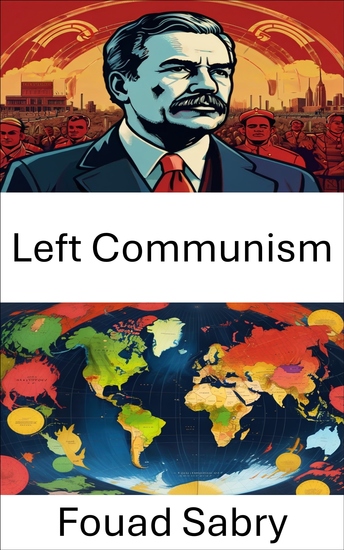
Left Communism - Radical Paths to Societal Transformation - cover

Left Communism - Radical Paths to Societal Transformation

Fouad Sabry

Verlag: One Billion Knowledgeable

  • 0
  • 0
  • 0

Beschreibung

As global politics shift and radical ideologies reappear, this book is essential for understanding alternative Marxist perspectives.
 
Chapters:
 
- Left Communism: Introduces Left Communism, critiquing parliamentary methods and advocating for revolutionary action.
 
- Amadeo Bordiga: Highlights Bordiga’s role, opposition to reformism, and call for a disciplined revolutionary party.
 
- Council Communism: Examines the councilist movement, advocating workers' councils over traditional state theories.
 
- Ultra-leftism: Discusses spontaneity, direct action, and the rejection of compromise in ultra-left positions.
 
- Communist Workers' Party of Germany: Details the KAPD’s history, ideology, and influence, breaking from mainstream Marxism.
 
- International Communist Party: Explores the PCI’s contributions and internationalist outlook on 20th-century revolutionary strategies.
 
- Communist Workers' Organisation (UK): Insights into UK Left Communist activism and views on imperialism, class struggle, and the proletariat.
 
- Internationalist Communist Party (Italy): Analyzes the PCInt’s ideas, linking them to broader Left Communist debates.
 
- Onorato Damen: Highlights Damen’s critiques of reformism and return to revolutionary principles.
 
- Jan Appel: Examines Appel’s impact on German and Dutch councilist movements and Left Communist thought.
 
- Leninism: Evaluates Left Communist critiques of Leninism, contrasting with Leninist vanguardism.
 
- Otto Rühle: Explores Rühle’s rejection of party politics and advocacy for council democracy.
 
- List of Communist Ideologies: Overview of various communist ideologies, situating Left Communism within revolutionary traditions.
 
- Marxist Schools of Thought: Contrasts Left Communist views with other Marxist schools and revolutionary strategies.
 
- Internationalist–Defencist Schism: Examines the WWI split between internationalists and defencists and its implications for Left Communist theory.
 
- "Left-Wing" Communism: An Infantile Disorder: Critiques Lenin's work from a Left Communist viewpoint, challenging its strategies.
 
- Workers' Council: Explores the role of workers' councils in revolutionary organization and socialist transition.
 
- List of Left-Wing Internationals: Surveys global revolutionary alliances among Left Communist groups.
 
- Proletarian Internationalism: Investigates proletarian internationalism in Left Communist thought, emphasizing solidarity and critiquing nationalism.
 
- Lotta Comunista: Offers insights into contemporary movements like Lotta Comunista and their relevance today.
 
- Outline of Marxism: Summarizes Marxist principles through Left Communism, reflecting on revolutionary theory’s evolution.
Verfügbar seit: 14.08.2024.
Drucklänge: 209 Seiten.

Weitere Bücher, die Sie mögen werden

  • Speak Up: Navigating Free Speech in a Turbulent World - Discover "Speak Up" audio lessons—master free speech and elevate your understanding for top performance! - cover

    Speak Up: Navigating Free Speech...

    Ethan Marlowe

    • 0
    • 0
    • 0
    Speak Up: Navigating Free Speech in a Turbulent World 
    ⭐⭐ Simplified Audio Guide ⭐⭐ 
    Are you seeking to advance in your career and strengthen your understanding of free speech in today's complex world?  
    Looking for a thorough guide that provides all the essential elements to effectively navigate contemporary conversations about free speech? 
    Your search ends here! 
    This guide is your definitive companion for deepening your knowledge, honing your skills, and engaging in practical exercises. With this, you'll be well-equipped for success. 
    Updated for the current context and challenges surrounding free speech. 
    Key features of this enriched guide: 
    - Profound insights about Empowering Your Voice in Today's Challenging Conversations 
    - Detailed explanation of Free Speech Principles 
    - Effective strategies for preparation and engagement in discussions 
    Our guide stands out with comprehensive coverage, which is crucial for your understanding and success. Concepts are not just skimmed over; they are explored in depth with precision. 
    Please note that this guide is not affiliated with any official entities and is purely an independent resource for your benefit. 
    Designed with a clear structure and easy-to-understand language, our Free Speech Guide ensures smooth transitions between topics. Say goodbye to dense jargon and welcome clear, precise, and technically accurate content. 
    So, why wait? Click the BUY NOW button, secure your guide, and begin your journey to confidently navigate the world of free speech!
    Zum Buch
  • Second Treatise of Government - cover

    Second Treatise of Government

    John Locke

    • 0
    • 0
    • 0
    The Second Treatise of Government is a political treatise written by English philosopher John Locke in 1689. It is considered one of the most important works on political philosophy, as it presents Locke's ideas on the natural rights of individuals and the proper role and limits of government in a society based on the consent of the governed. 
    In the Second Treatise, Locke argues that all individuals have natural rights to life, liberty, and property, which cannot be taken away by any authority, including the government. These rights are inherent and universal, and are not granted by any social contract or agreement. 
    Locke also argues that governments are formed by the consent of the governed, and are therefore obligated to protect the natural rights of their citizens. He asserts that the purpose of government is to promote the common good, and that governments that fail to do so may be overthrown by the people. 
    Moreover, Locke suggests that there are limits to the power of government, and that individuals have the right to resist or even overthrow a government that becomes tyrannical or violates their natural rights. 
    The Second Treatise of Government has had a significant impact on political theory and the development of democratic governance. It influenced the United States Declaration of Independence and the Constitution, as well as many other constitutions around the world.
    Zum Buch
  • A Rare Recording of Bobby Seale Founder of the Black Panther Party - cover

    A Rare Recording of Bobby Seale...

    Bobby Seale

    • 0
    • 0
    • 0
    Robert George Seale (born October 22, 1936) is an African American revolutionary, political activist and author. Seale is widely known for co-founding the Marxist–Leninist and black power political organization the Black Panther Party (originally called the Black Panther Party for Self-Defense) with fellow activist Huey P. Newton to monitor police activities and challenge police brutality in black communities, first in Oakland, California, and later in cities throughout the United States. Seale was also one of the “Chicago Eight” defendants, charged by the US government with conspiracy charges related to anti-Vietnam War protests in Chicago during the 1968 Democratic National Convention, later called the “Chicago seven” when Seale's case was severed from the other defendants. After which, the government declined to retry Seale on the conspiracy charges, and he was never convicted in the case.
    Zum Buch
  • The Fireside Chats of Franklin Delano Roosevelt - cover

    The Fireside Chats of Franklin...

    Franklin Delano Roosevelt

    • 0
    • 0
    • 0
    Shortly after taking office in 1933 President Franklin Delano Roosevelt delivered the first of his radio broadcasts to the American public.  In simple, plain language, he took pains to explain the basic mechanics of the banking system, the causes of the present banking crisis, and the steps he was taking to stabilize the system.  It was an extraordinary moment – the first time an American President had bypassed the traditional channels of communication (newspapers largely owned by conservative Republicans) and taken his message directly to the people.  In doing so, he conveyed a sense of intimacy and engagement with the decision-making process that earned the trust and affection of the American people. He was able to squelch rumors and build public support for the most radical social changes and the largest war in the history of the United States. They are an astonishing testimony to what great leadership looks like, sounds like, and what it can accomplish.There are thirty addresses in all, ranging from about ten to thirty minutes, given at the rate of about one every five months, with the timing dictated by public events.  The term “fireside chat” was coined by Harry C. Butcher at CBS in a press release in 1933. Most, but not all, of the original addresses were recorded in part or in full. The sound quality, however, is often quite poor.  Thus, these new recordings of the published texts of the original addresses.  While it is impossible to capture the cheery, affable charm of President Roosevelt, we hope the readings convey the spirit of the times and the temper of the man.
    Zum Buch
  • Walls of Words - How Boundaries Define Free Speech - cover

    Walls of Words - How Boundaries...

    Thomas T. Taylor

    • 0
    • 0
    • 0
    Delve into the intricate dance of free speech in the United States. "Walls of Words" is not just another book about the First Amendment; it is a deep dive into the intricate boundaries that define our freedom of expression. With a rich blend of history, jurisprudence, and real-world examples, this book paints a comprehensive picture of how speech has been shaped, celebrated, and suppressed since the founding of America. 
     
    Ever wondered about the intentions of the Founding Fathers when they penned the First Amendment? Or how landmark cases over the centuries have redefined its interpretation? From the early American media's struggles with censorship to the rise of digital platforms, discover the evolution of speech boundaries and the forces that have constantly sought to redraw them. 
     
    But it doesn't stop there. In today's digital age, speech boundaries are more complex than ever. Dive into the thorny issues of cyberbullying, doxing, and the rise of disinformation. Understand when speech crosses the line into crime, from threats and extortion to false advertising and copyright infringement. And for those moments when you find yourself walking on the eggshells of culturally sensitive speech, this book offers guidance on navigating those murky waters. 
     
    Moreover, in a world where the line between private censorship and public responsibility is increasingly blurred, "Walls of Words" challenges readers to reflect on the ethical implications of speech boundaries. How do we balance tolerance with limitation? What role do private entities play in shaping the discourse? And as technology continues to transform the landscape of expression, what challenges lie ahead for the future of free speech? 
     
    "Walls of Words" promises an enlightening journey through the ever-evolving wall of words that defines our collective responsibility to uphold the spirit of free speech.
    Zum Buch
  • GeopOlympics - English version - The great geopolitical stories of the olympics - cover

    GeopOlympics - English version -...

    Kévin Veyssière

    • 0
    • 0
    • 0
    Why have the Olympic Games always been a geopolitical event in their own right? How did the Olympic Games in Mexico City in 1968, Moscow in 1980 and Barcelona in 1992 reflect international tensions, despite the Olympics' political neutrality? In2024, what are the stakes for France in the Paris Olympics, against the backdrop of the Israeli-Palestinian and Russian-Ukrainian conflicts? Why have new powers such as China, Qatar and Saudi Arabia made the organization of the Games an objective of their influence strategy?
    
    In his fourth book, Kévin Veyssière invites sports fans, geography buffs and the curious to explore the history of our world through the Olympic Games. From Athens in 1896 to Paris in 2024, he unveils the most striking geopolitical backdrops to a theater of 206 nations, where sporting performances and power games come together.
    Zum Buch