Rejoignez-nous pour un voyage dans le monde des livres!
Ajouter ce livre à l'électronique
Grey
Ecrivez un nouveau commentaire Default profile 50px
Grey
Abonnez-vous pour lire le livre complet ou lisez les premières pages gratuitement!
All characters reduced
Intelligent Control - Fundamentals and Applications - cover

Intelligent Control - Fundamentals and Applications

Fouad Sabry

Maison d'édition: One Billion Knowledgeable

  • 0
  • 0
  • 0

Synopsis

What Is Intelligent Control
 
The term "intelligent control" refers to a category of control methods that make use of a number of different artificial intelligence computing methodologies, including neural networks, Bayesian probability, fuzzy logic, machine learning, reinforcement learning, evolutionary computation, and genetic algorithms.
 
How You Will Benefit
 
(I) Insights, and validations about the following topics:
 
Chapter 1: Intelligent Control
 
Chapter 2: Artificial Intelligence
 
Chapter 3: Machine Learning
 
Chapter 4: Reinforcement Learning
 
Chapter 5: Neural Network
 
Chapter 6: Adaptive Control
 
Chapter 7: Computational Intelligence
 
Chapter 8: Outline of Artificial Intelligence
 
Chapter 9: Machine Learning Control
 
Chapter 10: Data-driven Model
 
(II) Answering the public top questions about intelligent control.
 
(III) Real world examples for the usage of intelligent control in many fields.
 
(IV) 17 appendices to explain, briefly, 266 emerging technologies in each industry to have 360-degree full understanding of intelligent control' technologies.
 
Who This Book Is For
 
Professionals, undergraduate and graduate students, enthusiasts, hobbyists, and those who want to go beyond basic knowledge or information for any kind of intelligent control.
Disponible depuis: 03/07/2023.
Longueur d'impression: 121 pages.


D'autres livres qui pourraient vous intéresser

  • Summary: Determined - A Science of Life Without Free Will: Key Takeaways Summary and Analysis - cover

    Summary: Determined - A Science...

    Brooks Bryant

    • 0
    • 0
    • 0
    DISCLAIMER: THIS IS NOT THE OFFICIAL BOOK. 
    This is a summary, and it does not accompany the official 
    'Determined: A Science of Life Without Free Will' by Robert M. Sapolsky is a profound exploration of the concept of free will in human behavior. Building on his previous work in "Behave," which delved into the reasons behind good and bad human actions, Sapolsky advances the idea that the nature-nurture interplay significantly dictates our behavior, challenging the notion of a distinct self that controls our biology. 
    The book synthesizes a current understanding of consciousness, blending aspects of reason, emotion, and responses to stimuli across one's lifetime. Sapolsky methodically debunks major free will arguments, traversing through chaos and complexity science, quantum physics, and philosophical concepts. He illustrates how historical medical perspectives, like viewing seizures as demonic possession, have evolved to a more understanding stance that reduces personal blame. 
    Sapolsky also examines the implications of life without free will in the realms of punishment, morality, and societal living. Contrary to fears of anarchy and existential despair, he argues that acknowledging the absence of free will could lead to a more compassionate and humane world where judgment and self-criticism are less prevalent. 'Determined' presents a challenging yet enlightening perspective on human behavior, urging a reevaluation of how we perceive actions and responsibility.
    Voir livre
  • A Guide to Data Science and Analytics - Navigating the Data Deluge: Tools Techniques and Applications - cover

    A Guide to Data Science and...

    Juniper Blake

    • 0
    • 0
    • 0
    "A Guide to Data Science and Analytics: Navigating the Data Deluge: Tools, Techniques, and Applications" is a thorough resource for aspiring and seasoned data scientists, analysts, and business professionals who wish to harness the power of data in their work. This book explores the complex field of data science and provides a straightforward road map for navigating the frequently confusing world of data analytics. 
    The handbook, designed with a wide readership in mind, starts with fundamental ideas to ensure that readers understand data science fundamentals and the significance of data-driven decision-making in contemporary businesses. It covers a broad range of subjects, including advanced methods in data modeling and machine learning, as well as data gathering and cleaning. The book gives readers in-depth explanations of essential tools and technologies, including popular machine learning frameworks, R, Python, and SQL, so that they can apply workable solutions in their projects. 
    The book highlights the significance of comprehending the business context and using analytical insights to solve practical challenges in addition to technical skills. Case studies from various industries show how businesses use data to drive efficiency and creativity, illuminating the practical applications of data science. 
    The guide also examines ethical issues and best practices in data management to guarantee that practitioners use data responsibly and transparently. "A Guide to Data Science and Analytics" provides readers with a valuable manual for navigating the intricacies of the data flood by balancing theory, real-world examples, and ethical norms. That enables readers to turn data into actionable insights and strategic advantage.
    Voir livre
  • You Can Beat Prostate Cancer - And You Don't Need Surgery to Do It New Edition - cover

    You Can Beat Prostate Cancer -...

    Robert Marckini

    • 0
    • 0
    • 0
    Choosing the right prostate cancer treatment can be a daunting task. This book makes it easy. The first edition was a best seller for 10 years. It received more than 450 reader reviews, mostly 5-star. The second edition, endorsed by highly respected medical professionals from the most prestigious cancer treatment centers in the world, builds on the original. It’s about the author’s journey from diagnosis through his exhaustive research, treatment and quality of life after treatment. 
    The book explains in layman's terms the pros and cons of every major treatment option and focuses on a highly effective, non-invasive treatment - proton therapy - that cures cancer and leaves the patient with a higher quality of life and fewer, if any, side effects. It also covers the latest developments in prostate imaging and diagnostic technology. Finally, it presents the 10 steps for taking control of the detection and treatment of your prostate cancer. 
    Newly diagnosed men and their loved ones should read this book.
    Voir livre
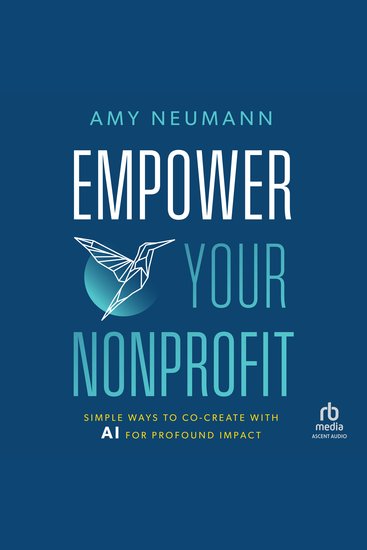
  • Empower Your Nonprofit - Simple Ways to Co-Create with AI for Profound Impact - cover

    Empower Your Nonprofit - Simple...

    Amy Neumann

    • 0
    • 0
    • 0
    Empower Your Nonprofit is a comprehensive, accessible, and highly practical guide to harnessing the power of emerging AI technologies in the nonprofit sector. This book delivers strategic research, tools, case studies, and advice to help nonprofits advance their missions through AI, with interviews, outlooks, testimonials, and quotes from nonprofit leaders and influencers in the AI industry delivering key insight to all listeners regardless of technical expertise. 


    Listeners will learn how to practically resolve the top ten most common nonprofit pain points through the utilization of AI, backed by current case studies of AI implementation for core nonprofit functions like fundraising, grants, marketing, and initiative event optimization. In this book, listeners will find information on the nonprofit sector's critical missions, success factors, challenges, and needs of today; AI as a way to automate inefficient internal processes, freeing talent to work on more inspired projects; and tools, tips, and tricks to get started with AI as soon as today. 


    Empower Your Nonprofit earns a well-deserved spot on the bookshelves of all nonprofit leaders and involved donors seeking a comprehensive step-by-step guidebook on how this exciting new technology can be leveraged for greater nonprofit success.
    Voir livre
  • Blockchain and Cryptocurrency for Beginners - A Beginner's Guide to the Future of Digital Finance Part 1 - cover

    Blockchain and Cryptocurrency...

    Simon Winston

    • 0
    • 0
    • 0
    "Blockchain and Cryptocurrency for Beginners: A Beginner's Guide to the Future of Digital Finance" 
    Are you intrigued by the world of digital finance but find the concepts of blockchain and cryptocurrency confusing? Fear not, for this comprehensive guide is here to demystify the complex terrain of blockchain technology and cryptocurrencies, making it accessible and understandable for beginners. 
    In this book, you will embark on a journey to unravel the revolutionary potential of blockchain technology and its most prominent offspring, cryptocurrency. From the fundamental building blocks of blockchain to the intricacies of cryptocurrency mining, trading, and investment, this guide covers it all. 
    Discover the inner workings of blockchain technology and learn how it has disrupted traditional financial systems. Dive into the fascinating history of Bitcoin, the first cryptocurrency, and explore the vast array of alternative digital currencies that have emerged since. Understand the crucial role of wallets and exchanges in managing and transacting cryptocurrencies securely. 
    Delve into the concept of smart contracts and decentralized applications (DApps), and explore the vast possibilities they present in transforming industries beyond finance. Uncover the strategies and tools of cryptocurrency trading and investment, whether you're seeking short-term gains or long-term portfolio management. 
    Security is of paramount importance in the crypto space, and this book provides essential insights into protecting your digital assets against scams, hacks, and privacy breaches. Gain a comprehensive understanding of the global regulatory landscape surrounding cryptocurrencies and explore the future trends that will shape the industry. 
    Get ready to unlock the mysteries of blockchain and embrace the potential of cryptocurrencies as you embark on this educational journey into the future of digital finance. 
      
     
    Voir livre
  • Orology - The Mountainous World - Understanding Earth's High Peaks - cover

    Orology - The Mountainous World...

    Mike Crawford

    • 0
    • 0
    • 0
    Mountains are among the most awe-inspiring features of the Earth's landscape, rising as towering peaks that shape weather patterns, influence ecosystems, and define the natural borders of continents. Their formation is a complex process driven by immense geological forces acting over millions of years. The primary mechanisms behind mountain building include tectonic activity, volcanic processes, and the gradual effects of erosion and uplift. 
    One of the most significant processes responsible for mountain formation is tectonic activity, particularly through folding and faulting. The Earth's crust is divided into massive plates that float atop the semi-molten mantle. When these plates collide, the immense pressure causes the crust to buckle and fold, resulting in the formation of fold mountains such as the Himalayas and the Alps. These ranges continue to rise as the plates press against each other, making them some of the youngest and most geologically active mountains in the world. Fault-block mountains, on the other hand, form when tectonic forces cause large sections of the Earth's crust to break and shift along faults. The Sierra Nevada in North America is an example of a fault-block mountain range created by the movement of these fractured rock masses. 
    Another major contributor to mountain formation is volcanic activity. When magma from beneath the Earth's surface erupts through cracks in the crust, it cools and solidifies, gradually building up into towering volcanic mountains. Over successive eruptions, these formations can grow into massive peaks such as Mount Fuji in Japan or Mount Kilimanjaro in Africa. Volcanic mountains can form along plate boundaries, particularly in subduction zones where one tectonic plate is forced beneath another, or in hotspot regions
    Voir livre