Join us on a literary world trip!
Add this book to bookshelf
Grey
Write a new comment Default profile 50px
Grey
Subscribe to read the full book or read the first pages for free!
All characters reduced
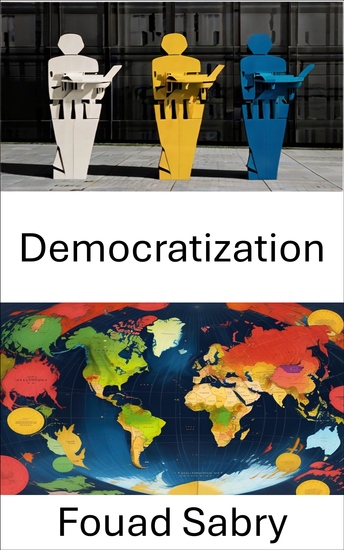
Democratization - Empowering the People Reshaping Power in a Changing World - cover

Democratization - Empowering the People Reshaping Power in a Changing World

Fouad Sabry

Publisher: One Billion Knowledgeable

  • 0
  • 0
  • 0

Summary

Understanding Democratization: A Key to the Modern Political Landscape
 
"Democratization" is an essential guide to grasping democratic transitions in today’s shifting global political landscape. This key text in the Political Science series explores how nations move from authoritarianism to democracy.
 
Chapter-by-Overview
 
- 1: Defines democratization and its core traits.- 2: Examines various democracy models and definitions.- 3 & 4: Contrast dictatorship and autocracy, providing context for democratic aspirations.- 5: Analyzes government structures and their impact on democracy.- 6: Investigates illiberal democracies that limit certain freedoms.
 
Theories and Transformations
 
- 7: Discusses Modernization Theory and its link to economic development and democracy.- 8 & 9: Engage with ideas from Barrington Moore Jr. and Adam Przeworski on democratization.- 10: Addresses challenges in consolidating new democracies.- 11: Introduces Dankwart Rustow’s framework for democratic transitions.- 12: Explores historical patterns of democratic expansion and decline.
 
Challenges and the Future
 
- 13: Unpacks the complexities of transitioning to democracy.- 14: Examines the role of external actors in promoting democracy.- 15: Provides insights into authoritarian regimes.- 16: Looks at coups and their impact on democratic governments.- 17: Discusses hybrid regimes that mix democratic and authoritarian elements.
 
The Book for Our Times
 
- 18: Investigates democratic backsliding and the erosion of democratic norms.- 19 & 20: Features Barbara Geddes’ work on how social structures influence regimes.- 21: Explores authoritarian enclaves within democracies.
 
"Democratization" helps you analyze current events, engage in discussions about democracy’s future, and understand the forces shaping today’s political landscape.
Available since: 08/01/2024.
Print length: 206 pages.

Other books that might interest you

  • Parents Who Bully - A Healing Guide for Adult Children of Immature Narcissistic and Authoritarian Parents - cover

    Parents Who Bully - A Healing...

    Eric Maisel, Dr. John Duffy

    • 0
    • 0
    • 0
    Uncover the truth about authoritarian parenting in Parents Who Bully. Through compelling real-life accounts and authoritative research, you'll gain invaluable insights into the signs of emotionally abusive parents. Understand the lasting impact of authoritarian parenting styles, and discover the path to healing and emotional freedom. This eye-opening book empowers you to confront the turmoil and scars caused by parental emotional abuse, offering a guide to recovery and personal transformation. 


    Are you ready to break free from the chains of the authoritarian personality? Parents Who Bully equips you with the tools to recognize and overcome the toxic dynamics of your family. With expert guidance, you'll learn how to deal with emotionally abusive parents, heal your emotional wounds, and ultimately find relief and empowerment. 


    In this book, you'll find: in-depth insights into emotionally abusive parents and their impact on adult children; authoritative research and real-life accounts that demonstrate the signs of toxic parenting styles; practical strategies to break free from bad parents and heal deep emotional wounds; and a comprehensive roadmap for understanding, recovery, and personal growth in the face of parental emotional abuse.
    Show book
  • Marcel Proust - A Very Short Introduction - cover

    Marcel Proust - A Very Short...

    Joshua Landy

    • 0
    • 0
    • 0
    100 years after Proust's death, In Search of Lost Time remains one of the greatest works in World Literature. At 3,000 pages, it can be intimidating to some. This short volume invites first-time readers and veterans alike to view the novel in a new way. 


    Marcel Proust (1871-1922) was arguably France's best-known literary writer. He was the author of stories, essays, translations, and a 3,000-page novel, In Search of Lost Time (1913-27). This book is a brief guide to Proust's magnum opus. 


    Joshua Landy shows why the questions Proust raises are important and exciting for all of us: how we can feel at home in the world; how we can find genuine connection with other human beings; how we can find enchantment in a world without God; how art can transform our lives; whether an artist's life can shed light on their work; what we can know about the world, other people, and ourselves; when not knowing is better than knowing; how sexual orientation affects questions of connection and identity; who we are, deep down; what memory tells us about our inner world; why it might be good to think of our life as a story; how we can feel like a single, unified person when we are torn apart by change and competing desires. Finally, Landy suggests why it's worthwhile to read the novel itself.
    Show book
  • Inca Empire The: An Enthralling Overview of the Incas Their Civilization in Ancient Peru and the Spanish Conquest - cover

    Inca Empire The: An Enthralling...

    Billy Wellman

    • 0
    • 0
    • 0
    Did you know that the Incas worshiped the mummies of their emperors? 
    For the Incas, death didn’t exist; it simply took the dead to a different plane of life. So, the mummies of their emperors were treated as people; they were given food and drink and even visited each other ceremoniously. They also owned country estates, which generated enough profits to keep them in the style to which they were accustomed. 
    This might sound like a curiosity, but this form of ancestor worship was central to the Inca culture and to the history of the Inca Empire, which stretched from Ecuador and Colombia in the north to Chile in the south. 
    Everyone has seen pictures of one of the Incas’ greatest achievements: the mountain-top wonder of Machu Picchu. But Inca history has always been told by the Spanish colonizers who conquered them since the Inca had no formal writing. Now, archaeology is giving us more information on how the Inca really lived, helping us differentiate real history from myth and propaganda. 
    In this audiobook, you will discover how the Inca created an expansive empire in just a century and why that civilization crumbled so fast once the Spanish arrived. 
    You’ll also discover the following:How the Inca civilization developed out of a number of preceding cultures in the Andes and Peruvian coast;How quickly the Incas were able to expand and why they needed to;How the empire was administered and how runners were able to take messages from one end of it to the other with remarkable speed;The amazing Inca infrastructure program, which included building roads through mountain ranges and across raging rivers;Why Inca cuisine included tasty guinea pigs and llama jerky;And so much more! 
    Scroll up and click the “add to cart” button to learn more about the fascinating Inca Empire!
    Show book
  • Max Schmeling: A short biography - 5 Minutes: Short on time – long on info! - cover

    Max Schmeling: A short biography...

    5 Minutes, 5 Minute Biographies,...

    • 0
    • 0
    • 0
    Max Schmeling, first German heavyweight world champion: Life and work in a short biography! Everything you need to know, brief and concise. Infotainment, education and entertainment at its best!
    Show book
  • The Public Purpose of Art - cover

    The Public Purpose of Art

    Arlene Goldbard

    • 0
    • 0
    • 0
    We’re on the cusp of a paradigm shift, a radical change in worldview that will thrust art and culture onto center stage. What does that mean? How will the world be different? What is the rising spirit of the times and how is it being expressed in art? Arlene Goldbard says, “I have this overwhelming image of energy gathering force and taking shape.” She likens this force to a wave and says, “No one masterminds a wave, ordering all the drops of water into line. Many independent forces operate simultaneously – wind, gravity, disturbances of all kinds – and somehow, the wave mounts.” In this dialogue we explore this mounting force and what’s opposing this rolling tide. (hosted by Justine Willis Toms)
    Show book
  • Tsarina Catherine the Great: A short biography - 5 Minutes: Short on time – long on info! - cover

    Tsarina Catherine the Great: A...

    5 Minutes, 5 Minute Biographies,...

    • 0
    • 0
    • 0
    Tsarina Catherine the Great, German-born ruler of Russia: Life and work in a short biography! Everything you need to know, brief and concise. Infotainment, education and entertainment at its best!
    Show book