Begleiten Sie uns auf eine literarische Weltreise!
Buch zum Bücherregal hinzufügen
Grey
Einen neuen Kommentar schreiben Default profile 50px
Grey
Jetzt das ganze Buch im Abo oder die ersten Seiten gratis lesen!
All characters reduced
Containment - Strategic Operations in Modern Warfare - cover

Containment - Strategic Operations in Modern Warfare

Fouad Sabry

Verlag: One Billion Knowledgeable

  • 0
  • 0
  • 0

Beschreibung

What is Containment
 
Containment was a geopolitical strategic foreign policy pursued by the United States during the Cold War to prevent the spread of communism after the end of World War II. The name was loosely related to the term cordon sanitaire, which was containment of the Soviet Union in the interwar period.
 
How you will benefit
 
(I) Insights, and validations about the following topics:
 
Chapter 1: Containment
 
Chapter 2: Domino theory
 
Chapter 3: Dean Acheson
 
Chapter 4: Truman Doctrine
 
Chapter 5: Reagan Doctrine
 
Chapter 6: Cold War
 
Chapter 7: John Lewis Gaddis
 
Chapter 8: George F. Kennan
 
Chapter 9: United States presidential doctrines
 
Chapter 10: NSC 68
 
(II) Answering the public top questions about containment.
 
Who this book is for
 
Professionals, undergraduate and graduate students, enthusiasts, hobbyists, and those who want to go beyond basic knowledge or information for any kind of Containment.
Verfügbar seit: 03.06.2024.
Drucklänge: 106 Seiten.
Weitere Bücher, die Sie mögen werden

  • The Software Engineer's Guidebook - Navigating senior tech lead and staff engineer positions at tech companies and startups - cover

    The Software Engineer's...

    Gergely Orosz

    • 0
    • 0
    • 0
    In my first few years as a developer I assumed that hard work was all I needed. Then I was passed over for a promotion and my manager couldn’t give me feedback on what areas to improve, so I could get to the senior engineer level. I was frustrated; even bitter: not as much about missing the promotion, but because of the lack of guidance. 
    By the time I became a manager, I was determined to support engineers reporting to me with the kind of feedback and support I wish I would have gotten years earlier. And I did. While my team tripled over the next two years, people became visibly better engineers, and this progression was clear from performance reviews and promotions. 
    This book is a summary of the advice I’ve given to software engineers over the years – and then some more. 
    This book follows the structure of a “typical” career path for a software engineer, from starting out as a fresh-faced software developer, through being a role model senior/lead, all the way to the staff/principle/distinguished level. It summarizes what I’ve learned as a developer and how I’ve approached coaching engineers at different stages of their careers. 
    We cover “soft” skills which become increasingly important as your seniority increases, and the “hard” parts of the job, like software engineering concepts and approaches which help you grow professionally. 
    Praise for the book 
    “From performance reviews to P95 latency, from team dynamics to testing, Gergely demystifies all aspects of a software career. This book is well named: it really does feel like the missing guidebook for the whole industry.” – Tanya Reilly, principal engineer and author of The Staff Engineer's Path 
    "Spanning a huge range of topics from technical to social in a concise manner, this belongs on the desk of any software engineer looking to grow their impact and their career." – James Stanier, Director of Engineering at Shopify
    Zum Buch
  • A Question of Standing - The History of the CIA - cover

    A Question of Standing - The...

    Rhodri Jeffreys-Jones

    • 0
    • 0
    • 0
    The mission of the CIA has always been intelligence. Seventy-five years ago, in the year of its creation, the National Security Act gave the agency, uniquely in world history up to that point, a democratic mandate to pursue that mission of intelligence. It gave the CIA a special standing in the conduct of United States foreign relations. That standing diminished when successive American presidents ordered the CIA to exceed its original mission. When they tasked the agency secretly to overthrow democratic governments, the United States lost its international standing, and its command of a majority in the United Nations General Assembly. Such dubious operations, even the government's embrace of assassination and torture, did not diminish the standing of the CIA in United States public opinion. However, domestic interventions did. CIA spying on domestic protesters led to tighter congressional oversight from the 1970s on. 


    A Question of Standing offers a balanced narrative and perspective on recognizable episodes in the CIA's history. Famous incidents include the Bay of Pigs invasion, the War on Terror, 9/11, the weapons of mass destruction deception, the Iran estimate of 2007, the assassination of Osama bin Laden, and Fake News. The book also defends the CIA's exposure of foreign meddling in United States elections.
    Zum Buch
  • AI In Education For A+ Success - Innovative and Practical Strategies for Teachers to Save Time Inspire Students of All Abilities and Transform Learning with Ethics and Insight - cover

    AI In Education For A+ Success -...

    M. D. Hooper

    • 0
    • 0
    • 0
    Discover the transformative power of AI in education: Enhance your teaching practices and inspire your students, even if you're not tech-savvy!It has become clear that our future classrooms will be shaped by AI, but for many educators, parents and students, this exciting change brings big questions and challenges.This comprehensive guide navigates the complexities of AI in education, equipping educators with practical strategies, real-world applications, and ethical considerations. Imagine yourself as a tech-savvy, innovative educator, transforming your students' learning experience with the positive power of Artificial Intelligence.Here's a peek of what you'll explore within this revolutionary book:* Step-by-step roadmap to seamlessly integrate AI into your existing curriculum, tailored to different age groups and subjects* Proven strategies to personalize learning for each student using AI* Exploration of ethical considerations and data privacy in AI use, with practical recommendations* Tips to overcome common technical hitches and get reliable support when you need it* Ideas to engage parents and the wider community in the value of AI assisted education* Inspirational case studies showcasing successful AI integration in diverse educational settings* Detailed discussion of how AI can assist with classroom management and administrative tasks* Cost-effective suggestions to help you implement AI tools in budget-constrained educational environments* Expert advice on how to foster student engagement with AI learning tools* Forecasts on the future of job markets and how AI can prepare your students* Methods to stay abreast of rapid AI advancements* Guidance on navigating the risks and challenges of AI in education and strategies to mitigate them* How AI can help students with special needs - the tools and the approach* Attention-grabbing techniques to assist with keeping up with rapid advancements of AI technology...and so much more!
    Zum Buch
  • In the Shadows of the Stars - Dark Space and the Fate of the Universe - cover

    In the Shadows of the Stars -...

    Dirk Fallon

    • 0
    • 0
    • 0
    The concept of the universe has captivated human curiosity for centuries, but what lies at its edge? The truth is that the edge of the universe is not defined by a physical boundary but by the limits of what we can observe and understand. Space stretches endlessly in every direction, but as we look farther and farther, the light from distant objects becomes increasingly redshifted, eventually disappearing beyond our ability to detect it. This phenomenon marks the boundary of the observable universe, a region from which light has had enough time to reach us since the beginning of the universe, around 13.8 billion years ago. 
    At the edge of the observable universe, we find a vast expanse of empty space, known as the "cosmic void." These regions contain few galaxies, stars, or other celestial objects, and their emptiness gives them an eerie and mysterious quality. The voids between galaxies are immense, sometimes stretching hundreds of millions of light-years across, and they represent one of the most puzzling aspects of cosmology. Why are these vast expanses of nothingness so prevalent? And what does it mean for the structure of the universe? 
    As we peer deeper into space, we encounter objects that have been traveling towards us for billions of years, their light providing a glimpse into the past. The most distant galaxies, discovered using advanced telescopes, show us the early universe as it was just a few hundred million years after the Big Bang. These galaxies offer valuable clues about the formation of stars, galaxies, and larger cosmic structures. However, the farther we look, the more difficult it becomes to see clearly. The expansion of the universe means that galaxies are moving away from us at an accelerating rate, causing their light to become increasingly stretched out, or redshifted. This makes them harder to detect and study, and the universe seems to grow darker the farther we look.
    Zum Buch
  • Computational Methods for Physicists - Using Numerical Techniques in Physics - cover

    Computational Methods for...

    Mark Hedges

    • 0
    • 0
    • 0
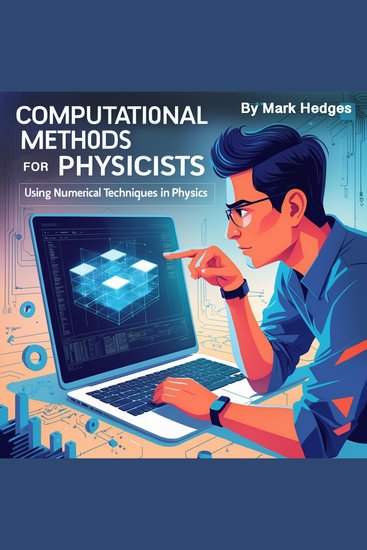
    Computational physics is a crucial branch of modern physics that utilizes numerical techniques and algorithms to solve complex physical problems. With the increasing complexity of theoretical models and the limitations of analytical solutions, computational methods have become an indispensable tool for physicists. From simulating quantum systems to modeling astrophysical phenomena, computation allows researchers to explore scenarios that are otherwise impractical or impossible to study experimentally. 
    One of the primary motivations for using computational techniques in physics is the ability to handle problems involving nonlinear equations, chaotic systems, or large datasets. Many physical equations, such as the Navier-Stokes equations in fluid dynamics or Schrödinger’s equation in quantum mechanics, lack closed-form analytical solutions. In such cases, numerical methods provide approximate but highly accurate solutions. Computational techniques also play a crucial role in experimental physics, where data analysis and simulations help interpret results and refine theoretical models. 
    Historically, computational physics emerged as a distinct discipline in the mid-20th century, with the advent of digital computers. Early physicists used numerical methods for simple problems, such as solving ordinary differential equations, but as computing power increased, so did the scope of applications. Today, computational physics is integrated with other scientific disciplines, including materials science, climate modeling, and biophysics, demonstrating its wide-ranging impact.
    Zum Buch
  • The Primacy of Doubt - From Quantum Physics to Climate Change How the Science of Uncertainty Can Help Us Understand Our Chaotic World - cover

    The Primacy of Doubt - From...

    Tim Palmer

    • 0
    • 0
    • 0
    Why does your weather app say “there’s a 10 percent chance of rain” instead of “it will be sunny”? In large part, this is due to the insight of award-winning physicist Tim Palmer, who pioneered the introduction of uncertainty into weather and climate prediction.  
    Now, he wants to apply it to how we study everything else. 
     
    In The Primacy of Doubt, Palmer gives us a revolutionary vision of mathematical uncertainty that provides new insights into a range of practical problems and some of the deepest questions in science and philosophy. He draws connections that are in equal parts unexpected  
    and fascinating: how ensemble forecasts can predict unpredictability, how the brain uses noise for creative thinking, how the geometry of chaos forces us to rewrite the laws of quantum mechanics, and in so doing reconciles determinism, free will, and moral responsibility.  
     
    A tour de force from a brilliant mind, The Primacy of Doubt shows that the fundamental law of the universe might just be to expect the unexpected.
    Zum Buch