Rejoignez-nous pour un voyage dans le monde des livres!
Ajouter ce livre à l'électronique
Grey
Ecrivez un nouveau commentaire Default profile 50px
Grey
Abonnez-vous pour lire le livre complet ou lisez les premières pages gratuitement!
All characters reduced
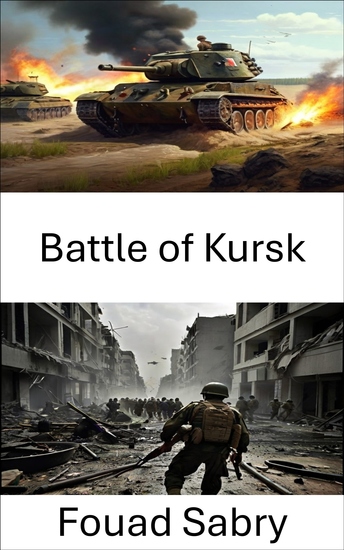
Battle of Kursk - Unleashing Steel The Clash That Shaped WWII's Eastern Front - cover

Battle of Kursk - Unleashing Steel The Clash That Shaped WWII's Eastern Front

Fouad Sabry

Maison d'édition: One Billion Knowledgeable

  • 0
  • 0
  • 0

Synopsis

What is Battle of Kursk
 
The Battle of Kursk was a major World War II Eastern Front battle between the forces of Germany and the Soviet Union near Kursk in southwestern Russia during the summer of 1943, resulting in a Soviet victory. The Battle of Kursk was the single largest battle in the history of warfare. It, along with the Battle of Stalingrad several months earlier, are the two most oft-cited turning points in the European theatre of the war. It was one of the costliest and fiercest battles of the entire Second World War, with it being the single deadliest armoured battle in history and the opening day of the battle, 5 July, being the single costliest day in the history of aerial warfare. The battle was also marked by fierce house-to-house fighting and hand-to-hand combat.
 
How you will benefit
 
(I) Insights, and validations about the following topics:
 
Chapter 1: Battle of Kursk
 
Chapter 2: Blitzkrieg
 
Chapter 3: Third Battle of Kharkov
 
Chapter 4: Operation Citadel
 
Chapter 5: Battle of Korsun-Cherkassy
 
Chapter 6: Operation Winter Storm
 
Chapter 7: Case Blue
 
Chapter 8: Lvov-Sandomierz offensive
 
Chapter 9: Battle of Debrecen
 
Chapter 10: Battle of Prokhorovka
 
(II) Answering the public top questions about battle of kursk.
 
Who this book is for
 
Professionals, undergraduate and graduate students, enthusiasts, hobbyists, and those who want to go beyond basic knowledge or information for any kind of Battle of Kursk.
Disponible depuis: 31/05/2024.
Longueur d'impression: 107 pages.
D'autres livres qui pourraient vous intéresser

  • Dad’s Book - cover

    Dad’s Book

    Beth Hindle

    • 0
    • 0
    • 0
    If you want to know how to live beyond the age of 99 with joy in your heart, then read this book. Share in the wisdom, stories, and adventures of a man living through the 20th century, who fought the Nazis first in Africa and then in Europe, never being able to return home in three 
    years.
     
    Born shortly after the First World War when peace was thought to be guaranteed, his exploits throughout his life rival any of today’s adventurers. This is also a story of a romance told in letters, the trials of a working-class family, and how friendships support us through the ups and downs of life. It’s a story of a seemingly ordinary man, the writer’s father, who did amazing things throughout his life.
     
    His history is all of our history. Why? Because the 20th Century with both its fantastic achievements and terrible destructive forces has shaped our today. How do we look back to the past to help us prepare for our unpredictable tomorrow? Answering that question is vital to us all. What can we learn from the past and his life to help our futures?
    Voir livre
  • One Ukrainian Summer - A memoir about falling in love and coming of age in the former USSR - cover

    One Ukrainian Summer - A memoir...

    Viv Groskop

    • 0
    • 0
    • 0
    'A memoir that captivates and delights. Fabulous' —Nina Stibbe 


    Autumn 1993. The former USSR. Viv is about to turn twenty-one and is on a study year abroad, supposedly immersed in the language, history, and politics of a world that has just ceased to exist: the Soviet Union. 


    Instead, she finds herself immersed in Bogdan Bogdanovich—the lead guitarist of a Ukrainian punk rock band. As the temperature drops, he promises that if she can get through the freezing Russian winter, he will give her "one Ukrainian summer." But is he serious about her? Or is she just another groupie? 


    At parties, gigs, and dive bars, Viv and her new friends argue over whose turn it is to buy cigarettes, the best places to find Levi's jeans and whether beer counts as a soft drink. No one debates the merits of speaking Ukrainian over Russian, the precise location of the border, or the undeniable brightness of the future. Of course good times are here to stay. Because the Soviet Union is finished. Isn't it? 


    A poignant and often comical account of coming-of-age in the time after the Cold War and before Putin, One Ukrainian Summer is a love letter to a unique moment in history.
    Voir livre
  • The Age of Absolutism - Kings and Queens of Power - cover

    The Age of Absolutism - Kings...

    Nova Ashford

    • 0
    • 0
    • 0
    The Age of Absolutism was a period in European history marked by the rise of powerful monarchs who sought to centralize authority and rule without interference. Spanning from the late 16th century to the early 19th century, this era saw kings and queens across Europe consolidate power, diminishing the influence of nobles, clergy, and representative bodies. At the heart of absolutism was the belief in the divine right of kings, the idea that monarchs were chosen by God and therefore answerable only to Him. This belief not only justified their rule but also placed them above challenge, reinforcing their ability to govern with near-unlimited power. 
    The roots of absolutism can be traced back to the political turmoil of the late medieval period. Feudalism had weakened, and as centralized states emerged, rulers sought to strengthen their authority. The Protestant Reformation further contributed to this shift, as religious conflicts created instability. Monarchs capitalized on these crises by presenting themselves as the ultimate unifying force within their realms. By controlling the military, bureaucracy, and economy, they ensured that no other institution could rival their power. 
    One of the most famous examples of an absolute monarch was Louis XIV of France, known as the "Sun King." His reign (1643–1715) epitomized absolutism. Louis XIV built the extravagant Palace of Versailles, a symbol of his dominance, and controlled every aspect of government. His declaration, "L'État, c'est moi" (I am the state), reflected his belief in total sovereignty. Similarly, Peter the Great of Russia modernized and expanded his empire, using absolute power to transform Russia into a formidable European force. Other rulers, like Philip II of Spain, Frederick the Great of Prussia, and Maria Theresa of Austria, also embraced absolutist policies to strengthen their nations.
    Voir livre
  • Napoleon Bonaparte - His Life Death and Revolutionary Wars - cover

    Napoleon Bonaparte - His Life...

    Kelly Mass

    • 0
    • 0
    • 0
    Undoubtedly, Napoleon, the French revolutionist and emperor, has left his mark on European history. His vast empire stretched all over the continent, his unique image and posture have been emulated by many, and his infamous defeat in Russia was a precursor of the defeat Hitler experienced for similar reasons. 
    When we take a time machine to the end of the 18th century and the beginning of the 19th century, how can we better understand the culture and ideas of those times? How did someone from the relatively tiny island of Corsica become such an iconic figure in history? 
    In this comprehensive guide, we will take a look at some of the greatest achievements of Napoleon Bonaparte, as well as his virtues and vices, personal background, politics, exile, and death. You will gain a greater comprehension of his motives, the problems he faced, and how he solved said problems in his own way.
    Voir livre
  • The Archaeology of Loss - Life love and the art of dying - cover

    The Archaeology of Loss - Life...

    Sarah Tarlow

    • 0
    • 0
    • 0
    My whole adult life, I have made a study of death.A stunning blend of the personal and professional, The Archaeology of Loss is Sarah Tarlow’s first memoir. An accomplished archaeologist, much of Sarah’s work is concerned with the ritual and belief behind the practice of grief. In 2012, she was awarded the Chair in Archaeology at the University of Leicester. But in the years that followed this appointment, Sarah’s husband, Mark, would begin to suffer from a progressive but undiagnosed illness, finally resulting in his inability to drive, to walk, to taste or to care for himself. Though Sarah had devoted her professional life to the study of emotion, of how we anticipate and experience grief, nothing could have prepared her for the realities of care-giving, of losing someone you love and the helplessness attached to both.A fiercely honest and unique memoir, The Archaeology of Loss describes a collective experience with an unflinching and singular gaze and will undoubtedly speak to listeners of The Salt Path and H is for Hawk. Told with humour, intelligence and urgency, this is an unforgettable experience.
    Voir livre
  • Hitler's Girl - The British Aristocracy and the Third Reich on the Eve of WWII - cover

    Hitler's Girl - The British...

    Lauren Young

    • 0
    • 0
    • 0
    A timely, riveting book that presents for the first time an alternative history of 1930s Britain, revealing how prominent fascist sympathizers nearly succeeded in overturning British democracy—using the past as a road map to navigate the complexities of today’s turn toward authoritarianism. 
    Hitler’s Girl is a groundbreaking history that reveals how, in the 1930s, authoritarianism nearly took hold in Great Britain as it did in Italy and Germany. Drawing on recently declassified intelligence files, Lauren Young details the pervasiveness of Nazi sympathies among the British aristocracy, as significant factions of the upper class methodically pursued an actively pro-German agenda. She reveals how these aristocrats formed a murky Fifth Column to Nazi Germany, which depended on the complacence and complicity of the English to topple its proud and long-standing democratic tradition—and very nearly succeeded. 
    As she highlights the parallels to our similarly treacherous time, Young exposes the involvement of secret organizations like the Right Club, which counted the Duke of Wellington among its influential members; the Cliveden Set, which ran a shadow foreign policy in support of Hitler; and the shocking four-year affair between socialite Unity Mitford and Adolf Hitler. 
    Eye-opening and instructive, Hitler’s Girl re-evaluates 1930s England to help us understand our own vulnerabilities and poses urgent questions we must face to protect our freedom. At what point does complacency become complicity, posing real risk to the democratic norms that we take for granted? Will democracy again succeed—and will it require a similarly cataclysmic event like World War II to ensure its survival? Will we, in our own defining moment, stand up for democratic values—or will we succumb to political extremism? 
    Supplemental enhancement PDF accompanies the audiobook.
    Voir livre