Begleiten Sie uns auf eine literarische Weltreise!
Buch zum Bücherregal hinzufügen
Grey
Einen neuen Kommentar schreiben Default profile 50px
Grey
Jetzt das ganze Buch im Abo oder die ersten Seiten gratis lesen!
All characters reduced
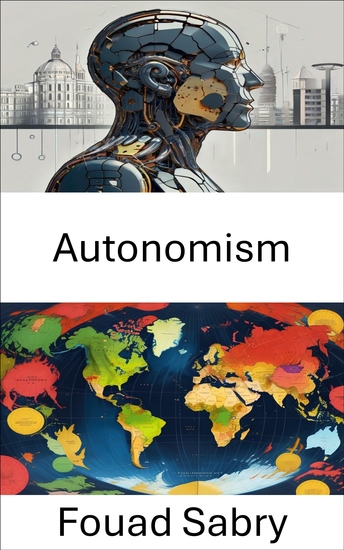
Autonomism - Radical Movements and Democratic Futures - cover

Autonomism - Radical Movements and Democratic Futures

Fouad Sabry

Verlag: One Billion Knowledgeable

  • 0
  • 0
  • 0

Beschreibung

Dive into "Autonomism," a comprehensive guide exploring its evolution and impact in Political Science. This book examines autonomous Marxist thought, highlighting its significant influence on worker self-organization and resistance to conventional capitalist structures.
 
1-Autonomism-Understand the core principles of Autonomism, its historical context, and its break from traditional Marxism.
 
2-Antonio Negri-Explore Antonio Negri's challenge to established ideas of power and resistance in modern capitalism.
 
3-Michael Hardt-Delve into Michael Hardt's work, especially "Empire," and its redefinition of global governance.
 
4-Workerism-Examine Workerism’s roots within Autonomism, focusing on labor empowerment through direct action.
 
5-Empire (Hardt and Negri book)-Analyze the concept of Empire and its impact on understanding global capitalism and resistance.
 
6-Multitude-Understand the idea of multitude, a key concept in Autonomism challenging traditional class notions.
 
7-Potere Operaio-Survey Potere Operaio’s influence, known for its radical approach to worker autonomy.
 
8-John Holloway (sociologist)-Consider Holloway's theories on change and resistance, aligning with Autonomism’s prefigurative politics.
 
9-Autonomia Operaia-Explore Autonomia Operaia’s history, advocating worker autonomy and direct action in Italy.
 
10-Prefigurative politics-Examine prefigurative politics, promoting future societal ideals through present actions.
 
11-Infoshop-Discover Infoshops’ role in spreading radical ideas, reflecting Autonomism’s grassroots knowledge sharing.
 
12-Indiani Metropolitani-Investigate Indiani Metropolitani, focusing on marginalized urban communities and their resistance strategies.
 
13-Paolo Virno-Explore Paolo Virno’s theories on immaterial labor and work's evolving nature in post-industrial societies.
 
14-Marxist schools of thought-Survey Marxist schools and their intersections with Autonomism, highlighting key theoretical debates.
 
15-Raniero Panzieri-Analyze Raniero Panzieri’s contributions, particularly his theories on capitalist development and class roles.
 
16-Mario Tronti-Examine Mario Tronti’s ideas on capitalist restructuring and working-class autonomy in Autonomism.
 
17-Left communism-Discuss Left Communism's principles and its relationship with Autonomism, critiquing centralized authority.
 
18-Post-Marxism-Explore Post-Marxism’s influence on autonomy and resistance in Autonomism's theoretical developments.
 
19-Immaterial labor-Investigate immaterial labor in Autonomism, examining its implications for contemporary exploitation.
 
20-Quaderni Rossi-Trace the legacy of Quaderni Rossi, a key publication in Autonomist thought, analyzing class and capitalism.
 
21-Classe Operaia-Examine Classe Operaia’s transformation in Autonomism, exploring its relevance in modern social movements.
 
This book is essential for professionals, students, and enthusiasts alike. Each provides focused insights, collectively offering a thorough understanding of Autonomism's enduring impact on political discourse and action.
Verfügbar seit: 15.08.2024.
Drucklänge: 152 Seiten.

Weitere Bücher, die Sie mögen werden

  • Korea - A New History of South and North - cover

    Korea - A New History of South...

    Victor Cha, Ramon Pacheco Pardo

    • 0
    • 0
    • 0
    A major new history of North and South Korea, from the late nineteenth century to the present day 


    Korea has a long, riveting history—it is also a divided nation. South Korea is a vibrant democracy, the tenth largest economy, and is home to a world-renowned culture. North Korea is ruled by the most authoritarian regime in the world, a poor country in a rich region, and is best known for the cult of personality surrounding the ruling Kim family. But both Koreas share a unique common history. 


    Victor Cha and Ramon Pacheco Pardo draw on decades of research to explore the history of modern Korea, from the late nineteenth century, Japanese occupation, and Cold War division to the present day. A small country caught amongst the world's largest powers—including China, Japan, Russia, and the United States—Korea's fate has been closely connected to its geography and the strength of its leadership and society. This comprehensive history sheds light on the evolving identities of the two Koreas, explaining the sharp differences between North and South, and prospects for unification.
    Zum Buch
  • A Better Nation - The Challenges of Scottish Independence - cover

    A Better Nation - The Challenges...

    Simon Barrow, Gerry Hassan

    • 0
    • 0
    • 0
    ­­­As the battle of words over the future of Scotland as a democracy, nation and society continues, A Better Nation: The Challenges of Scottish Independence aims to go beyond the superficial divisions and media noise in order to address matters of real substance. Drawing on a range of original thinkers from a wide range of backgrounds, it tackles key issues about money, culture, equality, energy, borders, jobs, Europe and other 'big questions' head on.
    
    A Better Nation illustrates the high stakes in this debate, as well as the opportunities it affords. Outlining political approaches which are respectful of different views, doubts and ambiguities, it asks what kind of society we want to create and how we want to govern ourselves. The nature of the British state and Scottish democracy, the need to tackle inequalities, the challenges of centre-left politics, the climate emergency and the pressing need for a wellbeing economy are put at the heart of the discussion about independence.
    
    Contributors include:
    Ciaran Martin, Roz Foyer, Paul Mason, Gavin Esler, Joyce McMillan, John Curtice, Dani Garavelli, David Clark, Tanja Bueltmann, Malcolm Chalmers, Kirsty Hughes, John Kay, Lisa Clark, Colin Kidd, Hannah Graham, Paul Sweeney and many others.
    Zum Buch
  • Moscow State University Address - cover

    Moscow State University Address

    Ronald Reagan

    • 0
    • 0
    • 0
    On May 31, 1988, at the request of General Secretary Mikhail Gorbachev, and standing below a bust of Lenin, Reagan spoke to and answered questions from a large audience of students and teachers at Moscow State University.  
    Reagan says “I wish you success” in Russian to the students on their upcoming exams. Reagan brings “a message of peace and good will and hope for a growing friendship and closeness between our two peoples.”  
    An information revolution is sweeping the globe that will transform our lives with robots, genetic coding, spacecraft, and other technologies. The key to progress is economic freedom. Entrepreneurs with the courage to take risks “are responsible for almost all the economic growth in the United States.”  
    The Republic of Korea, Singapore, Taiwan, India, and China are seeing the power of economic freedom. Freedom “is the continuing revolution of the marketplace.”  
    Nations “must renounce, once and for all, the right to an expansionist foreign policy.” “People do not make wars; governments do.” “Americans seek always to make friends of old antagonists”, for example, Britain, Germany, and Japan.  
    Nothing would please me more than to see “a growing, exuberant, exporting Soviet Union that had opened up to economic freedom”. In this Moscow spring of May 1988, we hope for a new world of reconciliation, freedom, and peace. 
    Following the speech, Reagan fields questions from the audience on a variety of topics: the START ballistic missile treaty, how young people have changed since he was a student, conflicts in Namibia and Nicaragua, the return of missing Soviet soldiers from Afghanistan, what’s unique about the U.S. Constitution, Reagan’s speaking plan on the mashed-potato circuit after retiring, American Indians, and Soviet dissidents. 
    Audio recording courtesy of the Ronald Reagan Presidential Library. 
    AspenLeafMedia.com
    Zum Buch
  • The Conquest of Bread - cover

    The Conquest of Bread

    Peter Kropotkin

    • 0
    • 0
    • 0
    The Conquest of Bread  is an 1892 book by the Russian anarcho-communist Peter Kropotkin.
    Peter Kropotkin was born a Russian prince whose father owned 1,200 serfs. But he became  a Russian activist, writer, revolutionary, scientist, economist, sociologist, historian, essayist, researcher, political scientist, biologist, geographer  and philosopher.
    The Conquest of Bread has become a classic of political anarchist literature. It was heavily influential on both the Spanish Civil War and the Occupy movement.
    In the work, Kropotkin goes on to propose a more decentralized economic system based on mutual aid and voluntary cooperation, asserting that the tendencies for this kind of organization already exist, both in evolution and in human society.
    Zum Buch
  • Congressional Tyranny: How Lawmakers Became Kings - cover

    Congressional Tyranny: How...

    A.A. Castor

    • 0
    • 0
    • 0
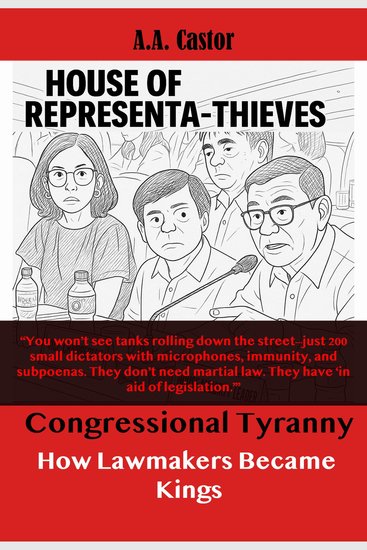
    What if the real dictators never wore military uniforms—but barongs and lapel pins? 
    In Congressional Tyranny, A.A. Castor pulls back the velvet curtain on one of the most dangerous illusions in modern Philippine democracy: that power resides in the President. With razor-sharp satire and sobering analysis, this book explores how lawmakers have quietly transformed themselves from representatives into rulers—armed not with guns, but with gavels, budgets, and contempt powers. 
    From weaponized budget hearings to backdoor appointments, media manipulation, and the jailing of critics without due process, Castor dissects how Congress has become the country's most powerful, unaccountable institution. With chapters like "Tyranny by Default" and "The Budget Becomes a Weapon," this book shines a light on the quiet coup happening under the guise of public service. 
    Congressional Tyranny is not a conspiracy theory—it's a mirror held up to a system designed to protect itself. A must-read for anyone who still believes that the greatest threat to democracy comes from above, when in truth, it may already be seated in session.
    Zum Buch
  • Liberalism - Individual Liberty and the Modern State - cover

    Liberalism - Individual Liberty...

    Hector Davidson

    • 0
    • 0
    • 0
    Liberalism is a political and philosophical ideology rooted in the principles of individual liberty, equality, and limited government. At its core, liberalism emphasizes the autonomy of the individual, arguing that each person has the right to pursue their own life and happiness, free from unnecessary interference by the state or society. Emerging in the Enlightenment period, liberalism challenged the traditional structures of monarchies and feudal systems, advocating for the rights of the individual and the importance of reason, tolerance, and democratic participation. 
    The roots of liberal thought can be traced back to the works of early modern philosophers such as John Locke, whose ideas on natural rights and government by consent laid the foundation for liberal political theory. Locke’s assertion that individuals possess inherent rights to life, liberty, and property formed the basis for much of liberal thought, influencing the development of constitutionalism and democratic governance. Over time, thinkers like Montesquieu, Rousseau, and later John Stuart Mill contributed to the evolution of liberalism, expanding its focus to issues of civil liberties, political freedoms, and social equality. 
    A defining characteristic of liberalism is its emphasis on individual freedom. This includes both personal liberty—the freedom to make choices about one’s own life—and political liberty—the right to participate in the democratic process and have a say in the laws and policies that govern society. Classical liberals advocated for minimal government interference in the economy and individual affairs, emphasizing free markets, private property, and limited state power. The role of the state, in this view, is to protect the rights of individuals and maintain social order, but not to intervene in the private lives or economic transactions of citizens.
    Zum Buch