Rejoignez-nous pour un voyage dans le monde des livres!
Ajouter ce livre à l'électronique
Grey
Ecrivez un nouveau commentaire Default profile 50px
Grey
Abonnez-vous pour lire le livre complet ou lisez les premières pages gratuitement!
All characters reduced
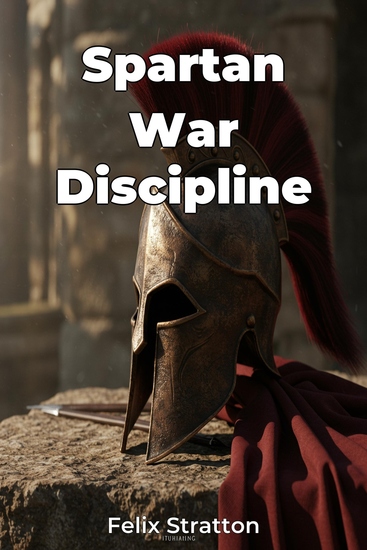
Spartan War Discipline - cover

Spartan War Discipline

Felix Stratton

Traducteur A AI

Maison d'édition: Publifye

  • 0
  • 0
  • 0

Synopsis

Spartan War Discipline explores how Sparta, despite its small population, dominated ancient Greek battlefields for centuries. This was achieved through a rigorous system of military training known as the "agoge" and a unique social structure that emphasized unwavering discipline and unit cohesion. The book highlights that Spartan military success wasn't just about combat skills but also about deeply ingrained values and societal expectations that shaped every aspect of a Spartan citizen's life.

 
The book examines the historical context of Sparta, including its political system and economic foundations, before delving into the "agoge." It uncovers how continuous drills and shared hardships fostered absolute obedience and transformed Spartan boys into formidable soldiers. The analysis extends to Spartan battle tactics and command structures, demonstrating how these elements were integrated with the social and psychological foundations established through the "agoge."

 
The book progresses by first establishing Sparta's historical and social context, then dissecting the "agoge" and finally analyzing Spartan battle tactics. By drawing on ancient texts and archaeological evidence, Spartan War Discipline challenges traditional views by emphasizing the critical role of social conditioning in shaping their military capabilities and offers insights into leadership, discipline, and social cohesion that underpinned their success.
Disponible depuis: 03/05/2025.
Longueur d'impression: 51 pages.


D'autres livres qui pourraient vous intéresser

  • Life As Dance: The Lost Wisdom of Ralph Waldo Emerson - cover

    Life As Dance: The Lost Wisdom...

    Ralph Waldo Emerson

    • 0
    • 0
    • 0
    Ralph Waldo Emerson was an American essayist, lecturer, philosopher, abolitionist, and poet who led the transcendentalist movement of the mid19th century. He was seen as a champion of individualism and a prescient critic of the countervailing pressures of society, and his ideology was disseminated through dozens of published essays and more than 1,500 public lectures across the United States. 
      
    Emerson gradually moved away from the religious and social beliefs of his contemporaries, formulating and expressing the philosophy of transcendentalism in his 1836 essay "Nature". Following this work, he gave a speech entitled "The American Scholar" in 1837, which Oliver Wendell Holmes Sr. considered to be America's "intellectual Declaration of Independence." 
      
    Emerson wrote most of his important essays as lectures first and then revised them for print. His first two collections of essays, Essays: First Series and Essays: Second Series, represent the core of his thinking. They include the well-known essays "SelfReliance", "The OverSoul", "Circles", "The Poet", and "Experience." Together with "Nature", these essays made the decade from the mid1830s to the mid1840s Emerson's most fertile period. Emerson wrote on a number of subjects, never espousing fixed philosophical tenets, but developing certain ideas such as individuality, freedom, the ability for mankind to realize almost anything, and the relationship between the soul and the surrounding world. Emerson's "nature" was more philosophical than naturalistic: "Philosophically considered, the universe is composed of Nature and the Soul." Emerson is one of several figures who "took a more pantheist approach by rejecting views of God as separate from the world."
    Voir livre
  • Dang Dang Doko Dang - The Sound of the Empty Drum - cover

    Dang Dang Doko Dang - The Sound...

    Osho

    • 0
    • 0
    • 0
    Osho sees Zen not as a historical spiritual tradition but as the future spirituality of a humanity that has matured to the point that people no longer need religions controlled by priesthoods and based on fearful superstitions that cripple people's innate intelligence and divide them from one another.
    This series of talks offers a deeper understanding of the underlying differences between Eastern and Western approaches to religion and the nature of consciousness. It's a beautiful introduction to a world where each individual has the capacity for an instant and profound understanding of existence and a rebirth of the trust in life that each of us is born with.
    Dang Dang Doko Dang represents the sound of the drum beaten by a Zen master in an existential lesson for a disciple. As well as symbolizing the poetic quality of Zen, the title represents the special flavor of this collection of Osho's commentaries on well-known Zen stories. This volume is part of the Osho Classics series and also includes Osho's responses to questions about the meditation technique of Zazen.
    
    - Freedom Is To Know That Which Is
    - Existence Flows In and Out of You
    - Only the Center Can Win
    - Understanding Is More Than Enough
    - Nothing Changes a Man Except Awareness
    - Joy Is the Criterion
    - Not Knowing Is the Beginning of Zazen
    - You Are Already There
    - The Nondual Has Come
    - Happiness Is Always Herenow
    © & ℗ 1976 OSHO International Foundation
    Voir livre
  • Perfume: The Story of a Murderer by Patrick Süskind (Book Analysis) - Detailed Summary Analysis and Reading Guide - cover

    Perfume: The Story of a Murderer...

    Bright Summaries

    • 0
    • 0
    • 0
    Unlock the more straightforward side of Perfume: The Story of a Murderer with this concise and insightful summary and analysis!This engaging summary presents an analysis of Perfume: The Story of a Murderer by Patrick Süskind, which follows the life of Jean-Baptiste Grenouille, who is shunned and rejected by society in spite of his incredible talent as a perfume-maker. What no one knows is that his own sense of smell is supernaturally acute – and that he is willing to go to any lengths necessary to create the perfect fragrance. Perfume: The Story of a Murderer is an internationally acclaimed bestseller which has been translated into more than 40 languages and was adapted into a film starring Ben Whishaw in 2006. In addition to penning several novels, Patrick Süskind has also worked as a screenwriter for a number of television seriesFind out everything you need to know about Perfume: The Story of a Murderer in a fraction of the time!This in-depth and informative reading guide brings you:• A complete plot summary• Character studies• Key themes and symbols• Questions for further reflectionWhy choose BrightSummaries.com?Available in print and digital format, our publications are designed to accompany you in your reading journey. The clear and concise style makes for easy understanding, providing the perfect opportunity to improve your literary knowledge in no time.See the very best of literature in a whole new light with BrightSummaries.com!
    Voir livre
  • Why I Care: And why care matters - cover

    Why I Care: And why care matters

    Sir Ed Davey

    • 0
    • 0
    • 0
    A deeply personal account of life as a carer and a call to support those who care for others 
    'Ed Davey wants to rewrite British politics – not with the language of crisis, but that of care. … He offers something rare – moral clarity rooted in lived experience.' Guardian 
    'Caring is how we know we’re alive. 
    The good in all of us has been shaped by care. Hold a mirror up to that, and we’ll realise our potential.' 
    Care is the thread that runs through Ed’s life. Aged only four, Ed lost his father. When his mother also became ill with cancer, Ed and his brothers nursed her at home until she died when Ed was just 15. That formative experience was one of the main inspirations in seeking election, and with it the opportunity to take action. Now, he and his wife care for their son John, who has severe physical and learning disabilities, as well as raising their younger daughter. So Ed has real knowledge of the emotional, physical and financial challenges faced by legions of carers in Britain today. 
    Why I Care is both a deeply personal story, drawing on Ed’s own experiences, and a book that reflects the stories of people everywhere to offer a vision of change. Shedding light on the often-invisible world of carers, he calls for society, our government and our institutions to recognise, support, and lift up the silent carers who form the backbone of our communities. 
    This isn’t just Ed’s story. It's the story of millions. 
    In Why I Care, Sir Ed Davey, a prominent political figure, delves into the pressing issues of health and welfare in our society. His autobiography is not just a personal narrative, but a call to action for policy changes and better public services. 
    nan 
    HarperCollins 2025
    Voir livre
  • The Grammar of Self - Collected Poems 2000-2023 - cover

    The Grammar of Self - Collected...

    George Watt

    • 0
    • 0
    • 0
    In THE GRAMMAR OF SELF, George Watt presents a lifetime of memories, which seemingly move at random from decade to decade, from continent to continent, from cosmos to microcosm. It does have one central goal: to look at poetry as an attempt towards objectification of aspects of personal identity, as a means through which the self may be confronted, challenged and celebrated. But the volume of verse does more than that as it subscribes to a notion from Thomas Szasz about the self: it is “not something that one finds. It is something that one creates.” (T.S. Szasz, The Second Sin (New York: Anchor Press, 1973, p. 49.) This volume accepts that the poetic text, or multiples thereof, is one means through which a self finds articulation. This articulation is open-ended, chaotic, composed of innumerable experiential fragments that come from deed, time, place and person. The self in this volume is composed of psychic jigsaw pieces (single poems) each of which assert their right to placement, but which will never collate into a perfect picture. This volume of poetry is a collection of many of these pieces, which together present an incomplete movement towards Szaszian self-creation.
    Voir livre
  • The Boys of the Dark - A Story of Betrayal and Redemption in the Deep South - cover

    The Boys of the Dark - A Story...

    Robin Gaby Fisher, Michael...

    • 0
    • 0
    • 0
    The harrowing true story of the abuses two boys suffered at a Florida reform school and how they came together fifty years later to confront their attackers. 
     
    “[The Boys of the Dark] reads seamlessly… . . . A worthy exploration of a regrettably long-lasting true-crime nightmare.” —Kirkus Reviews 
     
    Michael O’McCarthy and Robert W. Straley were teens when they were termed “incorrigible youth” by authorities and ordered to attend the Florida School for Boys. They discovered in Marianna, the “City of Southern Charm,” an immaculately groomed campus that looked more like an idyllic university than a reform school. But hidden behind the gates of the Florida School for Boys was a hell unlike any they could have imagined. The school’s guards and administrators acted as their jailers and tormentors. The boys allegedly bore witness to assault, rape, and possibly even murder. 
     
    For fifty years, both men—and countless others like them—carried their torment in silence. But a series of unlikely events brought O’McCarthy, now a successful rights activist, and Straley together, and they became determined to expose the Florida School for Boys for what they believed it to be: a youth prison with a century-long history of abuse. They embarked upon a campaign that would change their lives and inspire others. 
     
    Robin Gaby Fisher, a Pulitzer Prize–winning journalist and author of the New York Times–bestselling After the Fire, collaborates with Straley and O’McCarthy to offer a riveting account of their harrowing ordeal. The book goes beyond the story of the two men to expose the truth about a century-old institution and a town that adopted a Nuremberg-like code of secrecy and a government that failed to address its own wrongdoing. What emerges is a tale of strength, resolve, and vindication in the face of the kinds of terror few can imagine. 
     
    “Haunting and disturbing. The voices of the victims will forever touch my heart. To turn a deaf ear to this type of injustice is to give permission for it to continue. As a people, as a society, we should be outraged.” —Jennifer Thompson, coauthor of Picking Cotton 
     
    “This deeply moving story is highly recommended to readers of heart-wrenching memoirs, 20th-century American studies, or true crime.” —Library Journal
    Voir livre