Begleiten Sie uns auf eine literarische Weltreise!
Buch zum Bücherregal hinzufügen
Grey
Einen neuen Kommentar schreiben Default profile 50px
Grey
Jetzt das ganze Buch im Abo oder die ersten Seiten gratis lesen!
All characters reduced
Persian Gardens - cover

Persian Gardens

Everett Sinclair

Übersetzer A AI

Verlag: Publifye

  • 0
  • 0
  • 0

Beschreibung

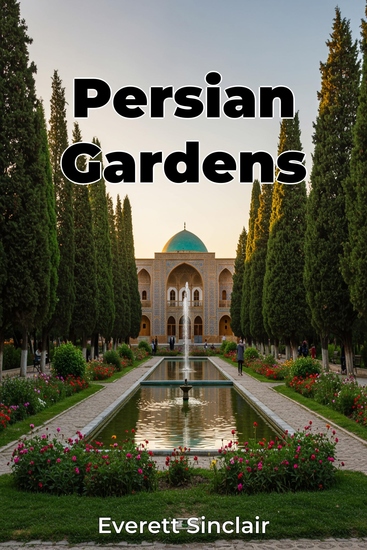
Persian Gardens explores the rich history and profound influence of these meticulously designed landscapes, revealing them as earthly representations of paradise. Persian Gardens, originating in ancient Persia, are more than just beautiful spaces; they are cultural statements reflecting power, faith, and identity.

 
Intriguingly, these gardens often incorporate the charbagh layout, a four-part design symbolizing the Zoroastrian elements of water, earth, fire, and air, demonstrating a deep connection to ancient beliefs.

 
The book progresses from the core design principles to specific examples across historical periods, examining their evolution and adaptation. It then delves into the symbolism and cultural significance of these gardens, drawing from textual and archaeological evidence.

 
Ultimately, Persian Gardens traces their impact on global garden design, particularly in Islamic and European traditions. By combining architectural analysis with cultural history, the book offers a unique perspective on these historical landscapes.
Verfügbar seit: 29.03.2025.
Drucklänge: 56 Seiten.

Weitere Bücher, die Sie mögen werden

  • Dirty Linen - The Troubles In My Home Place - cover

    Dirty Linen - The Troubles In My...

    Martin Doyle

    • 0
    • 0
    • 0
    Martin Doyle, Books Editor of The Irish Times, offers a personal, intimate history of the Troubles seen through the microcosm of a single rural parish, his own, part of both the Linen Triangle – heartland of the North’s defining industry – and the Murder Triangle – the Badlands roamed by the Glenanne gang of security forces colluding with loyalist paramilarites. He lifts the veil of silence drawn over the horrors of the past, recording in heartrending detail the terrible toll the conflict took – more than 20 violent deaths in a few square miles – and the long tail of trauma it has left behind. He also conveys the texture of the times, the high streets where cars could not be left unattended, the newsflashes, the constant background buzz of threat and fear. 
    Neighbours and classmates who lost loved ones in the conflict, survivors maimed in bomb attacks and victims of sectarianism, both Catholic and Protestant, entrust him with their stories. Doyle marries his local knowledge with a literary sensibility and skilfully shows how the once dominant local linen industry serves as a metaphor for both communal division but also the solidarity that transcended the sectarian divide. 
    To those who might ask why you would want to reopen old wounds, the answer might be that some wounds have never been allowed to heal. It is by sharing our stories that we build a ridge of common ground from which good things can grow.
    Zum Buch
  • Practice the Pause - Jesus' Contemplative Practice New Brain Science and What It Means to Be Fully Human - cover

    Practice the Pause - Jesus'...

    Caroline Oakes

    • 0
    • 0
    • 0
    These days, many of us live in a state of overreactive fight-or-flight response and chronic stress. The demands of modern life pull us in all directions and can often put the meaningful connections in our lives at risk—connections to our deepest selves, to others, and even to God. 


    But there is good news. New developments in brain science have recently proven that an intentional practice of pausing for a few minutes of meditation, prayer, or other contemplative practice actually rewires our brain in ways that make us calmer, less reactive, and better able to see the bigger picture. 


    In Practice the Pause, spiritual director and writer Caroline Oakes offers easy-to-understand explanations of how this new brain science is confirming what every spiritual tradition has been telling us for millennia: by practicing the pause, we become more self-aware and better able to understand others. We become more "God aware." With a refreshing focus on the Eastern Christian understanding of Jesus as a master of wisdom, Oakes shines a spotlight on Jesus's own centering pause practice as a transformative path for personal and social change. We learn that even a seven-second pause practice can move us beyond the fight-or-flight responses of our ego in our daily lives and actually equip us to cultivate the common good in the world.
    Zum Buch
  • Vampire Boys - True Tales from Operators of the RAF's First Single-Engined Jet - cover

    Vampire Boys - True Tales from...

    Charlotte Bailey

    • 0
    • 0
    • 0
    Sliding out of the shadows of World War Two, the de Havilland Vampire—accompanied by the distinctive whine of its Goblin engine—quickly proved itself an effective alternative to piston-powered fighters. After entering operational service with the RAF (as the service's first single-engine jet) in 1946, the Vampire—sought by air forces the world over—held a number of notable records: the first fighter to exceed 500 mph, the first to set a world altitude record of almost 60,000 feet, the first jet to take off and land from an aircraft carrier, and the first jet to cross the Atlantic Ocean. Not bad for something built partly of wood. Throughout this book, the "Vampire Boys" bring to life the trials and tribulations of operating a first-generation jet across the globe. Through their insightful anecdotes and exceptional experiences, listeners can follow squadrons across the dusty deserts of Iraq to exercises in West Germany. First-hand tales of training, aerial handling, incidents and accidents (including the much-maligned spin characteristics) and squadron life bring together a portrait of a pioneering time in aviation advancement, right up to the present day with the T.11 still flying from Coventry Airport.
    Zum Buch
  • The Enneagram of the Soul - A 40-Day Spiritual Companion for the 9 Types - cover

    The Enneagram of the Soul - A...

    Nhien Vuong

    • 0
    • 0
    • 0
    A guide to your spiritual journey of transformation using the Enneagram.   “The Enneagram of the Soul invites us on a journey of profound self-discovery.” —from the foreword by Russ Hudson, bestselling coauthor of The Wisdom of the Enneagram  The Enneagram of the Soul is inspired by over two decades of inner and outer work with the Enneagram by leading expert Nhien Vuong. Nhien provides a path to wholeness for the self, enabling the reader to be steered gently yet firmly away from the trap of solely identifying with their personality type, so they can live more fully from their divine nature.   This book is divided into two parts. Part 1 shares nine Enneagram-informed principles that guide one’s journey of transformation using the Enneagram, nine contemplative practices to propel and support the transformational process, and nine prayers to lend heart to the journey. Part 2 offers forty activations, which consist of very brief questions, reminders, or practices on forty different themes customized for each of the nine Enneagram personality types. When we begin to access the wholeness of all nine Enneagram energies working in concert, we experience a greater sense of inner peace, purpose, and fulfillment.   “An important and uniquely useful contribution to the Enneagram literature in that she provides a pathway for the types, built around practices and principles.” —Beatrice Chestnut, author of The Enneagram Guide to Waking Up
    Zum Buch
  • Journeys of Robert Monroe - Out-of-Body Explorer Consciousness Pioneer and Traveler of the Invisible World - cover

    Journeys of Robert Monroe -...

    Ronald Russell

    • 0
    • 0
    • 0
    The life story of Robert Monroe, consciousness pioneer, bestselling author, self-made millionaire, and out-of-body traveler.Robert Monroe was a towering figure in twentieth-century consciousness research, yet his story is mostly unknown. The boy who loved adventure and exploration, fast cars and rickety aircraft, became a millionaire through writing and producing radio shows in New York City. And then, at age forty-two, he found himself traveling out of body, having no idea what was happening to him.Journeys of Robert Monroe chronicles how Monroe became an iconoclast with his work in the consciousness world—making out-of-body experience (OBE) and astral travel household expressions. Monroe not only helped others understand this state of being, but through his research on binaural beats and his development of the technology known as Hemi-Sync, he made the OBE accessible through programs at the Monroe Institute. Attended by thousands of people each year, his institute used technology to create frequencies that helped people with everything from meditation and learning to curing insomnia, quitting smoking, and pain control.Journeys of Robert Monroe reveals his contribution to the understanding of human consciousness. Yet his legacies, as UC Davis psychology professor emeritus Charles Tart once said, “are not just a great gift to knowledge, but a real service to people who are plagued by doubts and unfulfilled spiritual longings.” His was a true hero’s journey.
    Zum Buch
  • After the Broken Spears - The Aztecs in the Wake of Conquest - cover

    After the Broken Spears - The...

    Camilla Townsend, Josh Anthony

    • 0
    • 0
    • 0
    Following Hernando Cortés's conquest of Tenochtitlan in 1521, the Aztec empire became the center of the largest European colony in the Americas. It has long been assumed that Indigenous people's personal experiences of this cataclysmic era are inaccessible. Spanish records do not reflect how Nahuas and other Indigenous peoples spoke privately about the great changes, and accounts written in Indigenous languages mostly date from the latter half of the sixteenth century.Through close readings of Nahuatl sources, the contributors to After the Broken Spears illustrate that records of Indigenous experiences of the early colonial period are both more abundant than first appear and more richly detailed than ever imagined. Nahuatl songs, annals, tall tales, and legal documents offer a comprehensive vision of how Mexico's Indigenous people lived through the years after the conquest and negotiated the creation of their new world. Often originally circulated as oral accounts, these stories were later copied into Nahuatl script by those determined to preserve their people's history. Interspersed between the main chapters are commentaries written by contemporary Indigenous Mexican scholars, highlighting how historical themes relate to the present day. Just as their ancestors did five hundred years ago, these writers negotiate the ramifications of the Spanish conquest for their communities. After the Broken Spears offers fresh perspectives on a critical transition period in Mesoamerican, Mexican, and colonial history.
    Zum Buch