Join us on a literary world trip!
Add this book to bookshelf
Grey
Write a new comment Default profile 50px
Grey
Subscribe to read the full book or read the first pages for free!
All characters reduced
Indigenous Engineering - cover

Indigenous Engineering

Everett Sinclair

Translator A AI

Publisher: Publifye

  • 0
  • 0
  • 0

Summary

"Indigenous Engineering" explores the often-overlooked ingenuity of ancient civilizations, highlighting their contributions to architecture, transportation, and water management. It argues that understanding these early innovations is crucial for a comprehensive view of engineering history and offers valuable lessons for contemporary sustainable design. The book examines architectural marvels like Mesoamerican pyramids, explores sophisticated transportation networks such as the Inca road system, and investigates ingenious irrigation methods like terraced farming.

 
The book is structured to first introduce the fundamental concepts of indigenous engineering and its significance in a historical context. Subsequent chapters delve into specific case studies, examining the architectural, transportation, and irrigation systems of selected indigenous cultures.

 
What sets this book apart is its focus on the engineering principles embedded within indigenous practices, moving beyond a purely historical or anthropological perspective. It analyzes these innovations through the lens of modern engineering, revealing the underlying scientific and mathematical principles at play.
Available since: 03/29/2025.
Print length: 65 pages.

Other books that might interest you

  • Gentlemen of the Shade: My Own Private Idaho - cover

    Gentlemen of the Shade: My Own...

    Jen Sookfong Lee

    • 0
    • 0
    • 0
    Gus Van Sant’s film and the ’90s cult of the alternative Gus Van Sant’s 1991 indie darling My Own Private Idaho perplexed and provoked, inspiring a new ethos for a new decade: being different was better than being good. Gentlemen of the Shade examines how the film was a coming-of-age for a generation of young people who would embrace the alternative and bring their outsider perspectives to sustainability, technology, gender constructs, and social responsibility. My Own Private Idaho ― fragmented and saturated with colour and dirt and a painfully beautiful masculinity ― also crept into popular media, and its influence can still be traced. R.E.M. Portlandia. Hipsterism. James Franco. Referencing the often-funny and sometimes-tragic cultural touchstones of the past 26 years, Gentlemen of the Shade sets the film as social bellwether for the many outsiders who were looking to join the right, or any, revolution.
    Show book
  • The Lost Family - How DNA Testing Is Upending Who We Are - cover

    The Lost Family - How DNA...

    Libby Copeland

    • 0
    • 1
    • 0
    “A fascinating exploration of the mysteries ignited by DNA genealogy testing—from the intensely personal and concrete to the existential and unsolvable.” —Tana French, New York Times–bestselling author  
     
    You swab your cheek or spit in a vial, then send it away to a lab somewhere. Weeks later you get a report that might tell you where your ancestors came from or if you carry certain genetic risks. Or, the report could reveal a long-buried family secret that upends your entire sense of identity. Soon a lark becomes an obsession, a relentless drive to find answers to questions at the core of your being, like “Who am I?” and “Where did I come from?” Welcome to the age of home genetic testing. 
     
    In The Lost Family, journalist Libby Copeland investigates what happens when we embark on a vast social experiment with little understanding of the ramifications. She explores the culture of genealogy buffs, the science of DNA, and the business of companies like Ancestry and 23andMe, all while tracing the story of one woman, her unusual results, and a relentless methodical drive for answers that becomes a thoroughly modern genetic detective story. Gripping and masterfully told, The Lost Family is a spectacular book on a big, timely subject. 
     
    “An urgently necessary, powerful book that addresses one of the most complex social and bioethical issues of our time.” —Dani Shapiro, New York Times–bestselling author 
     
    “Before you spit in that vial, read this book.” —The New York Times Book Review 
     
    “Impeccably researched . . . up-to-the-minute science meets the philosophy of identity in a poignant, engaging debut.” —Kirkus Reviews (starred review)
    Show book
  • Alternative History of Britain An - The War of the Roses - cover

    Alternative History of Britain...

    Timothy Venning

    • 0
    • 0
    • 0
    Timothy Venning's exploration of the alternative paths that British history might easily have taken moves on to the Wars of the Roses. What if Richard of York had not given battle in vain? How would a victory for Warwick the Kingmaker at the Battle of Barnet changed the course of the struggle for power? What if the Princes had escaped from the tower or the Stanleys had not betrayed their king at Bosworth? These are just a few of the fascinating questions posed by this book. 


    As always, while necessarily speculative, Dr. Venning discusses all the scenarios within the benefit of a deep understanding of the major driving forces, tensions, and trends that shaped British history. In so doing, he helps the listener to understand why things panned out as they did, as well as what might have been in this tumultuous period.
    Show book
  • How to Master Academic Writing - From Critical Thinking to Scholarly Excellence - cover

    How to Master Academic Writing -...

    Ranjot Singh Chahal

    • 0
    • 0
    • 0
    This audiobook is narrated by an AI Voice. In How to Master Academic Writing: From Critical Thinking to Scholarly Excellence, author Ranjot Singh Chahal presents a comprehensive and practical guide to help students, researchers, and professionals develop the skills needed to write with clarity, confidence, and academic integrity. This book breaks down the complex world of academic writing into clear, manageable steps—from understanding structure and style to crafting persuasive arguments and mastering research-based writing. Whether you’re writing your first essay or preparing a research paper, this guide equips you with the tools to communicate your ideas effectively and thoughtfully. 
     
    Drawing upon years of experience in education and research, Chahal emphasizes the importance of critical thinking, organization, and academic tone as the pillars of scholarly success. Each chapter guides readers through essential elements such as developing a strong thesis statement, building coherent paragraphs, integrating sources effectively, and refining one’s academic voice. Practical tips, examples, and step-by-step exercises make the book both a learning companion and a self-study manual for anyone aiming to elevate their academic writing skills. 
     
    Ultimately, this book isn’t just about writing—it’s about transforming the way you think, reason, and present knowledge. How to Master Academic Writing encourages readers to see writing as a process of discovery, reflection, and intellectual growth. Whether you’re a student aiming for higher grades or a scholar striving for publication, this book will inspire you to write with purpose, precision, and scholarly excellence.
    Show book
  • Highland Legends - The Wolf of Badenoch and the Moray Flood - cover

    Highland Legends - The Wolf of...

    Thomas Dick Lauder

    • 0
    • 0
    • 0
    Legends and traditions of the Scottish Highlands: the wolf of Badenoch, the ghosts of the Findhorn, the second sight, and the great Moray floods of 1829, which the author had witnessed. Thomas Dick Lauder was a Morayshire laird and a naturalist as well as a storyteller. The tales are told as a proprietor's local knowledge rather than as folklore. Sixty plates of painting, from Jacopo di Cione to John William Waterhouse, gather the shrines, saints and crowned Virgins that haunt these tales of Highland faith and flood.
    Show book
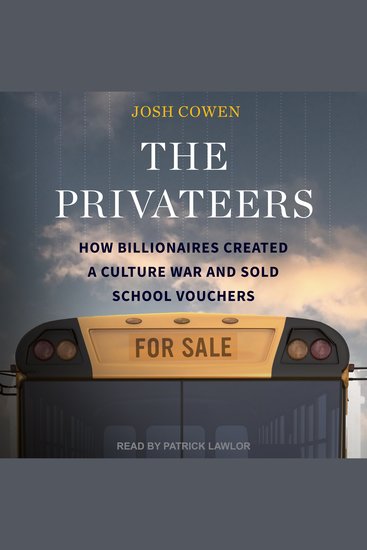
  • The Privateers - How Billionaires Created a Culture War and Sold School Vouchers - cover

    The Privateers - How...

    Josh Cowen

    • 0
    • 0
    • 0
    A deep-dive investigation of education privatization that reveals voucher programs as the faulty products of decades of work by wealthy patrons and influential conservatives 


    This thought-provoking work traces the origins of voucher-based education reform to mid-twentieth-century fears over school desegregation. It shows how, in the intervening decades, a cabal of billionaire conservatives supporting a host of special political interests—including economic libertarianism, religious choice, and parental rights—have converged around the issue of education freedom in an ongoing culture war. Through deliberate policymaking, legislation, and litigation, Cowen reveals, an insular advocacy network has enacted a flawed system for education finance driven largely by dogma. 


    Far from realizing the purported goal of educational equity, privatization is failing students and exacerbating income inequality, Cowen finds. He cites multiple research studies that conclude that voucher programs return poorer academic outcomes, including lower test scores on state exams, especially among students who are at greater academic risk because of their race, their religion, their gender identity, or their family's income. Continued advancement of these policies, Cowen argues, is an assault on public education as a defining American institution.
    Show book