Begleiten Sie uns auf eine literarische Weltreise!
Buch zum Bücherregal hinzufügen
Grey
Einen neuen Kommentar schreiben Default profile 50px
Grey
Jetzt das ganze Buch im Abo oder die ersten Seiten gratis lesen!
All characters reduced
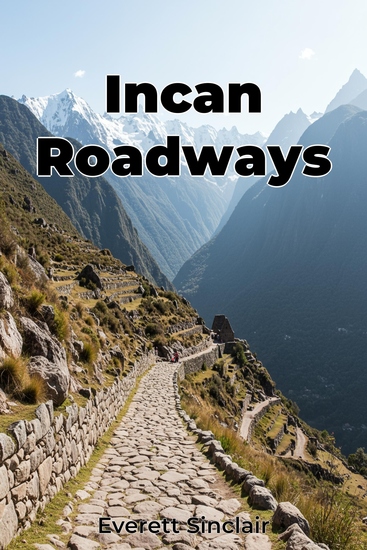
Incan Roadways - cover

Incan Roadways

Everett Sinclair

Übersetzer A AI

Verlag: Publifye

  • 0
  • 0
  • 0

Beschreibung

Incan Roadways explores the intricate road system of the Inca Empire and its critical role in the empire's success. More than just pathways, these roads facilitated political control, economic exchange, and cultural dissemination across the vast and diverse Andean landscape. The book highlights the sophisticated engineering of the Qhapaq Ñan, showcasing innovative solutions like suspension bridges and carved staircases that conquered formidable geographical barriers. Readers will discover how the roads were integral to the Inca's ability to manage resources, communicate efficiently through relay runners, and maintain social order. The book examines the Incan road system's impact on the empire's economy and culture, demonstrating how the roads enabled the movement of goods, the spread of Inca culture, and the integration of diverse populations. By drawing on archaeological evidence and historical accounts, the book reconstructs the history and function of these remarkable roadways, presenting a nuanced view of Inca achievements and limitations. The book progresses from detailing the engineering principles to exploring the administrative and logistical systems that sustained the road network, offering a comprehensive understanding of this ancient infrastructure.
Verfügbar seit: 29.03.2025.
Drucklänge: 57 Seiten.
Weitere Bücher, die Sie mögen werden

  • Soviet Union - cover

    Soviet Union

    Kelly Mass

    • 0
    • 0
    • 0
    From 1922 till 1991, the Soviet Union, officially the Union of Soviet Socialist Republics (USSR), was a socialist state that covered Europe and Asia. It was in theory a federal union of different sovereign republics; but, till its closing years, its administration and economy were highly centralized.The Bolsheviks, led by Vladimir Lenin, ousted the Provisional Federal government that had formerly toppled the Russian Empire's Romanov family in the October Revolution of 1917, bring to life the Soviet Union. They established the Russian Soviet Republic, the world's first socialist state with a constitution. Stress between the Bolshevik Red Army and some anti-Bolshevik forces across the previous Empire emerged into a civil war, with the White Guard being the most effective faction. The White Horror was a period of violent anti-communist repression by the White Defend Against the Bolsheviks and believed worker and peasant Bolsheviks. Through Red Horror, the Red Army extended and helped regional Bolsheviks in acquiring power, building soviets, and penalizing political challengers and defiant peasants. By 1922, the power balance had moved, and the Bolsheviks had thrived, unifying the Russian, Transcaucasian, Ukrainian, and Byelorussian republics to form the Soviet Union. After the civil war ended, Lenin's administration carried out The New Economic Policy, which led to a partial return of the free enterprise and personal property, and also a period of financial healing.Joseph Stalin rose to power after Lenin's death in the year 1924. Within the Communist Party, Stalin got rid of any political resistance to his rule and developed a command economy. As a consequence, the nation went through a period of quick industrialization and pushed collectivization, which led to great financial development but also a manufactured starvation in the year 1932-- 1933 and the growth of the Gulag labor camp system.
    Zum Buch
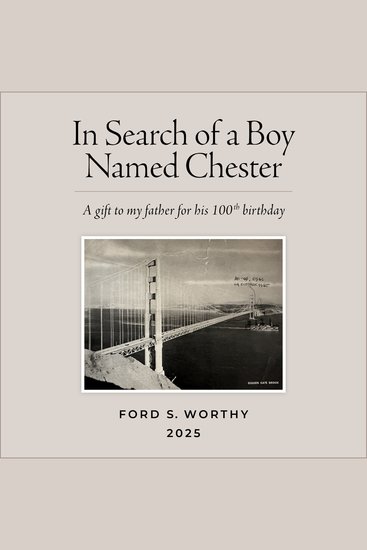
  • In Search of a Boy Named Chester - A gift to my father for his 100th birthday - cover

    In Search of a Boy Named Chester...

    Ford S. Worthy

    • 0
    • 0
    • 0
    Shortly after the end of World War II, a 21-year-old Navy officer – just back after a year at war in the Pacific – was eager to return to his small hometown in eastern North Carolina for a brief home leave. At the San Francisco airport, a mother travelling to Omaha offered him her seat – a patriotic gesture of gratitude, he believed. There was one condition: the sailor would need to accompany her 10-year-old son and see him safely to his grandmother in Omaha. 
    The boy’s name was Chester. The sailor never forgot him. 
    Nearly 80 years later, the sailor’s son sets out to give his father a special 100th birthday gift: to discover what became of that precocious boy. 
    The book blends memoir, investigative nonfiction, and family history into a poignant and suspenseful journey. Through letters, military records, census and newspaper archives and outreach to strangers-turned-allies, the author pieces together the life of a boy nearly lost to time. Along the way, the story explores themes of memory, intergenerational connection, and the lasting impact of wartime experiences. Rich in historical detail and emotional resonance, the book will appeal to readers of narrative nonfiction, World War II history, and family sagas, and to genealogical sleuths drawn to real-life mysteries. In Search of a Boy Named Chester is a story that shows us how even the most fleeting encounters can reveal who we are and who we may become.
    Zum Buch
  • Who Owns England?: How We Lost Our Green and Pleasant Land and How to Take It Back - cover

    Who Owns England?: How We Lost...

    Guy Shrubsole

    • 0
    • 0
    • 0
    ‘A formidable, brave and important book’ Robert Macfarlane 
    ‘Absolutely brilliant…You cannot read this book and defend the establishment’ Alastair Campbell, The Rest is Politics 
    Who owns England? 
    Behind this simple question lies this country’s oldest and best-kept secret. This is the history of how England’s elite came to own our land, and an inspiring manifesto for how to open up our countryside once more.  
    This book has been a long time coming. Since 1086, in fact. For centuries, England’s elite have covered up how they got their hands on millions of acres of our land, by constructing walls, burying surveys and more recently, sheltering behind offshore shell companies. But with the dawn of digital mapping and the Freedom of Information Act, it’s becoming increasingly difficult for them to hide. 
    Trespassing through tightly-guarded country estates, ecologically ravaged grouse moors and empty Mayfair mansions, writer and activist Guy Shrubsole has used these 21st century tools to uncover a wealth of never-before-seen information about the people who own our land, to create the most comprehensive map of land ownership in England that has ever been made public. 
    From secret military islands to tunnels deep beneath London, Shrubsole unearths truths concealed since the Domesday Book about who is really in charge of this country – at a time when Brexit is meant to be returning sovereignty to the people. Melding history, politics and polemic, he vividly demonstrates how taking control of land ownership is key to tackling everything from the housing crisis to climate change – and even halting the erosion of our very democracy. 
    It’s time to expose the truth about who owns England – and finally take back our green and pleasant land. 
    *Guy's next book The Lie of the Land is out now* 
    As a Sunday Times bestselling author, Guy Shrubsole delves into the political and environmental aspects of land ownership in England, shedding light on the conservation and protection policies that have been kept hidden for centuries. His expertise in urban planning and law, combined with his passion for nature and science, makes this book a top choice for those interested in understanding the architecture of power in Britain. 
    For fans of Robin Wall Kimmerer (The Serviceberry), Robert Macfarlane (Desert Solitaire), Chloe Dalton (Raising Hare), Manchán Magan (Thirty-Two Words for Field), and Yanis Varoufakis (Technofeudalism).
    Zum Buch
  • The Erich Fromm Reader - cover

    The Erich Fromm Reader

    Erich Fromm

    • 0
    • 0
    • 0
    "Fromm crossed the boundaries of traditional disciplines to expound his view on the alienation of man in an increasingly technological world." —Newsweek 


    Erich Fromm's basic idea was to look at the individual as a social being, and to look at society as an ensemble of many individuals who have not only mutual ideas and convictions based on a common practice of life, but also a shared psychic structure. With his concept of "social character," Fromm created a new interdisciplinary thinking presented in this compendium. 


    The Erich Fromm Reader exhibits the true genius of an original thinker in seeing the connections between overlapping knowledge from many different fields. Here, interdisciplinarity is not only a lip service but the impact of Erich Fromm's unique social psychological notion.
    Zum Buch
  • Veto Message Regarding the Bank of the United States - cover

    Veto Message Regarding the Bank...

    Andrew Jackson

    • 0
    • 0
    • 0
    In 1832, President Jackson vetoed a bill that aimed to renew a charter for the US Bank. He issued this message to accompany the rejection in which he explained his controversial decision. He believed the bank held too much power, and that “It is easy to conceive that great evils to our country and its institutions might flow from such a concentration of power in the hands of a few men irresponsible to the people.” While some saw this decision a dictator-like act, others saw it as a spark of hope for the poor.  
    Zum Buch
  • Lincoln in the Black Hawk War - cover

    Lincoln in the Black Hawk War

    Alfred Augustus Jackson

    • 0
    • 0
    • 0
    A Dusty Tomes Audio BookIn Cooperation with Spoken Realms 
    Lincoln in the Black Hawk War by Alfred Augustus Jackson. Collections of the State Historical Society of Wisconsin Volume XIV edited and annotated by Reuben Gold Thwaites.  
    Narrated by Joseph TablerNote - This book is ‘read as written'. It was published in 1898. It is in the public domain. 
    Dusty Tomes Audio Books are public domain writings retrieved from the ravages of time; Available as never before, as audio books, for your edification, pleasure, and consideration.
    Zum Buch