Rejoignez-nous pour un voyage dans le monde des livres!
Ajouter ce livre à l'électronique
Grey
Ecrivez un nouveau commentaire Default profile 50px
Grey
Abonnez-vous pour lire le livre complet ou lisez les premières pages gratuitement!
All characters reduced
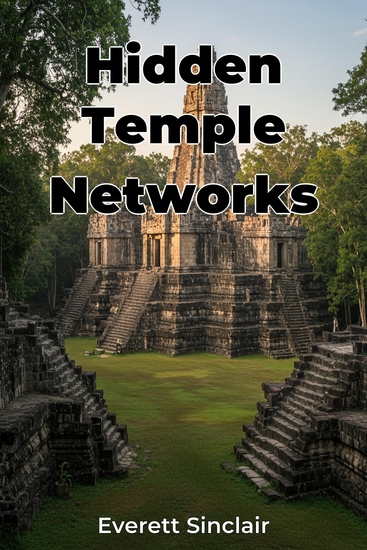
Hidden Temple Networks - cover

Hidden Temple Networks

Everett Sinclair

Traducteur A Ai

Maison d'édition: Publifye

  • 0
  • 0
  • 0

Synopsis

"Hidden Temple Networks" unveils the fascinating interconnectedness of ancient temple complexes, revealing them not as isolated structures but as vital networks shaping past societies. These temple networks, often featuring subterranean passageways, served as conduits for religious processions, knowledge dissemination, and cultural exchange. The book explores how architecture, history, and religious practices intertwined within these physical spaces, reinforcing the social and spiritual order of ancient civilizations.

 
By examining temple networks across diverse cultures, including Mesoamerica and Southeast Asia, the book uncovers the deliberate design behind these complexes. It demonstrates how their layouts and construction techniques embodied cosmological beliefs and power structures, reflecting a universal human impulse to create sacred spaces. The book challenges conventional interpretations by emphasizing the interconnectedness of these sacred spaces, offering a comprehensive understanding of ancient cultures from an Art History, Religious Studies, and Anthropology perspective.

 
The book progresses by first introducing the concept of temple networks, then focusing on specific geographical regions to analyze architectural features, symbolic elements, and historical context. This approach, drawing on archaeological evidence and historical texts, highlights the significance of these networks in understanding ancient civilizations.

 
The book uniquely emphasizes the interconnectedness of temple complexes, providing a more holistic view of ancient cultures.
Disponible depuis: 04/03/2025.
Longueur d'impression: 86 pages.

D'autres livres qui pourraient vous intéresser

  • 30 Days to Reparent your Inner Child - Heal your Childhood Trauma Transform your Attachment Style and Build Secure Loving Relationships - cover

    30 Days to Reparent your Inner...

    Dr. S Girish Kumar, Jyotsna...

    • 0
    • 0
    • 0
    Heal Your Inner Child, Break Free from the Past and Build Secure Relationships That Last  
    Your 30-Day Guided Journey to Reparenting, Emotional Freedom and Inner Peace 
    Still caught in patterns of anxiety, fear of abandonment, or low self-worth even as an adult? 
    Do your relationships leave you feeling unseen, unloved, or unworthy no matter how much you give? 
    Tired of overthinking, people-pleasing, or clinging to partners who do not meet your needs? 
    You are not broken. You are wounded. And healing is absolutely possible. 
    Inside This Book, You Will Discover:What anxious attachment is and how to shift toward a secure, empowered connection styleHow to identify and heal childhood wounds behind fear of rejection, abandonment, or criticismTools for emotional regulation to stay calm and grounded during moments of stress or conflictSelf-compassion exercises that release guilt, shame, and self-blame for true self-acceptanceA clear, day-by-day healing process that makes progress simple and sustainablePowerful affirmations, reflection prompts, and somatic tools to build inner safety 
    If you are ready to stop repeating old patterns, release the fear of abandonment, and feel emotionally secure from within... 
    Scroll up and click "Buy Now" to begin your 30-day reparenting journey with your companion workbook by your side.
    Voir livre
  • The Democracy We Must Keep - Seven Founders Nine Documents and the Ideas That Shaped America - cover

    The Democracy We Must Keep -...

    Sean Pratt, David O. Stewart

    • 0
    • 0
    • 0
    "A great scholar of the American past, David O. Stewart has brilliantly mined what has come before to guide us in our own, all-too-urgent American present. An important and timely volume." ~ Jon Meacham, Pulitzer Prize-winning author of The American Struggle
    What did America's founders say about democracy—and can we remain true to their vision for America?
     Two hundred fifty years ago, passionate men attempted to create something the world had never seen before: a nation built not on kings or armies, but on ideas where the people ruled.
     In The Democracy We Must Keep, historian David O. Stewart takes readers inside the nine key documents that shaped the formation of the United States—from Patrick Henry's thunderous cry for liberty to the carefully crafted design of a government chosen by the people, with limits on all officials holding power under the Constitution.
     Through the words of seven visionary founders—Washington, Jefferson, Madison, Hamilton, Gouverneur Morris, and others—Stewart shows how a fragile experiment in self-government took shape.
     These men were not saints. They argued passionately. They worried that the new nation might fall apart. Yet together, they forged the principles that must still define American democracy.
    
    - That power must be limited.
    - That leaders must answer to the people.
    - That individual rights must be protected by law.
     As the United States celebrates its 250th anniversary, The Democracy We Must Keep urges readers to rediscover core ideas that built the nation—and to consider what it will take to protect them.
     Accessible, engaging, and timely, this book is for anyone who wants to understand how American democracy started, and why it still matters.
    NOTE: This recording contains the complete narrative text. Appendix documents are available in the print and ebook editions.
     "The American experiment was built through action based upon the ideas preserved in our founding documents. In this compelling call to engage with our past to secure our future, David Stewart shows that democracy is not a spectator sport, but a responsibility each generation must uphold." ~ Colleen Shogan, 11th Archivist of the United States, CEO of In Pursuit
     "In The Democracy We Must Keep, noted historian David O. Stewart provides an inspiring antidote to America's current dangers of one-man rule and unprincipled government. Alarmed citizens can do no better than read Stewart's compact account of how America's flame of liberty was kindled, and how we must restore it." ~ James McGrath Morris is a New York Times best-selling biographer and author of Pulitzer: A Life in Politics, Print, and Power
    "The cause of America is...the cause of all mankind," the pamphleteer Tom Paine wrote in 1776. Grappling with very human sins and flaws, Americans have led the cause of freedom from Valley Forge to Omaha Beach, and promoted human rights from Seneca Falls to Selma. But now a deviant strain of oppression stalks America: What better moment for David O. Stewart, jurist and historian, to bring us The Democracy We Must Keep, a crisp and eloquent reminder of our better selves. "Only a few generations have been granted the role of defending freedom in its hour of maximum danger," John F. Kennedy said. "I do not shrink from this responsibility, I welcome it." So does Stewart, and in his books we find the energy, the faith and the devotion that Kennedy called for. The trumpet summons us again and Stewart, to our good fortune, is a virtuoso. ~ John A. Farrell, Author of Richard Nixon: The Life, Pulitzer Prize finalist
    Voir livre
  • Laughter in Ancient Rome - on Joking Tickling and Cracking Up - cover

    Laughter in Ancient Rome - on...

    Mary Beard

    • 0
    • 0
    • 0
    What made the Romans laugh? Was ancient Rome a carnival, filled with practical jokes and hearty chuckles? Or was it a carefully regulated culture in which the uncontrollable excess of laughter was a force to fear—a world of wit, irony, and knowing smiles? How did Romans make sense of laughter? What role did it play in the world of the law courts, the imperial palace, or the spectacles of the arena? 


    Laughter in Ancient Rome explores one of the most intriguing, but also trickiest, of historical subjects. Drawing on a wide range of Roman writing—from essays on rhetoric to a surviving Roman joke book—Mary Beard tracks down the giggles, smirks, and guffaws of the ancient Romans themselves. From ancient "monkey business" to the role of a chuckle in a culture of tyranny, she explores Roman humor from the hilarious, to the momentous, to the surprising. But she also reflects on even bigger historical questions. What kind of history of laughter can we possibly tell? Can we ever really "get" the Romans' jokes?
    Voir livre
  • ADHD Women - A Holistic Approach To ADHD Management - cover

    ADHD Women - A Holistic Approach...

    Ellen Davis

    • 0
    • 0
    • 0
    ★ ★ ★ Discover a life-changing audiobook that empowers ADHD women to take control and thrive. Based on Ellen's personal journey of overcoming undiagnosed and misdiagnosed ADHD, this audiobook is a transformative resource. ★ ★ ★ 
    Ellen's story resonates with countless women who have struggled silently with ADHD. Now, she shares her insights and techniques for regaining control over the mind and life. Drawing from personal exploration, she offers a holistic approach that goes beyond formal diagnosis and medication. 
    "ADHD Women: A Holistic Approach to ADHD Management" explores diverse methods, from nutrition to communication skills and professional success. It addresses all aspects of life, providing a comprehensive resource for women with ADHD, regardless of social class, profession, age, or lifestyle. 
    With this audiobook, ADHD women can reclaim their minds and embrace healthier, happier lives. Take the first step towards empowerment and order your copy today!
    Voir livre
  • Inca Empire The: An Enthralling Overview of the Incas Their Civilization in Ancient Peru and the Spanish Conquest - cover

    Inca Empire The: An Enthralling...

    Billy Wellman

    • 0
    • 0
    • 0
    Did you know that the Incas worshiped the mummies of their emperors? 
    For the Incas, death didn’t exist; it simply took the dead to a different plane of life. So, the mummies of their emperors were treated as people; they were given food and drink and even visited each other ceremoniously. They also owned country estates, which generated enough profits to keep them in the style to which they were accustomed. 
    This might sound like a curiosity, but this form of ancestor worship was central to the Inca culture and to the history of the Inca Empire, which stretched from Ecuador and Colombia in the north to Chile in the south. 
    Everyone has seen pictures of one of the Incas’ greatest achievements: the mountain-top wonder of Machu Picchu. But Inca history has always been told by the Spanish colonizers who conquered them since the Inca had no formal writing. Now, archaeology is giving us more information on how the Inca really lived, helping us differentiate real history from myth and propaganda. 
    In this audiobook, you will discover how the Inca created an expansive empire in just a century and why that civilization crumbled so fast once the Spanish arrived. 
    You’ll also discover the following:How the Inca civilization developed out of a number of preceding cultures in the Andes and Peruvian coast;How quickly the Incas were able to expand and why they needed to;How the empire was administered and how runners were able to take messages from one end of it to the other with remarkable speed;The amazing Inca infrastructure program, which included building roads through mountain ranges and across raging rivers;Why Inca cuisine included tasty guinea pigs and llama jerky;And so much more! 
    Scroll up and click the “add to cart” button to learn more about the fascinating Inca Empire!
    Voir livre
  • Unlocking Scots - The Secret Life of the Scots Language - cover

    Unlocking Scots - The Secret...

    Clive Young

    • 0
    • 0
    • 0
    The Scots language is the hidden treasure of Scottish culture. For many of us it is still how we speak to each other, how we express our feelings, our humour, even our Scottishness. It not only connects us to our communities at an emotional level but also links us to our past. Scots was created by millions of voices coming together to share words, phrases and jokes; to understand, act on (and often laugh at) the world around them.
    
    Aye, but what exactly is 'Scots' anyway?
    Usually spoken in a mix with Scottish English, at least nowadays, is it really a language at all?
    Was it ever?
    And what about its future?
    
    Dr Clive Young embarks on a quest to learn about the secret life of the language he spoke as a bairn. Along the way, he encounters centuries of intense argument on the very nature of Scots, from the first dictionaries, through MacDiarmid, The Broons, Trainspotting and on to present-day Twitter rammies. (And of course, endless stushies about how to spell it.) Some still dismiss Scots as 'just' a dialect, slang or bad English.
    
    Behind this everyday disdain Dr Young uncovers a troubling history of official neglect and marginalisation of our unique minority language, offset only by a defiant and inspiring linguistic loyalty.
    
    A refreshing counterbalance to the usual gloomy prognosis of Scots' supposedly 'inevitable' demise, Dr Young sketches out a practical roadmap to revitalise Scotland's beleaguered tongue and simple ways we can all keep it 'hale an hearty' for future generations.
    
    Acause if you dinna dae it, wha wull?
    Voir livre