Begleiten Sie uns auf eine literarische Weltreise!
Buch zum Bücherregal hinzufügen
Grey
Einen neuen Kommentar schreiben Default profile 50px
Grey
Jetzt das ganze Buch im Abo oder die ersten Seiten gratis lesen!
All characters reduced
Ethics And Corporeity From A Phenomenological Perspective - cover

Ethics And Corporeity From A Phenomenological Perspective

EVERALDO CESCON, Germán Vargas Vargas Guillén

Verlag: Babelcube

  • 0
  • 0
  • 0

Beschreibung

The approach to the theme of the body within the framework of phenomenology is developed in 20th century France. Despite the evident Cartesianism, it is there that the principles of a phenomenology of the body are configured, in the confluence between the phenomenological tradition and the philosophy of existence. The systematic development of the phenomenology of the body, which takes centered reflection on the corporeal existence and the incarnated subject, corresponds, among others, to Gabriel Marcel, Jean-Paul Sartre, Maurice Merleau-Ponty and Bernhard Waldenfels. 


The phenomenology of the body opens a new horizon to understand the corporeal dimension of human existence and offers a new philosophical view of the body, while the body is not only an observable reality as an object, but it is a dimension of the being itself, as, according to Merleau-Ponty, from the phenomenology of “corporeal existence”, the body is the “medium” of our “being-in-the-world”. That is precisely why it can be radically said that “being-in-the-world” (Heidegger) is primarily a “corporal-being-in-the-world" (Waldenfels). This implies “belonging to the world”, being “implicated” in the world through the body and, also, that the body opens a subject to the world. 


The phenomenology of the body sought to restore the unity of human existence. Husserl, Scheler, Marcel, Merleau-Ponty, Sartre, Waldenfels, among others, break with the modern mechanistic conception of the body and resignify subjectivity and objectivity, in open opposition to the dualistic tradition. The phenomenology of corporeal existence makes the body our way-to-be-in-the-world. The body not only ceases to be an object, but also a passive structure, receiving a reality configured by the confines of res cogitans. 


Based on Husserl, a theory of the phenomenological body is developed, which will reverse the subordinate role that the body had in Cartesian thought. Merleau-Ponty, who t
Verfügbar seit: 24.12.2021.

Weitere Bücher, die Sie mögen werden

  • Poverty by America: Book Summary and Analysis - cover

    Poverty by America: Book Summary...

    Briefly Summaries

    • 0
    • 0
    • 0
    This is a concise summary and analysis of Poverty, by America, by Matthew Desmond.
     
    It is not the original book and is not affiliated with or endorsed by Matthew Desmond.
     
    Ideal those seeking a quick and insightful overview.


    Why does poverty persist in the wealthiest nation in the world? Poverty, by America takes listeners on a powerful journey to uncover the systems, policies, and choices that sustain inequality in the United States. With a critical yet hopeful lens, the author reveals how poverty is not an inevitable condition but a deliberate outcome of exploitation, exclusion, and prioritizing wealth over welfare.
     
    Through compelling stories, hard-hitting data, and bold analysis, this audiobook explores the hidden architecture of poverty—from exploitative housing markets and stagnant wages to systemic exclusion from healthcare, education, and justice. It also tackles the provocative question: Who benefits from poverty? The answer will challenge listeners to rethink their understanding of inequality and their own role in perpetuating it.
     
    But Poverty, by America is more than a diagnosis—it’s a call to action. The author outlines proven solutions to reduce poverty and invites listeners to become “poverty abolitionists,” advocating for systemic change and justice. This audiobook is a clarion call for those who believe in creating a society where everyone has the opportunity to thrive.
     
    Perfect for anyone seeking clarity on one of today’s most pressing issues, Poverty, by America inspires hope and action. It’s not just about understanding poverty—it’s about fighting it.
    Zum Buch
  • Metacognitive Therapy - Free Yourself from Imprisoning Thoughts - cover

    Metacognitive Therapy - Free...

    Linda Burlan Sørensen

    • 0
    • 0
    • 0
    “Metacognitive Therapy – Free Yourself from Imprisoning Thoughts” 
    Metacognitive therapy is a groundbreaking approach in psychology, emphasizing the identification and challenge of metacognitive processes that individuals employ when dealing with their thoughts and feelings. By understanding and addressing the metacognitive management systems underlying behaviour and thought patterns, individuals can break free from the cycle of anxiety, depression, and stress. Offering a comprehensive understanding and practical guidance, the book empowers readers to explore the mechanisms behind thought patterns and emotional reactions influencing their well-being. 
    We cannot get better by ruminating and worrying. Nevertheless, these are the strategies for many who suffer from anxiety and depression. But a wound does not heal by continuing to scratch at it. It just becomes bigger and bigger. If we spend several hours each day wondering about our gloomy thoughts, we become even more depressed and anxious, and do not thrive well psychologically. By using cases as examples, "Metacognitive Therapy – Free Yourself from Imprisoning Thoughts" shows us how metacognitive therapy can help us manage our thought processes. At the same time, this book is also a critical voice and warning about the evaluation culture we have created. A culture where more and more people are developing anxiety and depressive disorders because we are constantly under surveillance and must fit into certain schemas. We need to learn how to think for ourselves and be aware that we can regain control over our thought processes. 
    The author Linda Burlan Sørensen is a licensed clinical psychologist and specialist in psychotherapy and supervision. She is an expert in metacognitive therapy and owner of the Neokognitivt Institut in Copenhagen, Denmark, which offers therapy, professional courses, education, and supervision.
    Zum Buch
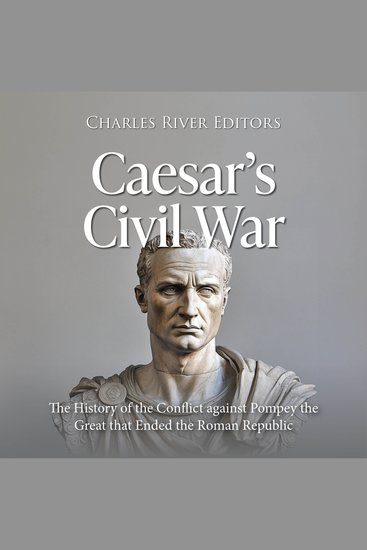
  • Caesar’s Civil War: The History of the Conflict against Pompey the Great that Ended the Roman Republic - cover

    Caesar’s Civil War: The History...

    Editors Charles River

    • 0
    • 0
    • 0
    The ultimate conqueror, statesman, dictator, visionary, and opportunist, during his time in power, Julius Caesar expanded the borders of Rome to almost twice their previous size, revolutionized the infrastructure of the Roman state, and destroyed the Roman Republic for good, leaving a line of emperors in its place. His legacy is so strong that his name has become, in many languages, synonymous with power: the emperors of Austria and Germany bore the title Kaiser, and the Tsars of Russia also owe the etymology of their title to Caesar. 
    Even in his time, Caesar was in many ways larger than life, and because of his legacy as virtual founder of the Roman Empire, much of what was written about – and by – him during his life and immediately after his assassination was politically motivated. The fact that he was murdered on the Ides of March is universal knowledge, but it’s often forgotten that he was stabbed while entering the Curia of Pompey, one of the Senate’s meeting places, in March of 44 BCE. The curia was a theater dedicated to Pompey the Great, Caesar’s rival in the civil war that ended the Republic and made Caesar dictator. When Caesar was stabbed, he fell at the base of a colossal statue of Pompey. 
    Thanks to Caesar’s victory in the civil war, Pompey is mostly remembered not for being one of Rome’s greatest generals, but for being defeated by Caesar and then ignominiously murdered after he fled to Egypt, where the boy pharaoh Ptolemy XIII decapitated Pompey and offered his head to Caesar as a gift. Although Caesar was there chasing Pompey’s men, he quickly became involved in Egypt’s own civil war. As a consequence of Ptolemy’s barbarity, Caesar impulsively decided to side with his sister Cleopatra in her bid for the throne of Egypt, escalating what was rapidly becoming an all-out civil war.
    Zum Buch
  • Save Your Marriage Playbook - cover

    Save Your Marriage Playbook

    Z.L. Allen

    • 0
    • 0
    • 0
    Save Your Marriage Playbook: A Guide to Restoring Your Marriage. Learn Proven Techniques to Repair and Strengthen Your RelationshipMarriage is a lifelong commitment that brings two individuals together as partners in life. However, over time, even the strongest relationships can experience difficulties and drift apart. If you and your spouse are facing challenges in your marriage, it's important to take proactive steps to rekindle the love and connection you once shared.This practical guide will provide you with tips and strategies to help you reignite the spark in your marriage and build a stronger, more fulfilling relationship. Whether you've been married for a few years or several decades, these strategies can help you to deepen your love and connection, communicate more effectively, and build a brighter future together.This audiobook will cover the following topics:- Guide to Rekindle Your Marriage- How to Calmly Discuss and Agree on the Big Goals- Assessing Yourself- The Power of Gratitude- And many more!Whether you've been married for a few years or several decades, these strategies can help you to deepen your love and connection, communicate more effectively, and build a brighter future together. To learn more, scroll up and click “add to cart” now!
    Zum Buch
  • The Girl With Three Birthdays - An Adopted Daughter’s Memoir of Tiaras Tough Truths and Tall Tales - cover

    The Girl With Three Birthdays -...

    Patti Eddington

    • 0
    • 0
    • 0
    Patti Eddington always knew she was adopted, and her beloved parents seemed amenable enough to questions—but she never wanted to hurt them by expressing curiosity, so she didn't. The story of her mother cutting off and dying her hair when she was a toddler? She thought it was eccentric and funny, nothing more. When she discovered at fifteen that her birthday wasn't actually her birthday? She believed it when her mother said she'd changed it to protect her from the "nosy old biddies" who might try to discover her identity. 


    It wasn't until decades later, when a genealogy test led Patti to her biological family (including an aunt with a shocking story) and the discovery of yet another birthday, that she really began to integrate what she thought she knew about her origins. Determined to know the truth, she petitioned a court to unseal records that had been locked up for almost sixty years—and began to put the pieces of her past together, bit by bit. 


    Framed by a brief but poignant 1963 "Report of Investigation" based on a caseworker's one-day visit to Patti's childhood home, The Girl With Three Birthdays tells the story of an adoptee who always believed she was the answer to a couple's seventeen-year journey to become parents, until a manila envelope from a rural county court arrived and caused her to question . . . everything.
    Zum Buch
  • The Greatest Evil is War - cover

    The Greatest Evil is War

    Chris Hedges

    • 0
    • 0
    • 0
    In fifteen short chapters, Chris Hedges astonishes us with his clear and cogent argument against war, not on philosophical grounds or through moral arguments, but in an irrefutable stream of personal encounters with the victims of war, from veterans and parents to gravely wounded American serviceman who served in the Iraq War, to survivors of the Holocaust, to soldiers in the Falklands War, among others. Hedges reported from Sarajevo, and was in the Balkans to witness the collapse of the Soviet Union. 


    In 2002 he published War Is a Force That Gives Us Meaning, which the Los Angeles Times described as "the best kind of war journalism . . . bitterly poetic and ruthlessly philosophical" and the New York Times called "a brilliant, thoughtful, timely, and unsettling book." In the twenty years since, Hedges has not wanted to write another book on the subject of war—until now, with the outbreak of war in Ukraine. It is important again to be reminded who are the victors of the spoils of war and of other unerring truths, not only in this war but in all modern wars, where civilians are always the main victims, and the tools and methods of war are capable of so much destruction it boggles the mind. This book is an unflinching indictment of the horror and obscenity of war by one of our finest war correspondents.
    Zum Buch