Join us on a literary world trip!
Add this book to bookshelf
Grey
Write a new comment Default profile 50px
Grey
Subscribe to read the full book or read the first pages for free!
All characters reduced
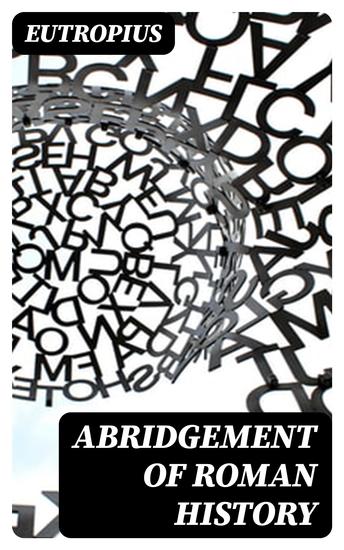
Abridgement of Roman History - cover

Abridgement of Roman History

Eutropius

Translator John Selby Watson

Publisher: DigiCat

  • 0
  • 0
  • 0

Summary

Eutropius's "Abridgement of Roman History" serves as a concise yet comprehensive overview of Rome's vast historical tapestry, written in an accessible Latin style ideal for a broad audience. Comprising ten books, this work meticulously condenses the annals of Roman history from its legendary foundation to the reign of Emperor Jovian. Eutropius employs clear narrative techniques, blending elevation with simplicity, making complex events digestible for readers unfamiliar with ancient historiography. The work emerges against the backdrop of the late Roman Empire, reflecting a nostalgia for the empire's glorious past while grappling with the challenges of its contemporary decline. Eutropius, a fourth-century Roman historian and apparently a freedman, likely drew from a wealth of sources, including earlier historians like Livy and Tacitus. His background as a bureaucrat within the imperial court bestowed him a unique perspective on Rome's historical evolution. The need to educate a growing population about their heritage may have motivated Eutropius to produce this abridgment, aiming to instill a sense of identity and continuity amid turbulent times. Highly recommended for scholars and enthusiasts alike, "Abridgement of Roman History" invites readers to explore Rome's monumental legacy through Eutropius's lens. This book not only fills a crucial gap in the canon of Roman historiography but also serves as an introductory text for those seeking to understand the complexities of Roman identity and the historical forces that shaped an empire.
Available since: 11/22/2022.
Print length: 89 pages.

Other books that might interest you

  • Laboratories against Democracy - How National Parties Transformed State Politics - cover

    Laboratories against Democracy -...

    Jacob M. Grumbach

    • 0
    • 0
    • 0
    Over the past generation, the Democratic and Republican parties have each become nationally coordinated political teams. American political institutions, on the other hand, remain highly decentralized. Laboratories against Democracy shows how national political conflicts are increasingly flowing through the subnational institutions of state politics—with profound consequences for public policy and American democracy. 


    Jacob Grumbach argues that as Congress has become more gridlocked, national partisan and activist groups have shifted their sights to the state level, nationalizing state politics in the process and transforming state governments. He shows how this has had the ironic consequence of making policy more varied across the states as red and blue party coalitions implement increasingly distinct agendas in areas like health care, reproductive rights, and climate change. Grumbach traces how national groups are using state governmental authority to suppress the vote, gerrymander districts, and erode the very foundations of democracy itself. 


    Laboratories against Democracy reveals how the pursuit of national partisan agendas at the state level has intensified the challenges facing American democracy, and asks whether today’s state governments are mitigating the political crises of our time—or accelerating them.
    Show book
  • The Adverse Childhood Experiences Guided Journal - Neuroscience-Based Writing Practices to Rewire Your Brain from Trauma - cover

    The Adverse Childhood...

    Donna Jackson Nakazawa, LCSW...

    • 0
    • 0
    • 0
    Trauma and its effects can feel like a never-ending storm, and there's no safe harbor in sight from the thoughts and emotions that toss and turn so violently and unpredictably in your head. But healing is possible. Your brain can actually rewire these thoughts and emotions. And you can direct that powerful healing process through journaling. By putting your thoughts to paper, you can identify, choose, and permanently adopt new ways of responding to stress. You can create a new narrative of your life—one that breaks you out of your most deeply ingrained and self-destructive thoughts and behaviors. 


    In this powerful guided journal, internationally acclaimed neuroscience journalist and author Donna Jackson Nakazawa outlines her inspiring, innovative, trauma-informed, and mindful Neural Re-Narrating™ program to help you: acknowledge your past while engaging in the present moment; create a new and empowering written narrative you can revisit again and again; release worry and trauma from your body by putting it onto the page; reduce your anxiety and alleviate symptoms of depression; and access inner calm—even in stressful situations. The act of unburdening oneself is essential when working through troubling or traumatic experiences. Through thoughtful, guided writing experiences, you'll find the strength to live authentically—with hope and optimism for the future.
    Show book
  • Founding Fanatics - Extremism and the Formation of American Democracy - cover

    Founding Fanatics - Extremism...

    Noah Eber-Schmid

    • 0
    • 0
    • 0
    Scholars and citizens have often assumed that dispassionate rationality, reciprocity, and nonviolent tolerance are necessary conditions for the sustained development of democracy. Accordingly, they reject oppositional parties that spurn consensus and terms of mutual respect—and often use force to accomplish their political goals—denouncing extremists as antidemocratic.Founding Fanatics questions this understanding, examining how moments of tension, violence, and extremism in the US have sometimes served the pursuit of political equality. Noah Eber-Schmid focuses his analysis on the American Founding era, presenting case studies of the early memorialization of the Boston Massacre, popular debates over Shays' Rebellion, the thought and practices of the Democratic Societies, and the use of the French Revolution in political discourse. From this account of popular politics in the Founding era, Eber-Schmid draws new insights for theoretical approaches to contemporary American democracy, challenging assumptions that extremism is always a negative or antidemocratic force. By recognizing the role that democratic extremism has played in the development of American popular democracy, political theorists and citizens will better understand how such movements may contribute to the struggle to deepen and expand political equality and participation that continues today.
    Show book
  • The Edge of Innocence - The Trial of Casper Bennett - cover

    The Edge of Innocence - The...

    David Miraldi

    • 0
    • 0
    • 0
    Named 2018 Book of the Year by International Rubery Book Award  
    The Edge of Innocence is a work of narrative nonfiction based on the 1964 murder trial of Casper Bennett, a man accused of drowning his wife in a bathtub of scalding water in Lorain, Ohio. Bennett's sensational trial pitted an aggressive, mercurial county prosecutor against the author's father, a civil trial attorney who had never before defended anyone for murder.  
    The book not only recreates the tension and excitement of this courtroom battle but also highlights the uncertain edge that often divides guilt from innocence. The author was ten years old when he answered the phone late at night when Bennett called his father from jail, seeking his legal representation.  
    Forty years later and long after his father's death, the author found the Bennett file in the bottom of his mother's closet. From the moment he began reading the papers, the long-forgotten drama cast a spell on him. As he uncovered more and more of the facts, the story he had known as a child disappeared, replaced by one far different.  
    The Edge of Innocence takes the listener through the criminal justice system and ultimately to the trial, where the listener, like a juror, must sift through competing claims and conflicting evidence. Full of twists and turns and colorful characters, The Edge of Innocence is all the more entertaining because it tells a true story.
    Show book
  • Sanctions - What Everyone Needs to Know - cover

    Sanctions - What Everyone Needs...

    Bruce W. Jentleson

    • 0
    • 0
    • 0
    A concise, authoritative overview of a little-understood yet extremely important phenomenon in world politics: the use of economic sanctions by one country to punish another. 


    It's hard to browse the news without seeing reports of yet another imposition of sanctions by one country on another. The United States has sanctions against more than thirty countries. Russia has repeatedly imposed sanctions against former Soviet republics. China has developed its own approach, including targeting private entities such as the NBA. And it's not just major powers: Japan and South Korea have sanctioned each other over WWII and colonial legacies; Saudi Arabia against Qatar because of differences over Iran; and France, Germany, and Norway against Brazil over the Amazon forest and climate change. In Sanctions: What Everyone Needs to Know®, Bruce Jentleson—one of America's leading scholars on the subject—answers the fundamental questions about sanctions today: Why are they used so much? What are their varieties? What are the key factors affecting their success? Why have they become the tool of first resort for states engaged in international conflict? Jentleson demonstrates that examining sanctions is key to understanding international relations and explains how and why they will likely continue to bear on global politics.
    Show book
  • The Buried City - Unearthing the Real Pompeii - cover

    The Buried City - Unearthing the...

    Gabriel Zuchtriegel, Jamie Bulloch

    • 0
    • 0
    • 0
    The director of the Pompeii Archaeological Park offers a vivid view of daily life in the lost city, shares the latest discoveries, and reflects on preserving heritage. In The Buried City, Gabriel Zuchtriegel takes us on a behind-the-scenes tour of Pompeii and reveals new archaeological finds that are being unearthed at the site’s biggest dig in a generation. As director of the Pompeii Archaeological Park, Zuchtriegel presents a uniquely intimate perspective on this city that was tragically destroyed and frozen in time by the eruption of Mount Vesuvius in 79 CE. Among the ruins, we find unmade beds, dishes left drying, and bodies of victims encased in ash, but Zuchtriegel shows that we’ve only begun to understand this fascinating place, as a third of the site remains unexcavated. Zuchtriegel leads us into the heart of the city, reconstructing Pompeii as it would have been, showing us who lived there, what mattered to them, and what happened in their final hours. The Buried City reveals the latest discoveries unearthed at Pompeii—including a banquet hall with murals of Greek gods, a fresco of what appears to be a pizza, and the remains of individuals crushed by debris—all buried for almost two thousand years. Zuchtriegel offers a vivid portrait of this World Heritage site as a vibrant and diverse city, connecting us to a past that is much closer than we think and inviting us to reflect on our role as keepers of the site and its history.
    Show book