Begleiten Sie uns auf eine literarische Weltreise!
Buch zum Bücherregal hinzufügen
Grey
Einen neuen Kommentar schreiben Default profile 50px
Grey
Jetzt das ganze Buch im Abo oder die ersten Seiten gratis lesen!
All characters reduced
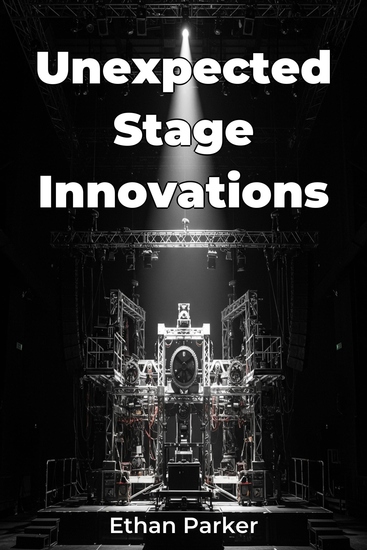
Unexpected Stage Innovations - cover

Unexpected Stage Innovations

Ethan Parker

Übersetzer A Ai

Verlag: Publifye

  • 0
  • 0
  • 0

Beschreibung

Unexpected Stage Innovations explores the fascinating evolution of theater, spotlighting the pivotal role of technology in transforming live performances. From rudimentary gas lighting to immersive projection mapping and robotics, the book examines how stage innovations have continually redefined storytelling. It highlights that these advancements aren't mere tools, but active agents that shape the artistic landscape, influencing everything from narrative structures to audience experiences. 

 
The book traces this evolution across three sections, beginning with foundational technologies and their initial impact. It then delves into specific innovations through case studies of groundbreaking productions. Did you know that the introduction of electricity in theaters marked a paradigm shift, enabling unprecedented control over lighting and atmosphere? Or that kinetic architecture is now being used to create stages that dynamically transform during a performance?

 
Finally, the book analyzes current trends like virtual and augmented reality, pondering their potential to further revolutionize live performance. Ultimately, Unexpected Stage Innovations provides a unique perspective by focusing on the collaborative dynamics between artists and technicians, and underscoring the often-unsung contributions of those behind the scenes. By bridging technical jargon with artistic interpretation, the book offers valuable insights into the past, present, and future of stagecraft.
Verfügbar seit: 29.03.2025.
Drucklänge: 59 Seiten.

Weitere Bücher, die Sie mögen werden

  • Multimodal LLM - A Comprehensive Guide to Multimodal Language Models for Text and Image Processing - cover

    Multimodal LLM - A Comprehensive...

    Et Tu Code

    • 0
    • 0
    • 0
    Dive into the cutting-edge world of Multimodal Language Models with our comprehensive guide!  
    In 'Introduction to Multimodal Language Models,' lay the foundation for your journey by understanding how these models seamlessly integrate text and image processing, revolutionizing communication. 
     Explore 'Building Multimodal Language Models' to grasp the intricate process of constructing these powerful tools. Then, fine-tune your understanding with 'Fine-tuning Multimodal Language Models,' where you'll learn to optimize models for specific tasks.  
    Dive into practical implementation with 'Implementing Multimodal LLMs with Python,' equipping yourself with essential coding skills. Feeling adventurous? 'Creating Your Own Multimodal LLM from Scratch' empowers you to customize models to suit your unique needs.  
    Discover the landscape of popular models, including those from Hugging Face, and explore real-world applications in 'Practical Applications of Multimodal LLMs.' Anticipate future challenges and directions in 'Challenges and Future Directions,' ensuring you stay ahead of the curve.  
    Conclude your journey with 'Conclusion,' where you'll reflect on your newfound knowledge and its implications. With insights, practical guidance, and hands-on tutorials, this audiobook equips you to navigate and harness the full potential of Multimodal Language Models for text and image processing.
    Zum Buch
  • The Cosmic Dance - How Dark Matter and Energy Shape Our Universe - cover

    The Cosmic Dance - How Dark...

    Dirk Fallon

    • 0
    • 0
    • 0
    Long before we had names for them, the stars told us stories. They shimmered in the night sky, seemingly eternal, guiding ancient travelers and inspiring mythologies. But as science advanced, we discovered that what we saw was only part of the story. A vast, invisible component of the universe lurked beyond the reach of our eyes and instruments—a hidden mass that neither emitted nor reflected light. This was the beginning of our encounter with dark matter and dark energy. 
    In the early 20th century, astronomers began to notice something strange. When they looked at galaxies and observed how stars within them moved, they found that these stars were traveling at speeds that didn’t make sense. Based on the visible matter alone—the stars, gas, and dust—the galaxies should have been flying apart. There simply wasn’t enough gravitational pull to hold them together. Something unseen had to be providing the extra mass needed to bind them. 
    This mysterious substance was dubbed "dark matter." It didn't shine or absorb light, making it completely invisible to traditional telescopes. Yet its gravitational effects were undeniable. It was as if galaxies were embedded in massive halos of invisible material, holding them together with unseen hands. The concept was both unsettling and thrilling—it suggested that the universe was much stranger than we had ever imagined.
    Zum Buch
  • Essential Strategies for NCE Success - "Supercharge your NCE exam prep with dynamic audio lessons for unbeatable test success!" - cover

    Essential Strategies for NCE...

    Ronan Ashcombe

    • 0
    • 0
    • 0
    Essential Strategies for NCE Success 
    ⭐⭐ A Simplified Guide with In-Depth Explanations ⭐⭐ 
    Are you looking to advance your career and solidify your knowledge by successfully passing the NCE Exam 2024-2025? 
    Searching for a thorough guide that provides all the essential elements to ensure your success on the NCE Exam 2024-2025? 
    Your search ends here! 
    This guide is your ultimate companion for enhancing your understanding, applying your skills, and engaging in practical exercises. With this resource, you are poised for success. 
    Updated for the NCE 2024-2025 Exam Structure. 
    Key features of this comprehensive guide include: 
    - In-depth insights about the NCE Exam 2024-2025 Certification 
    - Detailed explanations to master essential concepts for confident exam performance 
    - Effective strategies for exam preparation and problem-solving 
    What sets our guide apart is its extensive coverage, which is vital for your exam success. Concepts are not just brushed over; they are explored with care and precision. 
    Please note that this guide operates independently and is not officially affiliated with any NCE organization. 
    Crafted with a clear structure and straightforward language, our NCE Exam Guide 2024-2025 ensures seamless transitions between topics. Say farewell to confusing jargon and embrace clear, accurate, and technically sound content. 
    So, why delay? Click the BUY NOW button, secure your guide, and start your journey towards passing the NCE Exam 2024-2025! 
     
    Begin your path to success today!
    Zum Buch
  • Astrotopia - The Dangerous Religion of the Corporate Space Race - cover

    Astrotopia - The Dangerous...

    Mary-Jane Rubenstein

    • 0
    • 0
    • 0
    As environmental, political, and public health crises multiply on Earth, we are also at the dawn of a new space race in which governments team up with celebrity billionaires to exploit the cosmos for human gain. The best-known of these pioneers are selling different visions of the future: while Elon Musk and SpaceX seek to establish a human presence on Mars, Jeff Bezos and Blue Origin work toward moving millions of earthlings into rotating near-Earth habitats. Despite these distinctions, these two billionaires share a core utopian project: the salvation of humanity through the exploitation of space. 


    In Astrotopia, philosopher of science and religion Mary-Jane Rubenstein pulls back the curtain on the not-so-new myths these space barons are peddling, like growth without limit, energy without guilt, and salvation in a brand-new world. As Rubenstein reveals, we have already seen the destructive effects of this frontier zealotry in the centuries-long history of European colonialism. But Rubenstein does more than expose the values of capitalist technoscience as the product of bad mythologies. She offers a vision of exploring space without reproducing the atrocities of earthly colonialism, encouraging us to find and even make stories that put cosmic caretaking over profiteering.
    Zum Buch
  • Galaxies - (The MIT Press Essential Knowledge series) - cover

    Galaxies - (The MIT Press...

    Or Graur

    • 0
    • 0
    • 0
    In Galaxies, Or Graur offers a brief and fascinating overview of the history, physics, and astrophysical uses of galaxies. Starting with the history of the last two thousand years of galaxy studies, Graur discusses the types of galaxies we observe and the physics that drive them; the myths and physical structure of the Milky Way; how galaxies were used to discover and study the mysterious phenomena of dark matter and dark energy; and how scientists think galaxies formed shortly after the Big Bang and evolved to their present forms. 


    Tracing galaxy studies back thousands of years ago to their beginnings, Graur describes their origin in Ptolemy's book Almagest, which was written in the first century CE. Almagest catalogued hundreds of stars and a few hazy cloud-like objects, one of which was the Andromeda galaxy. The listener will also encounter in this book well-known figures such as William Herschel, who, along with his sister Caroline, discovered hundreds of galaxies and lay the foundations for modern galaxy studies, as well as lesser-known astronomers, including tenth-century Persian astronomer Abd al-Rahman al-Sufi. Galaxies concludes by showing listeners how they can get involved in galaxy studies themselves and do their part to fight the light pollution that today obscures the Milky Way and all but the brightest of stars.
    Zum Buch
  • Beyond Quantity - Research with Subsymbolic AI - cover

    Beyond Quantity - Research with...

    Jens Schröter, Andreas Sudmann,...

    • 0
    • 0
    • 0
    How do artificial neural networks and other forms of artificial intelligence interfere with methods and practices in the sciences? Which interdisciplinary epistemological challenges arise when we think about the use of AI beyond its dependency on big data? Not only the natural sciences, but also the social sciences and the humanities seem to be increasingly affected by current approaches of subsymbolic AI, which master problems of quality (fuzziness, uncertainty) in a hitherto unknown way. But what are the conditions, implications, and effects of these (potential) epistemic transformations and how must research on AI be configured to address them adequately?
    Zum Buch