Begleiten Sie uns auf eine literarische Weltreise!
Buch zum Bücherregal hinzufügen
Grey
Einen neuen Kommentar schreiben Default profile 50px
Grey
Jetzt das ganze Buch im Abo oder die ersten Seiten gratis lesen!
All characters reduced
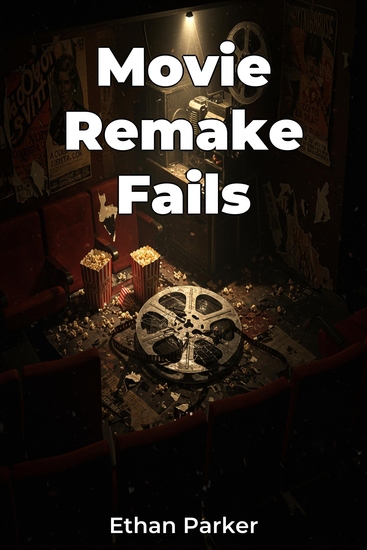
Movie Remake Fails - cover

Movie Remake Fails

Ethan Parker

Übersetzer A Ai

Verlag: Publifye

  • 0
  • 0
  • 0

Beschreibung

Movie Remake Fails explores why some cinematic reimaginings resonate while others flop. The book dissects the delicate balance between honoring the original film and updating it for modern audiences. One crucial aspect explored is how misinterpreting audience expectations can doom a remake. Another is the challenge of recreating a film's unique atmosphere. The book argues that understanding why the original resonated is key to a successful remake.

 
The book's analysis progresses through case studies, divided into sections like Misinterpreted Nostalgia, Technical Misfires, and The Curse of Expectation. These cases highlight creative and business decisions that led to failure. For example, remakes that misunderstand the original's core themes or caricature beloved characters often struggle.

 
By examining film reviews, box office data, and filmmaker interviews, the book provides a balanced perspective beyond simple criticism. It offers a structured framework for understanding failure in film adaptations.
Verfügbar seit: 24.02.2025.
Drucklänge: 64 Seiten.

Weitere Bücher, die Sie mögen werden

  • Oasis: What's The Story?: Life on tour with Liam and Noel Gallagher - cover

    Oasis: What's The Story?: Life...

    Iain Robertson

    • 0
    • 0
    • 0
    *THE MUST-LISTEN BOOK FOR THE OASIS REUNION TOUR*'Deserves to stay on the bestseller lists for a long time to come' - Caitlin Moran'Brilliant' - NMEOasis were a band like bands used to be. Hard-drinking and substance abusing. If they liked you, they loved you. If they didn't, you had to be prepared for confrontation. Iain Robertson is used to tough jobs - after retiring from the Parachute Regiment, he took on jobs guarding George Harrison, Gary Moore and Johnny Rotten. But keeping Oasis on the rails after debut album Definitely Maybe ignited their rise toward global superstardom would be the toughest gig of them all. Oasis would explode into public consciousness and have the world at their feet in the wake of their epic first album and a huge world tour. Iain was side-by-side as their road manager and minder, twenty-four hours a day, eight days a week, as they took on the world and won. No one was closer. Now updated with new unpublished material to celebrate the thirty year anniversary of Definitely Maybe and ahead of their upcoming reunion tour, this story is the defining chronicle of life on tour with Oasis.
    Zum Buch
  • How to start selling on ZAZZLE as a creative person - based on pro designer experience - cover

    How to start selling on ZAZZLE...

    Parshwika Bhandari

    • 0
    • 0
    • 0
    I am Parshwika, I am selling on Zazzle since 2021 and so far I am a Pro Bronze seller on Zazzle soon going to be Silver, in this book/course I am sharing my own steps and experience to start selling your art/design on Zazzle to make money as a designer, artist or pod seller, real tips and strategies based on my experience help me to make 1000s dollars in profit on Zazzle and still counting, lets see you in book
    Zum Buch
  • The Han Dynasty - Golden Age of Chinese Civilization - cover

    The Han Dynasty - Golden Age of...

    Jun Liu

    • 0
    • 0
    • 0
    The Han Dynasty, one of the most influential periods in Chinese history, emerged from the collapse of the Qin Dynasty in 206 BCE. After years of harsh rule under Qin Shi Huang, widespread unrest and rebellion led to the fall of the Qin. In the power vacuum that followed, Liu Bang, a commoner-turned-military leader, rose to prominence and ultimately established the Han Dynasty. His leadership and political acumen laid the foundation for a dynasty that would last over four centuries, shaping China’s governance, culture, and identity. 
    Liu Bang, later known as Emperor Gaozu, was originally a minor official under the Qin. Unlike his aristocratic rivals, he came from humble origins, making him a unique figure in Chinese history. As the Qin administration crumbled due to heavy taxation and forced labor policies, numerous factions vied for control. The most significant of these was the Chu-Han Contention, a prolonged struggle between Liu Bang and Xiang Yu, a powerful general of noble descent. Liu Bang, known for his ability to rally support from various social classes, ultimately defeated Xiang Yu at the Battle of Gaixia in 202 BCE. This victory marked the official beginning of the Han Dynasty, with Liu Bang declaring himself emperor. 
    Once in power, Liu Bang sought to distance his rule from the harsh legalist policies of the Qin. He adopted a more lenient and pragmatic approach, blending Confucian ideals with centralized governance. Although he retained elements of Qin’s bureaucratic structure, he reduced the severity of laws and punishments, earning the trust of the people. To ensure stability, he granted land and titles to his loyal followers, creating a semi-feudal system that allowed regional kings to govern under the central authority of the emperor. This balance between centralization and decentralization was a defining characteristic of early Han rule.
    Zum Buch
  • Apocalypse Television - How The Day After Helped End the Cold War - cover

    Apocalypse Television - How The...

    David Craig, Robert Iger

    • 0
    • 0
    • 0
    On November 20, 1983, a three-hour made-for-TV movie, The Day After, premiered on ABC. Set in the heartland of Lawrence, Kansas, the film depicted the events before, during, and after a Soviet nuclear attack with vivid scenes of the post-apocalyptic hellscape that would follow. The film was viewed by over 100 million Americans and remains the highest rated TV movie in history. 


    The path to primetime for The Day After proved nearly as treacherous as the film's narrative. Battles ensued behind the scenes at the network, between the network and the filmmakers. But these skirmishes pale in comparison to the culture wars triggered by the film in the press, alongside a growing Nuclear Freeze movement, and from a united, pro-nuclear Right. Once efforts to alter the script failed, the White House conducted a full-throttled propaganda campaign to hijack the film's message. 


    Apocalypse Television features a dramatic insider's account of the making of and backlash against The Day After. No other book has told this story in similar fashion, venturing behind-the-scenes of the programming and news divisions at ABC, the backlash from the conservative movement and Religious Right, the challenges encountered by the film's production team, and the experiences of the citizens of Lawrence, Kansas, where the film was set and shot.
    Zum Buch
  • Get Out - The Ultimate Trivia Collection - From The Movie Directed By Jordan Peele - cover

    Get Out - The Ultimate Trivia...

    Film Trivia Metaverse

    • 0
    • 0
    • 0
    GET OUT 
    THE ULTIMATE TRIVIA COLLECTION 
      
    FROM THE MOVIE DIRECTED BY JORDAN PEELE 
      
    CREATED BY FILM TRIVIA METAVERSE 
      
    ABOUT THE FILM 
    Get Out is a 2017 horror film directed by Jordan Peele. It follows Chris Washington, a young African American man, who visits the family home of his white girlfriend, Rose. Initially, the visit seems uneventful, but Chris soon becomes uncomfortable with the odd behavior of the family and their strange connections with black servants. As the weekend progresses, he begins to uncover unsettling truths about his girlfriend’s family. The film explores themes of racism, privilege, and exploitation, blending social commentary with psychological horror and suspense. It challenges perceptions of race while creating a chilling, tense atmosphere. 
      
    TRIVIA SAMPLES: 
      
    “Daniel Kaluuya was cast as the lead after impressing Jordan Peele during his audition. Kaluuya performed five takes of a crucial scene where his character has to cry, and each time, a single tear fell at the same moment in each take.” 
      
    “Jordan Peele mentioned that the title of the film is a nod to what he often hears from black audiences when watching horror films: they shout ‘Get out!’ at the screen. In the movie, both Rod and Andre say it to Chris.” 
      
    “The success of Get Out made Jordan Peele the first African-American writer, producer, and director to earn more than $100 million with his debut film.” 
      
    “Chance the Rapper was so impressed by Get Out that he bought out movie tickets at select Chicago theaters so people could watch the film for free. He tweeted about it, saying, ‘Just pull up with an ID and enjoy the movie.’”
    Zum Buch
  • American Legends: The Life of Roy Rogers - cover

    American Legends: The Life of...

    Editors Charles River

    • 0
    • 0
    • 0
    In the early 20th century, Westerns were one of the most popular genres in Hollywood, and one of the young stars at the forefront was Roy Rogers, who had come from an Ohio farm to transform himself into a cowboy. Regardless of his background, Rogers certainly looked the part of the quintessential cowboy, along with his wife Dale Evans and his horse Trigger. His versatile singing and acting abilities made him successful both on radio and on the screen. 
    Rogers came of age at a time when the “singing cowboy” was at the apex of his popularity, and that was favorable because he actually got his start in show business as a singer. In the early ‘30s, he bounced around several groups as a country music singer before earning national attention as a member of the Sons of the Pioneers, who were signed to Decca and had a couple of hits. As a result, when he first appeared in movies in 1935, it was usually in bit roles that required singing, but when Gene Autry threatened to quit acting in 1938, Rogers was viewed as a suitable replacement for lead roles. As it turned out, he became the premiere “singing cowboy” in Autry’s stead, and from 1939-1954, he was one of the Top 10 Western stars in Hollywood, and a Top 10 movie star overall during some of those years. 
    As Rogers evolved into the “King of the Cowboys”, he became a pop culture icon, and he was shrewd enough to capitalize on his image. All sorts of Roy Rogers merchandise hit stores, from action figures to comic strips, and Rogers even banked on the popularity of his horse Trigger by featuring him enough to make the horse a household name as well. Even today, people can find the name Roy Rogers all over the place, if only because he eventually had his name lent to a popular fast food chain in later years.
    Zum Buch