Begleiten Sie uns auf eine literarische Weltreise!
Buch zum Bücherregal hinzufügen
Grey
Einen neuen Kommentar schreiben Default profile 50px
Grey
Jetzt das ganze Buch im Abo oder die ersten Seiten gratis lesen!
All characters reduced
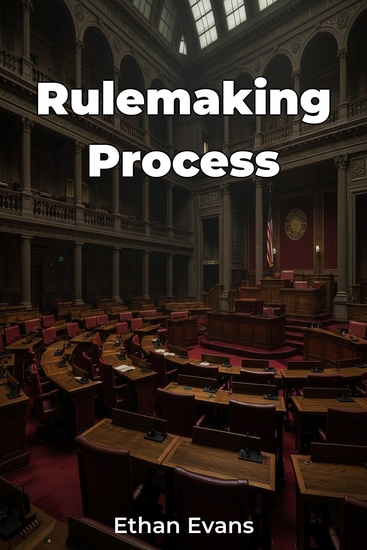
Rulemaking Process - cover

Rulemaking Process

Ethan Evans

Übersetzer A AI

Verlag: Publifye

  • 0
  • 0
  • 0

Beschreibung

Rulemaking Process explores the complex world of government regulation, detailing how rules impacting businesses, the environment, and daily life are created and implemented. It examines the dynamics between public interests, industry needs, and the legal frameworks that shape regulatory actions. Did you know that poorly conceived regulations can stifle innovation, while well-crafted rules can protect consumers and promote sustainability? The book emphasizes the importance of transparency and accountability for effective regulation.

 
The book progresses systematically, starting with key regulatory theories and administrative law. It then analyzes the drafting process, the debates within agencies and legislative bodies, and the implementation phase, including compliance and enforcement. Through legal scholarship, government reports, and case studies, the book provides practical strategies for engaging effectively in the rulemaking process. It highlights the practical challenges of regulatory implementation, making it uniquely valuable for business leaders, policymakers, and engaged citizens.
Verfügbar seit: 03.04.2025.
Drucklänge: 91 Seiten.

Weitere Bücher, die Sie mögen werden

  • The Legacy of the Roman Empire - cover

    The Legacy of the Roman Empire

    Rogan Fish

    • 0
    • 0
    • 0
    The rise of Rome is one of the most remarkable stories in world history, transforming from a small settlement on the banks of the Tiber River into one of the most powerful empires the world has ever seen. The foundation of Rome is traditionally dated to 753 BCE, attributed to the legendary figure Romulus. Over time, Rome evolved through three major phases: the monarchy, the republic, and the empire, each contributing to its dominance. The city's location played a crucial role in its growth, offering natural protection, fertile land, and access to trade routes that facilitated economic and military expansion. 
    During the period of the Roman Kingdom, Rome was ruled by a series of kings, who laid the groundwork for its legal and social structures. However, dissatisfaction with monarchical rule led to the establishment of the Roman Republic in 509 BCE. This new form of government introduced a complex system of checks and balances, with power divided among elected officials, including consuls, senators, and popular assemblies. The republic was built on the idea of civic duty and military service, which helped unify its citizens under a shared sense of identity. It was during this time that Rome expanded its influence, conquering neighboring territories through strategic military campaigns. The Roman legions, known for their discipline and tactical superiority, played a key role in these conquests. 
    Rome’s transition from a republic to an empire was marked by internal conflicts and power struggles. As Rome’s territories expanded, so did the challenges of governance. The late republic saw growing economic inequality, political corruption, and civil wars between powerful leaders. Figures like Julius Caesar, Pompey, and Crassus sought control, leading to the eventual downfall of the republic. The assassination of Caesar in 44 BCE created further instability, but it ultimately paved the way for the rise of Augustus, who became the first emperor in 27 BCE.
    Zum Buch
  • Lord Byron and Ada Lovelace: The Lives of the Father and Daughter Who Scandalized Victorian Britain - cover

    Lord Byron and Ada Lovelace: The...

    Charles River Editors

    • 0
    • 0
    • 0
    Lord Byron’s very name conjures up visions of the Romantic movement and outlandishly dressed bohemians, for if Alfred, Lord Tennyson was the poetic darling of the masses, Byron was the hero of the hedonists. While the traditional English literary hero was a nobleman rescuing a damsel in distress, Byron created the anti-hero, a man plagued by self-doubt and hidden sorrow. At the same time, his hero was also capable of facing reality once he had wrestled through his own angst, and even of occasionally acting nobly in the great tradition of the author’s Puritan forebears.  
    If Byron himself was eclectic in his tastes and character, his poetry was even more so, for he could feature satiric pieces poking fun at the status quo and historical renditions of ancient battles fought with nobility and valor, all in the same volume. Like so many other writers, he used poetry to explore his own most deeply guarded secrets, in one poem playing in first person the dramatic hero and in another the troubled penitent. He was sometimes funny, sometimes lyrical, and sometimes verbose, but he was always interesting, and that is what allowed him to become one of the most famous writers of all time, almost against his own will, and despite his premature death. 
    	Charles Babbage and Ada Lovelace were the first to conceive the notion of a programmable and automatic universal computer, which, on top of its ability to calculate any mathematical equation at an unmatched speed, could also be used for a seemingly infinite number of other applications. In other words, they envisioned the precursor to the modern computer. It was certainly an unusual path for any woman, and she managed to do so before an incredibly premature death. Augusta Ada King, Countess of Lovelace, died in 1852 at the age of 36, but during her short and tumultuous life, she was one of the first to recognize that computers could do far more than complex calculations.
    Zum Buch
  • Worth Seeing - Viewing Others Through God's Eyes - cover

    Worth Seeing - Viewing Others...

    Amy L. Williams

    • 0
    • 0
    • 0
    "We are in the business of seeing others, seeing them the way God sees them, and letting them know they have value."
    Amy L. Williams has spent three decades doing ministry with youth in gangs and prisons. While most of society sees high-risk youth through lenses of fear or disregard, she has come to see them through God's eyes as having tremendous value and potential. Worth Seeing provides an up-close look at her work—successes, losses, lessons, and embarrassing mistakes. Through personal narrative, Amy reveals the lives of youth who are often pushed to the margins of society. Her storytelling both challenges perceptions and increases compassion and understanding, not just with youth, but all people. Practical tips equip you to take action to see others the way God sees them.
    Zum Buch
  • Viracocha: The History and Legacy of the Inca’s Creator God - cover

    Viracocha: The History and...

    Editors Charles River

    • 0
    • 0
    • 0
    Although the Inca’s oral traditions suggested that the history of the region began with their empire, the various gods and the religious ceremonies of the peoples that inhabited the Inca’s lands before their arrival were assimilated into the Inca Empire and were incorporated into Inca religion. However, under Inca rule, all those gods were to be subordinate to those gods of the Incas themselves, so as to ensure that imperial authority was clear and without dispute among all quarters of the empire.  
    	Viracocha was the primary god in the Inca pantheon as the origin and creator of all things. His son, the god Inti, or the Sun, was married to Mama Quilla, the Moon, who was also created by Viracocha. According to one myth, Inti was the father of Manco Cápac, the founder of the Inca ruling dynasty, but it was believed by some that Viracocha himself fathered Manco Cápac. In practice, the Inca centered their religious worship on Inti, and this god's High Priest was the second most important person in Inca society. The god Inti was honored at an annual celebration held each June, and the Inti Raymi festival included sacrifices, feasts and sexual abstinence. This cosmology was imposed throughout the empire, and temples to the Sun were constructed and staffed by religious officials who were allotted farmland called “lands of the Sun.” Other local cults were provided with produce from these lands as well.  
    	The main temple of Inca religion was the Coricancha or Sun Temple in Cuzco, in which was kept the great golden disk of the Sun. The disk was appropriated by the Spanish in 1571 and sent off to the Pope. While it has disappeared, perhaps lost somewhere during the tortuous route to Spain, it remains alive in the fabulous world of adventure story writers, New Age mystics and manufacturers of souvenirs. It became a major element in the iconography of the 19th century independence movement in South America.
    Zum Buch
  • Poetry Unbound - 50 Poems to Open Your World - cover

    Poetry Unbound - 50 Poems to...

    Pádraig Ó Tuama

    • 0
    • 0
    • 0
    In the tumult of our contemporary moment, poetry has emerged as an inviting, consoling outlet with a unique power to move and connect us, to inspire fury, tears, joy, laughter, and surprise. This generous anthology pairs fifty illuminating poems with poet and podcast host Pádraig Ó Tuama's appealing, unhurried reflections. With keen insight and warm personal anecdotes, Ó Tuama considers each poem's artistry and explores how its meaning can reach into our own lives. 


    Focusing mainly on poets writing today, Ó Tuama engages with a diverse array of voices that includes Ada Limón, Ilya Kaminsky, Margaret Atwood, Ocean Vuong, Layli Long Soldier, and Reginald Dwayne Betts. Natasha Trethewey meditates on miscegenation and Mississippi; Raymond Antrobus makes poetry out of the questions shot at him by an immigration officer; Martín Espada mourns his father; Marie Howe remembers and blesses her mother's body; Aimee Nezhukumatathil offers comfort to her child-self. Through these wide-ranging poems, Ó Tuama guides us on an inspiring journey to reckon with self-acceptance, history, independence, parenthood, identity, joy, and resilience. 


    For anyone who has wanted to try their hand at a conversation with poetry but doesn't know where to start, Poetry Unbound presents a window through which to celebrate the art of being alive.
    Zum Buch
  • The Prophecies - cover

    The Prophecies

    Michel Nostradamus

    • 0
    • 0
    • 0
    Brought to you by Altrusian Grace Media and narrated by Matthew Schmitz. 
     Nostradamus’s The Prophecies presents hundreds of tightly compressed quatrains that fracture time and history into symbolic glimpses of upheaval, power, and ruin. The work avoids narrative order; instead it disperses images of kings, empires, celestial disturbances, plagues, and wars across a fog of allegory, where each vision feels suspended between history and imagination. The language is deliberately opaque—layered with astrological references, classical allusions, and oblique metaphors—forcing the reader to navigate a shifting terrain of potential meanings rather than fixed predictions.
    Zum Buch