Join us on a literary world trip!
Add this book to bookshelf
Grey
Write a new comment Default profile 50px
Grey
Subscribe to read the full book or read the first pages for free!
All characters reduced
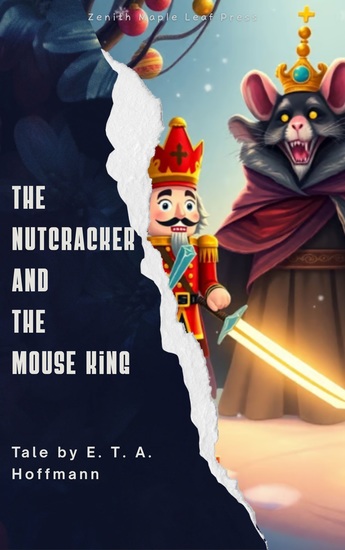
The Nutcracker and the Mouse King - E T A Hoffmann's Magical Christmas Classic - cover

The Nutcracker and the Mouse King - E T A Hoffmann's Magical Christmas Classic

E. T. A. Hoffmann, Zenith Maple Leaf Press

Publisher: Zenith Maple Leaf Press

  • 0
  • 0
  • 0

Summary

The enchanting holiday tale that inspired Tchaikovsky's beloved ballet.

Step into a world of magic, wonder, and imagination with E. T. A. Hoffmann's timeless classic The Nutcracker and the Mouse King. First published in 1816, this fairy tale follows young Marie Stahlbaum, who receives a wooden nutcracker as a Christmas gift. But when the clock strikes midnight, the Nutcracker comes to life, battling the wicked Mouse King and leading Marie into a dazzling realm of fantasy and adventure.

💡 Why this story continues to captivate:

The inspiration behind Tchaikovsky's famous ballet The Nutcracker, beloved worldwide.

A magical blend of fantasy, childhood dreams, and Christmas wonder.

A heartwarming reminder of courage, loyalty, and the power of imagination.

A perfect holiday read for both children and adults.

🎄 Perfect for:

Families looking to share a classic Christmas story.

Fans of fairy tales, fantasy, and timeless holiday traditions.

Lovers of magical adventures and whimsical storytelling.

🚀 Relive the holiday magic and follow Marie into a world of wonder—Click "Buy Now" to add this Christmas classic to your library!
Available since: 08/19/2025.
Print length: 194 pages.

Other books that might interest you

  • Her Lover - From their pens to your ears genius in every story - cover

    Her Lover - From their pens to...

    Maxim Gorky

    • 0
    • 0
    • 0
    Alexei Maximovich Peshkov was born on 28th March 1868, in Nizhny Novgorod, Russia. 
    Better known as Maxim Gorky he was orphaned at 11 and ran away from home at 12.  At 19 he had already attempted suicide and thereafter travelled, by foot, across the Russian Empire for 5 years. 
    His first book ‘Essays & Stories’ in 1898 was a sensation and so began a long career as an author of short stories, novels and plays.  Gorky saw writing as a moral and political act that would help to change the unjust world around him.  He was an ardent early advocate of the emerging Marxist movement and publicly opposed the Tsarist regime leading several times to his arrest.  
    In 1904 he began his own theatre but the censor banned every play and Gorky was forced to abandon the project. 
    But Gorky was a financially successful author, editor, and playwright and gave monies to political parties as well as for civil rights and social reform.  The brutal shooting of workers, which set in motion the Revolution of 1905, pushed Gorky more decisively toward radical solutions.  
    In 1906 he went to the United States to raise funds for the Bolsheviks. Those experiences including a scandal over travelling with his lover and not his wife deepened his contempt for the ‘bourgeois soul.’ 
    Gorky now moved to Capri in Italy, both for health reasons and to escape the increasingly repressive times in Russia.  
    An amnesty for the 300th anniversary of the Romanov dynasty saw him return to Russia in 1914. His politics remained close to the Bolshevik cause.  But soon, after the 1918 revolution, his essays referred to Lenin as a tyrant for his senseless arrests and repression.  He was soon appealing to the outside world for food aid after the catastrophic crop failure. 
    In October 1921 Gorky returned to Italy, now in Fascist hands, and settled in Sorrento until 1932.  His health worsened with the onset of tuberculosis. 
    He wrote several successful books there but now decided to find an understanding with the communist regime. Stalin invited him home and his return was hailed as a major propaganda victory.  He was decorated with the Order of Lenin, and a province, a park, and various streets re-named in his honour. 
    But he had his faults too.  In 1933, Gorky co-edited a book on the White Sea-Baltic Canal and denied even a single prisoner died during its construction, but thousands had. As well, knowing that some Nazis were homosexual, a phrase was attributed to him that said ‘exterminate all homosexuals and fascism will vanish’.  Although he was himself was quoting another he was decidedly homophobic. 
    With the increase of Stalinist repression in 1935 Gorky was placed under unannounced house arrest. 
    Maxim Gorky died on the 18th June 1936 from pneumonia.  He was 68. 
    Stalin and Molotov were among those who carried Gorky's urn of ashes at his funeral.
    Show book
  • Season of Need - cover

    Season of Need

    Michael Barry Keck

    • 0
    • 0
    • 0
    Some stories spring from pure imagination, mere reflections of an author's perception of reality. Others, like this one, are forged in the mud and misery of actual conflict. In the decaying jungles and fetid rice paddies of South Vietnam, a diverse band of soldiers and civilians endures a harrowing year of combat that will continue to haunt them for more than three decades. Their season of need reveals not only the horror of war, but also the possibility of finding solace and purpose in the most unlikely of places. In 1970, Captain Book arrives in Ba Xuyen Province of the Mekong Delta, supremely confident in his mission to help bring the Vietnam War to a swift conclusion. There, he meets his Vietnamese counterpart, Captain Nguyen Van Tranh, and a bond forms between them as they work side by side to restore public confidence in the South Vietnamese government. Surrounded by a unique cast of allies, they confront violence, heartbreak, and moments of profound humanity that lay bare the fragile fabric of human relationships. In the crucible of combat, their friendship becomes a testament to selflessness and sacrifice. Even in the darkest moments, solidarity and hope can rise from the ashes of war.
    Show book
  • Great Gatsby The: Original 1925 Edition (An F Scott Fitzgerald Classic Novel - cover

    Great Gatsby The: Original 1925...

    Francis Scott Fitzgerald

    • 0
    • 0
    • 0
    The Great Jazz Age Novel_______The 1925 Original Version, with Classroom History_______The Great Gatsby is considered F. Scott Fitzgerald's magnum opus, exploring themes of decadence, idealism, social stigmas, patriarchal norms, and the deleterious effects of unencumbered wealth in capitalistic society, set against the backdrop of the Jazz Age and the Roaring Twenties. At its heart, it's a cautionary tale, a revealing look into the darker side to the American Dream."When I came back from the East last autumn I felt that I wanted the world to be in uniform and at a sort of moral attention forever; I wanted no more riotous excursions with privileged glimpses into the human heart. Only Gatsby, the man who gives his name to this book, was exempt from my reaction—Gatsby who represented everything for which I have an unaffected scorn. If personality is an unbroken series of successful gestures, then there was something gorgeous about him, some heightened sensitivity to the promises of life, as if he were related to one of those intricate machines that register earthquakes ten thousand miles away. This responsiveness had nothing to do with that flabby impressionability which is dignified under the name of the "creative temperament"—it was an extraordinary gift for hope, a romantic readiness such as I have never found in any other person and which it is not likely I shall ever find again. No—Gatsby turned out all right at the end; it is what preyed on Gatsby, what foul dust floated in the wake of his dreams that temporarily closed out my interest in the abortive sorrows and short-winded elations of men..."
    Show book
  • Know about "ashoka the great" - "the enlightened ruler" - cover

    Know about "ashoka the great" -...

    Saurabh Singh Chauhan

    • 0
    • 0
    • 0
    This is a small part of the book introduction : In the annals of history, there are rare figures whose lives transcend their time, leaving an indelible mark on the tapestry of human civilization. Ashoka the Great, often dubbed "The Enlightened Ruler," stands as one such luminary figure. His story, one of profound transformation and enduring legacy, continues to captivate generations. 
    In this journey through the life and times of Ashoka, we traverse the corridors of ancient India, exploring an epoch marked by both conquest and enlightenment. The tale of Ashoka Maurya begins in 304 BCE, a significant year that heralded the birth of this remarkable figure in Pataliputra, the capital of the Maurya Empire. 
    From his earliest days, Ashoka's life was intertwined with the grand narrative of a powerful empire, where the fate of millions was shaped by the decisions of a few. We uncover the formative years of Ashoka's education and upbringing, the foundations upon which his reign would be built. 
    The ascent to the throne in 272 BCE marked a crucial turning point. Ashoka's journey as the third Mauryan emperor was not simply an ascent to power; it was the start of a profound odyssey, a saga marked by military conquests that painted the map of the empire in the hues of expansion.
    Show book
  • History's Greatest Frauds & Hoaxes: True Stories of Scams - cover

    History's Greatest Frauds &...

    Atlas History

    • 0
    • 0
    • 0
    This audiobook is narrated by an AI Voice. What if everything you learned in school about human evolution was built on a lie? From the infamous Piltdown Man that fooled scientists for four decades to elaborate art forgeries that deceived museums worldwide, history's most notorious frauds and hoaxes reveal the shocking vulnerability of even our most trusted institutions. This captivating collection exposes the masterminds behind legendary deceptions, the victims who fell for their schemes, and the devastating consequences that rippled through society. Discover how a medieval skull and orangutan jaw were transformed into humanity's missing link, fooling Britain's most prestigious scientists and derailing evolutionary research for generations. Explore the psychology behind these elaborate cons, from the desperate ambition of amateur archaeologist Charles Dawson to the confirmation bias that blinded expert analysis. Each fascinating case study reveals the intricate methods used to construct convincing lies, the red flags that were ignored, and the painstaking detective work that eventually exposed the truth. Learn how financial scams, scientific fraud, and cultural hoaxes have shaped public opinion, influenced policy, and cost millions of dollars throughout history. These true crime stories of deception demonstrate how con artists exploit human nature, institutional pride, and our desire to believe extraordinary claims. Perfect for fans of true crime podcasts and historical mysteries, this riveting exploration of famous frauds offers invaluable lessons about critical thinking, skepticism, and the importance of questioning authority in our modern world of misinformation.
    Show book
  • Mexican History - Drug Cartels Wars and Heroes (3 in 1) - cover

    Mexican History - Drug Cartels...

    Kelly Mass

    • 0
    • 0
    • 0
    This book includes three titles about Mexico's history: 
    Cristero War - The Cristero War, also known as the Cristero Rebellion or La Cristiada [la kistjaa], was a widespread and deeply significant conflict that unfolded in central and western Mexico during the late 1920s. It was primarily driven by a violent response to the secularist and anti-clerical provisions of the 1917 Mexican Constitution, which sought to curtail the influence of the Catholic Church over the country's political and social life. The Constitution introduced sweeping reforms, including the restriction of church property rights and the severe limitations placed on the clergy’s ability to engage in public life. 
    Mexican Drug Cartels - The Mexican drug war, also known as the Guerra contra el narcotráfico en México, is the Mexican theater of the global war on drugs, a campaign led by the United States federal government. This war has resulted in a protracted, asymmetric low-intensity conflict between the Mexican government and various drug trafficking organizations. The Mexican government’s main objective when it intervened militarily in 2006 was to curb drug-related violence, which had escalated in the preceding years. The government’s stated aim, in collaboration with U.S. officials, was to eliminate the cartels and reduce the demand for drugs trafficking. 
    Pancho Villa - Francisco Villa, better known as Pancho Villa, was a key figure in the Mexican Revolution, known for his transformation from a bandit to one of the revolution’s most influential commanders. Villa’s rise to prominence in the early 20th century marked him as a central player in the violent upheavals that reshaped Mexico’s political landscape. In 1911, Villa became a significant actor in the revolutionary violence that led to the overthrow of President Porfirio Díaz, ushering in Francisco I. Madero’s government.
    Show book