Begleiten Sie uns auf eine literarische Weltreise!
Buch zum Bücherregal hinzufügen
Grey
Einen neuen Kommentar schreiben Default profile 50px
Grey
Jetzt das ganze Buch im Abo oder die ersten Seiten gratis lesen!
All characters reduced
War and the Arme Blanche - cover

War and the Arme Blanche

Erskine Childers

Verlag: DigiCat

  • 0
  • 0
  • 0

Beschreibung

In "War and the Arme Blanche," Erskine Childers presents a compelling treatise on the ethics of military engagement and the psychological ramifications of warfare, particularly in the context of the early 20th century conflicts. Written with a meticulous attention to detail, Childers employs a narrative style that blends personal reflections with historical analysis, capturing the stark realities of combat through both prose and poetry. The book effectively critiques the conventional view of modern warfare, advocating for an acknowledgment of the moral choices that soldiers must confront, as well as the broader societal impacts of armed conflict. Childers' nuanced exploration of the 'arma blanche'—the bayonet and its symbolic representation of direct, close combat—positions the text within a rich literary tradition concerned with the human experience of war. Erskine Childers was not only a writer but also a passionate political activist, deeply influenced by his experiences in the Boer War and his strong nationalist sentiments. His background as an Irishman with British colonial ties provided a unique perspective on issues of imperialism and freedom, which are deeply woven into this work. Childers' firsthand encounters with the horrors of war serve as the foundation for his poignant reflections, urging readers to contemplate the ethical implications of their societies' military actions. "War and the Arme Blanche" is a must-read for those seeking to understand the multifaceted nature of warfare and its lasting consequences on humanity. Ideal for scholars, historians, and any thoughtful readers interested in military ethics and literary critiques of war, this book invites readers to engage in a vital conversation about the responsibilities of soldiers and the moral exigencies faced in times of conflict.
Verfügbar seit: 16.09.2022.
Drucklänge: 326 Seiten.

Weitere Bücher, die Sie mögen werden

  • Brief History of Equality A: Book Summary & Analysis - cover

    Brief History of Equality A:...

    Briefly Summaries

    • 0
    • 0
    • 0
    This is a concise summary and analysis of A Brief History of Equality, by Thomas Piketty.
     
    It is not the original book and is not affiliated with or endorsed by Thomas Piketty.
     
    Ideal those seeking a quick and insightful overview.
     
    "A Brief History of Equality" offers a concise yet profound exploration of humanity's long struggle toward a more equitable society. This thought-provoking work delves into centuries of economic and social transformations, highlighting the milestones and setbacks in the quest for equality. With a sharp analysis of wealth distribution, power dynamics, and systemic change, the book argues that progress, though uneven, is achievable through collective effort and informed policy. Accessible and empowering, it serves as both a historical overview and a roadmap for creating a fairer world.
    Zum Buch
  • Dressed and Oppressed 2 - Tulle and Unusual Punishment: A Forced Feminization Fantasy - cover

    Dressed and Oppressed 2 - Tulle...

    Jane Fox

    • 0
    • 0
    • 0
    Sally's being fitted for a bridesmaid's dress, but her boyfriend Trip is being a nightmare about it! But the seamstress of the shop brings out a little gift to put Trip in his place: A form-fitting gown that shapes him like a woman. With him in his new dress, Sally and her best friend Joan make Trip into "the weaker sex"...leading to a wedding where bridesmaid Trip will be the star of a very humiliating show.
    Zum Buch
  • The Rise and Fall of the Roman Empire - A Comprehensive History - cover

    The Rise and Fall of the Roman...

    Rogan Fish

    • 0
    • 0
    • 0
    The founding of Rome is one of the most famous legends in history, blending myth and reality to shape the origins of one of the greatest civilizations of the ancient world. According to Roman tradition, the city was established in 753 BCE by Romulus, the first king of Rome, after he and his twin brother, Remus, were rescued and raised by a she-wolf. This tale, passed down through generations, symbolized Rome’s strength, resilience, and divine favor. While the legend is deeply ingrained in Roman identity, historians believe the city’s origins were more complex, involving the gradual unification of Latin and Etruscan tribes. 
    The early formation of Rome was influenced by its strategic location along the Tiber River. The site provided access to trade routes, fresh water, and natural defenses, making it an ideal settlement for early inhabitants. Archaeological evidence suggests that small villages existed in the area long before Rome’s legendary founding, with early settlers engaging in agriculture, trade, and warfare. These early communities gradually coalesced, forming a unified society under a monarchical system. The first rulers of Rome were part of the Roman Kingdom, a period that saw the development of political institutions, religious practices, and military organization that would shape the city’s future. 
    Roman society during its early years was structured around family and clan-based systems, with the patricians, or aristocratic families, holding the majority of political power. The king was the central authority, responsible for religious duties, military leadership, and lawmaking. However, his rule was supported by a council of elders known as the Senate, which played an advisory role. Over time, tensions arose between the patricians and the common people, or plebeians, who sought greater political representation. These early power struggles foreshadowed the later conflicts that would lead to the transition from monarchy to a republic.
    Zum Buch
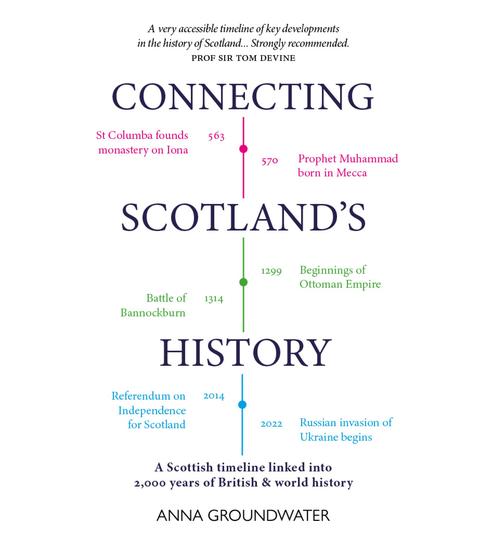
  • Connecting Scotland's History - A Scottish History Timeline Linked into 2000 Years of World History - cover

    Connecting Scotland's History -...

    Anna Groundwater

    • 0
    • 0
    • 0
    What was happening elsewhere in the world when Robert the Bruce was outlawed and Mary Queen of Scots lost her head? When Genghis Khan was on the warpath and Ivan the Terrible was the Russian czar, what was happening in Scotland? Find the answers to these questions in 2,000 years of Scottish history presented alongside what was happening in the rest of the world.
    By placing events in Scotland in relation to those elsewhere, we can see what is different or distinctive about Scotland's experience. Simultaneously we can also see where movements in Scottish history were part of wider cultural or political change in Europe and beyond. John Knox's fiery sermons of the 1560s were connected into a wider Protestant Reformation, but they also represented a singularly Scottish version of a European phenomenon.
    Connecting Scotland's History also gives us a history of 'many Scotlands'. We see the hybrid nature of a country where multiple peoples have come together in a distinctively Scottish mixture. From the Gaels, Picts and Norse people to more recent influxes from England, Ireland, continental Europe and beyond, Scotland's history tells us of internal connections as well as connections between Scotland and the wider world.
    Zum Buch
  • Diversify - cover

    Diversify

    June Sarpong

    • 0
    • 0
    • 0
    ‘A handbook for these troubled times’ Psychologies Magazine 
    ’Engaging and informative … highlights our common humanity’ Kofi Annan 
    ‘A passionately written polemic’ You MagazineThe truth is, INCLUSION is better for EVERYONE. 
    In this empowering call to arms, June Sarpong MBE proves why. 
    Putting the spotlight on groups who are often marginalised in our society, including women, ethnic minorities, those living with disabilities, and the LGBTQ+ community, Diversify uncovers the hidden cost of exclusion and shows how a new approach to how we learn, live and do business can solve some of the most stubborn challenges we face. 
    With unshakeable case studies, brand-new research from Oxford University, and six revolutionary steps to help you overcome unconscious bias, this book will help you become part of a better society. 
    The old way isn’t working. This is a case for change. 
    In Diversify, June Sarpong delves into the heart of social and economic disparity, shedding light on the discrimination faced by minority classes. The book is a top pick for those interested in understanding the intersection of race, ethics, and public policy. 
    For fans of Mary Ann Sieghart (The Authority Gap), Steve Silberman (Skeleton Key), Reni Eddo-Lodge (Why I’m No Longer Talking to White People About Race), Laura Bates (Fix the System, Not the Women), and Darren Chetty (How to Disagree).
    Zum Buch
  • How to Tell a Story: 7 Easy Steps to Master Storytelling Story Boarding Writing Stories Storyteller & Story Structure - cover

    How to Tell a Story: 7 Easy...

    Jaiden Pemton

    • 0
    • 0
    • 0
    Are you ready to dive into the world of storytelling, but don’t know where to start?  
    Do you feel unclear about how to distinguish and use the elements of the storytelling process? 
    Are you still on the search to tell stories that will stick out to your audience, and have a lasting impact that will be passed on for years to come? 
      
    How to Tell a Story is the guide you need! We will teach you how to tell a story in 7 easy steps. This guide is designed to provide you with all the tools you need in a concise, easy to understand format that will answer all your burning questions and get you on your way to successful storytelling. 
      
    To be a successful storyteller, you have to draw your audience in immediately and keep them engaged throughout the entirety of the story. As the story reaches its end and the conflict has been resolved, you must provide a sense of satisfaction for your audience, as well as a message they can hold onto going forward. 
      
    YOU’LL LEARN:Logistics of each element of storytelling (character development, plot development, setting, point of view, theme, conflict)Common storytelling mistakes to avoidBrainstorming exercises to help you choose a story angleHow to create an emotional experience How to develop a positive story outcomeHow to create a shining moment which will stick with your audienceAnd so much more!  
      
    Whether you're just starting on the journey of storytelling and need to develop a clearer understanding of the elements, or have been at it for a while and are looking for fresh perspectives and tips for further develop how you tell stories, this guide is the companion you need. Let’s get started! 
     
    Zum Buch