Rejoignez-nous pour un voyage dans le monde des livres!
Ajouter ce livre à l'électronique
Grey
Ecrivez un nouveau commentaire Default profile 50px
Grey
Abonnez-vous pour lire le livre complet ou lisez les premières pages gratuitement!
All characters reduced
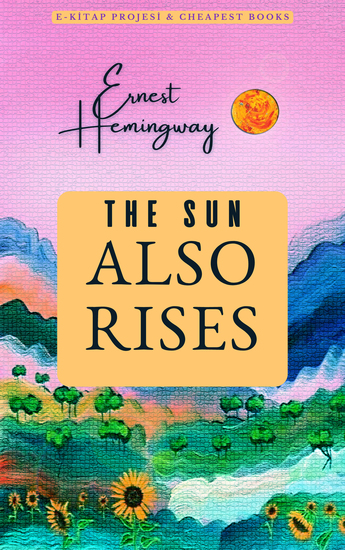
The Sun Also Rises - cover

The Sun Also Rises

Ernest Hemingway

Maison d'édition: E-Kitap Projesi & Cheapest Books

  • 0
  • 0
  • 0

Synopsis

The illustrated edition of Ernest Hemingway's first novel. 

The Sun Also Rises is a 1926 novel by American writer Ernest Hemingway, his first, that portrays American and British expatriates who travel from Paris to the Festival of San Fermín in Pamplona to watch the running of the bulls and the bullfights. An early and enduring modernist novel, it received mixed reviews upon publication. However, Hemingway biographer Jeffrey Meyers writes that it is now "recognized as Hemingway's greatest work", and Hemingway scholar Linda Wagner-Martin calls it his most important novel. The novel was published in the United States in October 1926 by Scribner's. A year later, Jonathan Cape published the novel in London under the title Fiesta. It remains in print. 

The novel is a roman à clef: the characters are based on real people in Hemingway's circle, and the action is based on real events, particularly Hemingway's life in Paris in the 1920s and a trip to Spain in 1925 for the Pamplona festival and fishing in the Pyrenees. Hemingway presents his notion that the "Lost Generation"-considered to have been decadent, dissolute, and irretrievably damaged by World War I-was in fact resilient and strong. Hemingway investigates the themes of love and death, the revivifying power of nature, and the concept of masculinity. His spare writing style, combined with his restrained use of description to convey characterizations and action, demonstrates his "Iceberg Theory" of writing. 

Plot summary

On the surface, the novel is a love story between the protagonist Jake Barnes-a man whose war wound has made him unable to have sex-and the promiscuous divorcée Lady Brett Ashley. Jake is an expatriate American journalist living in Paris, while Brett is a twice-divorced Englishwoman with bobbed hair and numerous love affairs, and embodies the new sexual freedom of the 1920s. Brett's affair with Jake's college friend Robert Cohn causes Jake to be upset and break off his friendship with Robert; her seduction of the 19-year-old matador Romero causes Jake to lose his good reputation among the Spaniards in Pamplona. 

Book One is set in the café society of young American expatriates in Paris. In the opening scenes, Jake plays tennis with Robert, picks up a prostitute (Georgette), and runs into Brett and Count Mippipopolous in a nightclub. Later, Brett tells Jake she loves him, but they both know that they have no chance at a stable relationship. 

In Book Two, Jake is joined by Bill Gorton, recently arrived from New York, and Brett's fiancé Mike Campbell, who arrives from Scotland. Jake and Bill travel south and meet Robert at Bayonne for a fishing trip in the hills northeast of Pamplona. Instead of fishing, Robert stays in Pamplona to wait for the overdue Brett and Mike. Robert had an affair with Brett a few weeks earlier and still feels possessive of her despite her engagement to Mike. After Jake and Bill enjoy five days of fishing the streams near Burguete, they rejoin the group in Pamplona. 

All begin to drink heavily. Robert is resented by the others, who taunt him with antisemitic remarks. During the fiesta the characters drink, eat, watch the running of the bulls, attend bullfights, and bicker with each other. Jake introduces Brett to the 19-year-old matador Romero at the Hotel Montoya; she is smitten with him and seduces him.
Disponible depuis: 04/12/2023.
Longueur d'impression: 350 pages.


D'autres livres qui pourraient vous intéresser

  • Animal Farm - cover

    Animal Farm

    George Orwell

    • 0
    • 0
    • 0
    Animal Farm is an allegorical novella by George Orwell, first published in England on 17 August 1945. The book tells the story of a group of farm animals who rebel against their human farmer, hoping to create a society where the animals can be equal, free, and happy. Ultimately, however, the rebellion is betrayed, and the farm ends up in a state as bad as it was before, under the dictatorship of a pig named Napoleon. 
    According to Orwell, the fable reflects events leading up to the Russian Revolution of 1917 and then on into the Stalinist era of the Soviet Union. Orwell, a democratic socialist, was a critic of Joseph Stalin and hostile to Moscow-directed Stalinism, an attitude that was critically shaped by his experiences during the Spanish Civil War. The Soviet Union had become a brutal dictatorship built upon a cult of personality and enforced by a reign of terror. In a letter to Yvonne Davet, Orwell described Animal Farm as a satirical tale against Stalin ("un conte satirique contre Staline"), and in his essay "Why I Write" (1946), wrote that Animal Farm was the first book in which he tried, with full consciousness of what he was doing, "to fuse political purpose and artistic purpose into one whole". 
    The original title was Animal Farm: A Fairy Story, but U.S. publishers dropped the subtitle when it was published in 1946, and only one of the translations during Orwell's lifetime kept it. Other titular variations include subtitles like "A Satire" and "A Contemporary Satire". Orwell suggested the title Union des républiques socialistes animales for the French translation, which abbreviates to URSA, the Latin word for "bear", a symbol of Russia. It also played on the French name of the Soviet Union, Union des républiques socialistes soviétiques. 
    Voir livre
  • Moby Dick - cover

    Moby Dick

    Herman Melville

    • 0
    • 0
    • 0
    "Moby-Dick; or, The Whale" is a novel by American writer Herman Melville, published in 1851. The story follows Ishmael, a young sailor who joins the whaling ship Pequod, captained by the obsessive and enigmatic Ahab. Captain Ahab is bent on killing Moby Dick, a giant white sperm whale that had previously destroyed Ahab's former ship and severed his leg. The novel is renowned for its intricate narrative structure, elaborate symbolism, and exploration of themes like obsession, the sublime, and the complexities of good and evil.
    Voir livre
  • The Selfish Giant - cover

    The Selfish Giant

    Oscar Wilde

    • 0
    • 0
    • 0
    The Selfish Giant owns a beautiful garden which has 12 peach trees and lovely fragrant flowers, in which children love to play after returning from school. On the giant's return after visiting his friend the Cornish Ogre for seven years, he takes offence at the children and builds a wall to keep them out.
    Voir livre
  • Joan of Naples - cover

    Joan of Naples

    Alexandre Dumas

    • 0
    • 0
    • 0
    "Joan of Naples" by Alexandre Dumas is a dramatic historical novel exploring the tumultuous life of Queen Joan I of Naples. A figure of both admiration and scandal, Joan navigates political intrigue, betrayal, and personal passion in a kingdom rife with conflict. Her reign is marked by struggles for power, accusations of murder, and alliances that blur the lines between loyalty and manipulation. Dumas vividly portrays her resilience amid courtly conspiracies and shifting allegiances, while delving into themes of love, justice, and the burdens of leadership. Set against the rich tapestry of medieval Italy, this gripping tale blends romance, tragedy, and ambition, offering a poignant reflection on the complexities of ruling as a woman in a ruthless world.
    Voir livre
  • The Theogony - cover

    The Theogony

    Hesiod

    • 0
    • 0
    • 0
    The Theogony "the genealogy or birth of the gods" is a poem by Hesiod (8th – 7th century BC) describing the origins and genealogies of the Greek gods, composed c. 730–700 BC. It is written in the Epic dialect of Ancient Greek and contains 1022 lines. 
    Hesiod's Theogony is a large-scale synthesis of a vast variety of local Greek traditions concerning the gods, organized as a narrative that tells how they came to be and how they established permanent control over the cosmos. It is the first known Greek mythical cosmogony. The initial state of the universe is chaos, a dark indefinite void considered a divine primordial condition from which everything else appeared. Theogonies are a part of Greek mythology which embodies the desire to articulate reality as a whole; this universalizing impulse was fundamental for the first later projects of speculative theorizing.
    Hesiod appropriates to himself the authority usually reserved to sacred kingship. The poet declares that it is he, where we might have expected some king instead, upon whom the Muses have bestowed the two gifts of a scepter and an authoritative voice (Hesiod, Theogony 30–3), which are the visible signs of kingship. It is not that this gesture is meant to make Hesiod a king. Rather, the point is that the authority of kingship now belongs to the poetic voice, the voice that is declaiming the Theogony.
    Voir livre
  • Time Machine The - Audiobook - cover

    Time Machine The - Audiobook

    H. G. Wells, Classic Audiobooks,...

    • 0
    • 0
    • 0
    The Time Machine is a groundbreaking science fiction novella by H. G. Wells that introduced the concept of time travel through a mechanical device. The story follows the unnamed Time Traveller as he ventures far into the future, arriving in the year 802,701. There he encounters the peaceful, childlike Eloi and the sinister, subterranean Morlocks, uncovering the disturbing future of humanity.A sharp critique of social class, industrialization, and the human condition, The Time Machine is both a thrilling adventure and a philosophical meditation on progress, decay, and the fate of civilization. Wells's vision remains hauntingly relevant to this day.
    Voir livre