Begleiten Sie uns auf eine literarische Weltreise!
Buch zum Bücherregal hinzufügen
Grey
Einen neuen Kommentar schreiben Default profile 50px
Grey
Jetzt das ganze Buch im Abo oder die ersten Seiten gratis lesen!
All characters reduced
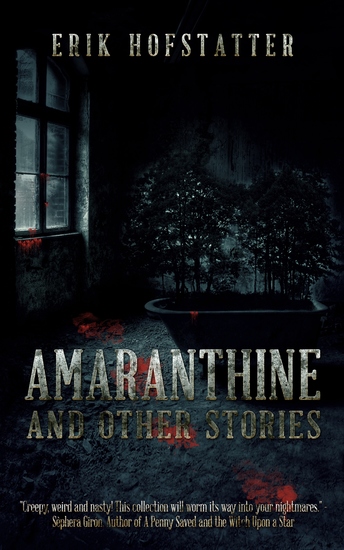
Amaranthine - And Other Stories - cover

Amaranthine - And Other Stories

Erik Hofstatter

Verlag: Next Chapter

  • 0
  • 0
  • 0

Beschreibung

Forget vampires. Forget werewolves. Forget ghosts. Humans are the ultimate grotesques.
 
Variant flavors of woe sift through these pages. The results are sometimes hilarious, sometimes outright hair-raising.
 
Amaranthine and Other Stories serves up nine slices of schlock horror, sprinkled with quirk and humor. As a bonus, the collection includes story notes, offering the reader a rare glimpse into the inspiration behind each tale.
 
This book contains graphic sex and violence, and is not suitable for readers under the age of 18.
Verfügbar seit: 22.01.2022.
Drucklänge: 73 Seiten.


Weitere Bücher, die Sie mögen werden

  • I Am Alien to Life - Selected Stories - cover

    I Am Alien to Life - Selected...

    Djuna Barnes, Merve Emre

    • 0
    • 0
    • 0
    Djuna Barnes is rightly remembered for Nightwood, her breakthrough and final novel: a hallmark of modernist literature, championed by T. S. Eliot, and one of the first, strangest, and most brilliant novels of love between women to be published in the twentieth century. Barnes's career began long before Nightwood, however, with journalism, essays, drama, and satire of extraordinary wit and courage. Long into her later life, after World War II, when she published nothing more, it was her short fiction above all that she prized and would continue to revise. 


    Here are all the stories Barnes sought to preserve, in the versions she preferred, as well as a smattering of rarities as selected by critic and New Yorker contributor Merve Emre. These are tales of women "'tragique' and 'triste' and 'tremendous' all at once," of sons and daughters being initiated into the ugly comedy of life, monuments all to a worldview singular and scathing. As Emre writes in her foreword "[Barnes's] themes are love and death, especially in Paris and New York; the corruption of nature by culture; the tainted innocence of children; and the mute misery of beasts . . . her characters may be alien to life, but they are alive—spectacularly, grotesquely alive."
    Zum Buch
  • Moby Dick - cover

    Moby Dick

    Herman Melville

    • 0
    • 0
    • 0
    "Moby Dick" by Herman Melville is one of the most celebrated works of fiction in the English language, a cornerstone of American literature, and an unflinching exploration of the human spirit. First published in 1851, this timeless classic has captivated generations with its daring narrative and profound themes, earning its place as a touchstone of literary excellence. 
    Whether you're new to the epic or revisiting its pages, "Moby Dick" promises an unforgettable journey across storm-tossed seas and into the hearts of its characters. Captain Ahab, with his fiery determination and unyielding obsession, stands as one of literature's most iconic figures, while Ishmael's reflective voice offers readers a lens through which to grapple with the novel's expansive questions. With its masterful blend of adventure, drama, and existential inquiry, this is a book that rewards both the curious reader and the philosophical thinker. 
    Perfect for lovers of classic literature, maritime history, or tales of relentless pursuit, "Moby Dick" remains as powerful and relevant today as when it was first penned. Join the crew of the Pequod and immerse yourself in an odyssey that will leave you awestruck, reflective, and deeply moved.
    Zum Buch
  • Weird Wilderness Stories - cover

    Weird Wilderness Stories

    A. Merritt, Algernon Blackwood,...

    • 0
    • 0
    • 0
    A collection of strange stories that take place in the oft weird and wonderful great outdoors. 
    Contents: 
    "The Pool of the Stone God" by A. Merritt 
    An encounter with a strange statue. 
    "The Wood of the Dead" by Algernon Blackwood 
    An encounter with a ghost, whose appearance is an omen of death. 
    "Skeleton Lake: An Episode in Camp" by Algernon Blackwood 
    Men on a moose hunting trip find a dead man washed ashore. 
    "Genius Loci" by Clark Ashton Smith 
    A painter’s strange account of a meadow. 
    "Uneasy Lie the Drowned" by Donald Wandrei 
    A troubling lake crossing. 
    "The Moon-Bog" by H. P. Lovecraft 
    A man acquires a family estate with unfortunate results. 
    "The Tree on the Hill" by H. P. Lovecraft 
    A tree with strange properties. 
    "The Hunt" by Jennifer Gill 
    A young lady’s first hunt of the season. 
    "The Death of Halpin Frayser" by Ambrose Bierce 
    A man apparently dies at the hands of his deceased mother. 
    "Chickamauga" by Ambrose Bierce 
    A child strays into the forest...
    Zum Buch
  • Evening Guest An - From their pens to your ears genius in every story - cover

    Evening Guest An - From their...

    Alexander Kuprin

    • 0
    • 0
    • 0
    Alexander Kuprin was born in Narovchat, Penza in Russia on 7th September 1870. 
    At 3 his Father died and he and mother moved to Moscow. By 10 he was enrolled at the Second Moscow Military High School and there his interest in literature began. The Alexander Military Academy followed and two years later he was a sub-lieutenant and posted to an Infantry Regiment for a further four years. 
    Despite his duties he was a now a keen writer and published his first short story at this time. His military duties also garnered him experiences for his breakthrough work ‘The Duel’.  Leaving the military he left for Kiev to work for local newspapers.  He continued to publish both stories and novels and by 1901 he was in St Petersburg becoming part of a group that included Chekhov, Ivan Bunin, Maxim Gorky and Leonid Andreyev.  
    In the years that followed further controversial works and acclaim followed.  His comments on the regime meant he was also put under secret police surveillance.   
    As World War I erupted, Kuprin opened a military hospital but was then given command of an infantry company in Finland. He was soon discharged on grounds of ill health.  
    The October Revolution saw him praise Lenin, but he warned that the Bolsheviks threatened Russian culture and might cause further widespread suffering to the peasants.  As Civil War raged he took his family to Helsinki and then on to Paris. 
    Exile saw his talents decline further and his succumbing to alcoholism. He became lonely and withdrawn. The family's poverty increased his malaise.   
    In May 1937, the Kuprin’s returned to Moscow.  He now saw his work published but wrote almost nothing new.  In 1938 his health rapidly deteriorated.  Already suffering from a kidney problems and sclerosis, he had now developed cancer of the oesophagus.  
    Alexander Kuprin died on 25th August 1938.
    Zum Buch
  • Aristocratic Education - From their pens to your ears genius in every story - cover

    Aristocratic Education - From...

    Stephen Leacock

    • 0
    • 0
    • 0
    Stephen P H Butler Leacock FRSC was born on the 30th December 1869 in Swanmore, near Southampton, England, the third of eleven children. 
    The family emigrated to Canada in 1876 to live on a 100-acre farm in Sutton, Ontario.  There Leacock was home-schooled and later enrolled into the elite private school Upper Canada College in Toronto.  Academically he was very strong and enrolled at the University of Toronto to study languages and literature.  He left there after his alcoholic father abandoned the family and finances were too stretched to continue his attendance.  He now enrolled in a three-month course at Strathroy Collegiate Institute to become a qualified high school teacher and with it a regular income. 
    Leacock published humorous articles in many Canadian and US magazines but his real passion was economics and political theory.  In 1899 he enrolled for postgraduate studies at the University of Chicago and earned his PhD in 1903. 
    His marriage to Beatrix Hamilton produced a single child 15 years later.  Over time father and son developed a love-hate relationship, partially caused by his son’s diminutive stature of only four feet.  
    He accepted a post at McGill University and kept it until he retired in 1936.  His work ‘Elements of Political Science’, was adopted as a standard textbook for two decades and was also his most profitable.  He now also began public speaking and lecturing.  
    In 1910, he privately printed some articles as ‘Literary Lapses’.  It was then released by a recognised publisher, and he became a commercially successful writer.  His collections of light-hearted whimsy, parody, nonsense, and satire were now frequently published along with biographies and several award-winning volumes on Canada. 
    Politically Leacock was a difficult creature.  He opposed women’s right to vote, was a champion of Empire but advocated social welfare legislation and wealth redistribution, but he often caused friction with his racist views. 
    Leacock has been forgotten as an economist, but it’s often said that in 1911 more people had heard of him than had heard of Canada.  For the decade after 1915 Leacock was the most popular humorist in the English-speaking world. 
    Stephen Leacock died on 28th March 1944 of throat cancer in Toronto, Canada.  He was 74.
    Zum Buch
  • Crossings - 3 Short Stories - cover

    Crossings - 3 Short Stories

    Kate McCord

    • 0
    • 0
    • 0
    Engaging, profound, beautifully narrated, these stories explore the hope and sorrow wrapped in the challenge of finding our way home.Story 1: "The Long Drive Home"Story 2: "Crossing Over"Story 3: "The Farm"
    Zum Buch