Begleiten Sie uns auf eine literarische Weltreise!
Buch zum Bücherregal hinzufügen
Grey
Einen neuen Kommentar schreiben Default profile 50px
Grey
Jetzt das ganze Buch im Abo oder die ersten Seiten gratis lesen!
All characters reduced
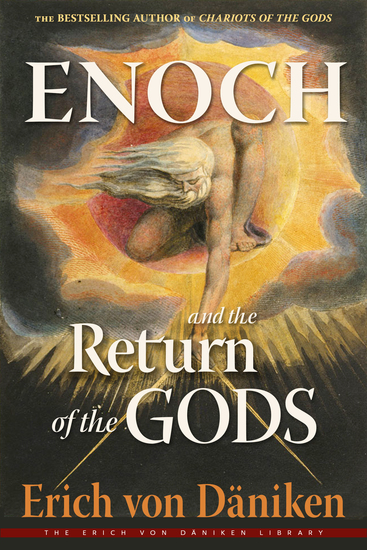
Enoch and the Return of the Gods - cover

Enoch and the Return of the Gods

Erich von Däniken

Verlag: New Page Books

  • 0
  • 0
  • 0

Beschreibung

Who Was Enoch and Did He Speak the Language of Extraterrestrials?   The bestselling author of Chariots of the Gods, Erich von Däniken, examines the great traditions of mankind—thousands of years old—for signs, traces, messages that point to early contact with extraterrestrial intelligences. The Gods were here. But when will they return? Or have they ever really left?   The culmination of long-term research, Enoch and the Return of the Gods argues that we are very much in the minds and eyes of other cosmic life-forms and that, as a result, many of the dramatic historical events and remarkable teachings of religious texts should be reinterpreted. The words of the Bible are at the center of his text-critical interpretations that pick apart the sense and nonsense of religious views. He also draws on ancient Jewish sagas and legends, reports from early historians, and Indian, Babylonian, and Persian traditions.   As always, von Däniken finds support for a number of interesting questions:  Did Adam and Eve witness a UFO?  What will Judgment Day truly be?  Why did extraterrestrials tinker with humanity’s DNA?    The Gods were here, and it is clear their influence remains to this day.   This book was first published in 1998 under the title The Return of the Gods. This new edition features a new introduction by the author.
Verfügbar seit: 03.07.2023.
Drucklänge: 256 Seiten.
Weitere Bücher, die Sie mögen werden

  • Roman Architecture - Building the Empire's Legacy - cover

    Roman Architecture - Building...

    Rogan Fish

    • 0
    • 0
    • 0
    Roman architecture emerged as a distinctive style that blended elements from earlier civilizations, primarily Greek and Etruscan influences. As Rome expanded from a small settlement into a powerful empire, its architectural identity evolved, incorporating new techniques and materials that allowed for grander and more functional structures. The early foundations of Roman architecture set the stage for innovations that would shape the empire’s urban landscape for centuries. 
    One of the most significant influences on Roman architecture came from the Etruscans, a civilization that dominated central Italy before Rome’s rise. The Etruscans were skilled builders who introduced techniques such as the use of the arch and vault, both of which would later become hallmarks of Roman engineering. Etruscan temples, with their high podiums and deep porches, also served as models for early Roman religious structures. Another major influence was Greek architecture, which Romans admired and adapted to suit their needs. The Greeks provided inspiration in the use of columns, decorative friezes, and symmetrical design, elements that were later integrated into Roman temples, public buildings, and monuments. 
    Roman architectural development was also shaped by advancements in building materials and construction techniques. The early Romans initially built using wood and mudbrick, but as they refined their skills, they transitioned to more durable materials like stone and concrete. The introduction of concrete was a groundbreaking innovation, allowing for stronger and more flexible structures. Unlike the Greeks, who relied heavily on marble, the Romans preferred concrete for its affordability and adaptability, enabling them to construct larger and more complex buildings, such as amphitheaters, aqueducts, and domes.
    Zum Buch
  • 'Til Death Did We Part - cover

    'Til Death Did We Part

    Justin Erickson

    • 0
    • 0
    • 0
    A love story between two men. This is my personal account of falling in love with a man who struggled with alcohol and drug abuse. I dive into the roots of what unconditional love can lead someone like me and perhaps you! It's a story of surviving abuse and evil while witnessing the physical, mental, emotional and spiritual decay of the man I once knew and fell in love with. It's a testament that you too don't have to be treated any less than how you would want to be treated. The fight is worth fighting and you are not alone in yours!
    Zum Buch
  • Phoney War The: The History of the Uneasy Calm along the Western Front at the Start of World War II - cover

    Phoney War The: The History of...

    Editors Charles River

    • 0
    • 0
    • 0
    Though the French would be decisively defeated soon after the Nazi invasion of Belgium and France in early 1940, they had not sat on their hands. As the power of Nazi Germany grew alarmingly during the 1930s, the French sought means to defend their territory against the rising menace of the Thousand Year Reich. As architects of the most punitive measures in the Treaty of Versailles following World War I, France was the most natural target for German retribution, so the Maginot Line, a series of interconnected strongpoints and fortifications running along much of France's eastern border, helped allay French fears of invasion.  
    	The popular legend of the Maginot Line portrays the frontier defenses as a useless “white elephant” project that was prompted by a gross misapprehension of warfare's new realities in the mid-20th century and quickly overwhelmed by the forceful advance of the German blitzkrieg. English idiom today invokes this vision of the Maginot Line as a metaphor for any defensive measure strongly believed in but actually useless. Indeed, usages such as “Maginot Line mentality,” describing an overly defensive, reactive mindset, perpetuate the legend. As a French author and military liaison with the British, Andre Maurois, wrote about his disillusionment with the defensive line he originally enthusiastically supported: “We know now that the Maginot line-complex was a dangerous disease of the mind; but I publish this as it was written in January, 1940.”  
    This was what brought about the stasis along the Western Front near the end of 1939, a short period of time now referred to as the Phoney War, during which the Western Allies awaited some sort of action by the Nazis. Ultimately, the Allies had not expected the Germans would be able to move armored units through the Ardennes Forests, a heavily wooded region spanning parts of Belgium, France and the Netherlands. 
    Zum Buch
  • Five Major Reasons Africa is Poor - A Deep Introspection on the Perpetuating Factors and what we can do to Change Them - cover

    Five Major Reasons Africa is...

    Rev Walter Mwambazi

    • 0
    • 0
    • 0
    Africa is one of the oldest continents but hasn’t it struck you as absolutely odd how a continent endowed with such wealth in terms of both ground resource as well as human resource, unbelievably great weather and wonderful soil can have such unbelievably high levels of poverty? It is nothing short of preposterous. 
    What makes this worse for is the fact that 58 years later, Africa still grapples with so much challenges that make you wonder why it has taken us so long as a people to be emancipated in every way. 
    In 1963, on 1st May, leaders from all across free and colonized Africa gathered in Addis Ababa with a dream of seeing the African continent become one giant regional power. It has not happened yet – but however that does not take away the yearning every son and daughter of the soil has to see Pan Africanism materialize. 
    The purpose for this narrative by the author in this particular book is to add his voice and help ignite any smoldering rubble of broken dreams and disenchantment back to a blazing flame. 
    It is Mwambazi’s opinion that Africa has everything it needs to become the economic engine of the entire world and can and will surpass both the West and the East should its citizens awaken to their true potential. 
    Now here is the enigma, AFRICA DOESN’T NEED THE REST OF THE WORLD TO SURVIVE BUT THE WORLD NEEDS AFRICA TO SURVIVE. I believe the Second African Renaissance is upon us, but it will take A COLLECTIVE AWAKENING OF THE GIANT’S INDIVIDUAL COMPONENTS – ITS PEOPLE!
    Zum Buch
  • The Comte de St Germain - The Secret of kings: A Monograph - cover

    The Comte de St Germain - The...

    Isabel Cooper-Oakley

    • 0
    • 0
    • 0
    The Comte de Saint Germain was a European courtier, with an interest in science and the arts. He achieved prominence in European high society of the mid-1700s. In order to deflect inquiries as to his origins, he would invent fantasies, such as that he was 500 years old, leading Voltaire to sarcastically dub him "The Wonderman".
    Zum Buch
  • Home Schooling - Fostering Creativity And Independence In Your Child - cover

    Home Schooling - Fostering...

    Owen Jones

    • 0
    • 0
    • 0
    Home schooling is an increasingly popular alternative to traditional classroom education, offering a flexible and customisable approach to learning that can be tailored to the unique needs and abilities of each child. But despite its many benefits, home schooling can also present a number of challenges, from navigating curriculum and lesson planning to fostering social connections and managing the demands of teaching and parenting at the same time. 
    This book is a beginner`s guide to home schooling, providing an overview of the different approaches, strategies, and resources available to families who choose to educate their children at home. The author covers important topics such as curriculum planning, teaching methods, assessment and evaluation, and socialisation, with a focus on practical tips and best practices. 
    This book is written for families who are new to home schooling, as well as for those who are considering it as an option, who want to learn more about this form of education. It is also for families who are currently home schooling and looking for advice and support. The book is designed to be a helpful, easy-to-read introduction to the world of home schooling, providing the information and inspiration you need to make informed decisions about your child`s education. 
    The book covers a wide range of topics, from the basics of home schooling to more advanced strategies and resources. The author will start you on the process of creating a customised curriculum that is tailored to your child`s unique needs and abilities, while also providing tips and strategies for balancing structure and flexibility, fostering creativity and independence, and navigating the challenges of home schooling. Whether you`re a new home schooling parent or a more experienced educator looking for new ideas and inspiration, this book is a useful resource for anyone interested in home schooling.
    Zum Buch