Rejoignez-nous pour un voyage dans le monde des livres!
Ajouter ce livre à l'électronique
Grey
Ecrivez un nouveau commentaire Default profile 50px
Grey
Abonnez-vous pour lire le livre complet ou lisez les premières pages gratuitement!
All characters reduced
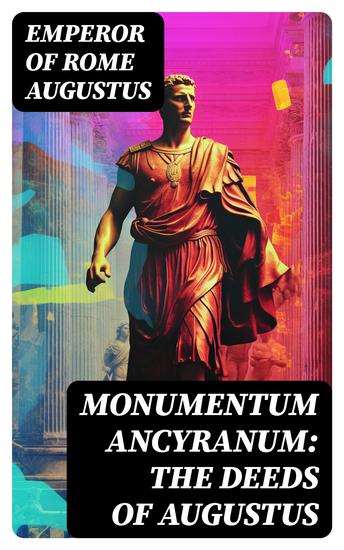
Monumentum Ancyranum: The Deeds of Augustus - cover

Monumentum Ancyranum: The Deeds of Augustus

Emperor of Rome Augustus

Maison d'édition: DigiCat

  • 0
  • 0
  • 0

Synopsis

The "Monumentum Ancyranum: The Deeds of Augustus" presents an intricately detailed account of the achievements and policies of Rome's first emperor, Augustus, inscribed on a temple wall in Ancyra (modern-day Ankara, Turkey). This monumental text combines autobiography and propaganda, skillfully employing laudatory rhetoric in its portrayal of Augustus's military victories, administrative reforms, and religious honors. Written in the classic style of Roman history, it serves not only as a personal narrative but also as a declaration of the era's political ethos, established in the wake of the turbulent Roman Republic's decline. Augustus, originally known as Gaius Octavius, rose to power following Julius Caesar's assassination, fundamentally transforming Rome from a republic to an imperial power. His reign marked a Pax Romana—an unprecedented peace across the empire. The creation of this text can be seen as part of his larger strategy to solidify his legacy while shaping public perception, a task that required deft political acumen and a deep understanding of Roman cultural values. For readers interested in the foundations of Western political thought and historical narrative, the "Monumentum Ancyranum" is essential. It not only illuminates the complexities of Augustus's rule but also offers insight into the ways leaders construct their identities. As such, it is an invaluable resource for historians, classicists, and anyone keen on understanding the origins of political power in ancient Rome.
Disponible depuis: 21/11/2023.
Longueur d'impression: 93 pages.

D'autres livres qui pourraient vous intéresser

  • COPOUT - How governments have failed the people on climate - An insider’s view of Climate Change Conferences from Paris to Dubai - cover

    COPOUT - How governments have...

    Nick Breeze

    • 0
    • 0
    • 0
    ‘Wry and passionate first-hand observations from the global climate negotiations – essential for capturing the spirit of this endlessly frustrating struggle’ – Bill McKibben 
    Most people tend to turn away, perhaps understandably, from the key existential issue of the day: climate change or, some would say more accurately, climate collapse. Nick Breeze tells the engaging, very human story of successive COP conferences over the past decade: it is a tale of imperfection, failure even, but not yet defeat. 
    So far, the UN process has achieved almost the exact opposite of what it first set out to achieve at the Rio Earth Summit in 1992. Nick shows clearly that it is not Extinction Rebellion, Just Stop Oil nor any other climate protesters who are the extremists; the true extremists are the policymakers who consistently undermine faltering efforts to reduce emissions. Repeatedly claiming to be saving us whilst allowing carbon emissions to continue rising, governments have failed their people on climate. Nick shows us how, why and what we can do about it. 
    The public remains largely uninformed about climate change and, for the most part, those who seek to draw attention to the issue are seen as ‘crazy’. There remains a terrifying gap between scientific reality and political action. 
    Packed with his own experiences and insights from expert interviewees, Nick’s page-turning account is less about the intricacies of the science and more about the mainstream perception of how we are understanding and responding to the problem.
    Voir livre
  • Roman Empire: An Enthralling Overview of Imperial Rome - cover

    Roman Empire: An Enthralling...

    Enthralling History

    • 0
    • 0
    • 0
    Did you know that not all Romans could wear togas? 
    Movies and shows might depict Romans wearing togas and sandals everywhere they went, but that was actually not the case. In fact, togas were considered formal wear and a status symbol, as those in the higher social classes typically wore them. 
    There are many surviving writings authored by ancient Roman historians that describe the interesting traditions and customs of ancient Rome. These records provide detailed insights and scenes of the empire’s past. Some throw in a few myths, while some are infused with bias. Because of this, it can be difficult for curious listeners to distinguish between facts and opinions. 
    However, with this Enthralling History audiobook, you can easily discover the fascinating journey of the ancient Roman Empire, from the emergence of its first emperor until the fall of the Western Roman Empire. 
    Here’s just a tiny fraction of what you’ll discover:How Augustus ended the decades-long civil war and rose as the empire’s “first citizen”;How the emperor’s private military forces, the Praetorian Guard, became powerful enough to slay Rome’s mad emperor;The vicious scenes of Rome’s biggest entertainment shows: the gladiatorial games and chariot races;The unique and luxurious structures of Rome that have survived to this day;Harsh punishments and training of the legionnaires;Comparison between the lush life of the wealthy and the mundane lives of commoners, slaves, and freemen;Early Christians as Emperor Nero’s scapegoats and their terrible persecution;The rise of Christianity and the sacking of Rome;And much, much more! 
    Scroll up and click the “add to cart” button to learn more about the Roman Empire!
    Voir livre
  • Nightmare Fuel - The Science of Horror Films - cover

    Nightmare Fuel - The Science of...

    Nina Nesseth

    • 0
    • 0
    • 0
    Do you like scary movies? Have you ever wondered why? 


    In Nightmare Fuel, Nina Nesseth explores the strange and often unexpected science of fear through the lenses of psychology and physiology. How do horror films get under our skin? And why do we keep coming back for more? 


    Horror films promise an experience: fear. But how exactly do filmmakers pull this off? The truth is, there's more to it than just loud noises and creepy images. 


    With the affection of a true horror fan and the critical analysis of a scientist, Nesseth explains how audiences engage horror with both their brains and bodies, and teases apart the elements that make horror films tick. Nightmare Fuel covers everything from jump scares to creature features, serial killers to the undead, and the fears that stick around to those that fade over time. 


    With in-depth discussions and spotlight features of some of horror's most popular films—from classics like The Exorcist to modern hits like Hereditary—and interviews with directors, film editors, composers, and horror academics, Nightmare Fuel is a deep dive into the science of fear, a celebration of the genre, and a survival guide for going to bed after the credits roll.
    Voir livre
  • A Rare Recording of British Prime Minister Neville Chamberlain Declaring War On Germany - cover

    A Rare Recording of British...

    Neville Chamberlain

    • 0
    • 0
    • 0
    Arthur Neville Chamberlain (March 18, 1869 - November 9, 1940) served as Prime Minister of the United Kingdom from May 1937 to May 1940.He is best known for his appeasement foreign policy, and in particular for his signing of the Munich Agreement in 1938, conceding the Sudetenland region of Czechoslovakia to Germany. When Adolf Hitler continued his aggression by invading Poland, Britain declared war on Germany on 3 September 1939, and Chamberlain led Britain through the first eight months of the Second World War.
    Voir livre
  • The Soviet Famine of 1932-1933 - Stalin's Harvest of Despair - cover

    The Soviet Famine of 1932-1933 -...

    Sarah Willards

    • 0
    • 0
    • 0
    The Soviet famine of 1932-1933, one of the most devastating events in Soviet history, can be traced back to the aggressive agricultural policies enforced under Joseph Stalin’s leadership. The roots of the famine lay in the drastic changes to agriculture during the late 1920s and early 1930s, particularly the forced collectivization campaign, which aimed to reshape the entire agricultural sector to fit the needs of the Soviet state. This chapter explores the key policies that set the stage for the disaster that would unfold in the early 1930s. 
    The first step towards the famine was the rise of collectivization, a policy introduced by Stalin to consolidate individual farms into large, state-controlled collective farms. The goal was to increase agricultural productivity and provide the state with a surplus of grain to fuel industrialization. However, this policy met with widespread resistance from peasants who feared losing their land and livelihood. In response, the Soviet government resorted to violent measures to force peasants to join collective farms, including the execution or deportation of so-called "kulaks"—wealthier peasants—whom the regime labeled as class enemies. 
    Alongside collectivization, Stalin’s government implemented harsh grain procurement quotas. These quotas demanded that peasants surrender large portions of their harvest to the state at low prices, which were often below the cost of production. The policy was particularly detrimental to regions with fertile land, where the government set even higher quotas to maximize exports, often at the expense of local populations. The pressure to meet these quotas, combined with the challenges of collectivized farming, led to a dramatic reduction in food available for local consumption.
    Voir livre
  • Substance of Leadership Bundle 2 in 1 Bundle - cover

    Substance of Leadership Bundle 2...

    Kevin Grey, Danny Fiore

    • 0
    • 0
    • 0
    Substance of Leadership Bundle, 2 in 1 Bundle: Lead With No Fear and Mindful MasterMany studies have been conducted on the subject of leadership. Some scientists argue that genetics has a strong link to leadership due to some examples of prominent families that have produced great leaders like the Kennedy's. But leadership is greatly impacted by external factors as well and no matter if you were born into a family of leaders, environmental or other external factors will still play a big part in shaping your leadership skills. Leadership starts with a focus and vision and oftentimes, leaders have great people skills that can relate well with others. Successful leaders and managers today are willing to exercise their leadership in such a way that their people are empowered to make decisions, share information, and try new things.This bundle will teach you the different factors that contribute to making a great leader. It will examine how effective leaders are able to achieve greatness despite the challenges that they face. You will learn how to improve your existing leadership skills. It will also teach you proven strategies on how you can motivate and empower your people so they could help you achieve your goals by working better and  more efficiently. This 2 in 1 bundle includes the following audiobooks:1. Lead With No Fear: The Ultimate Guide to Effective Leadership, Learn the Successful Methods and Techniques on How You Can Take Charge and Lead Your Team With No Fear2. Mindful Master: Discover the Secrets on How to Properly Motivate and Empower Your People So They Can Work Effectively Towards a Greater GoalIf you want to learn more, download your copy of Substance of Leadership 2 in 1 Bundle today!
    Voir livre