Rejoignez-nous pour un voyage dans le monde des livres!
Ajouter ce livre à l'électronique
Grey
Ecrivez un nouveau commentaire Default profile 50px
Grey
Abonnez-vous pour lire le livre complet ou lisez les premières pages gratuitement!
All characters reduced
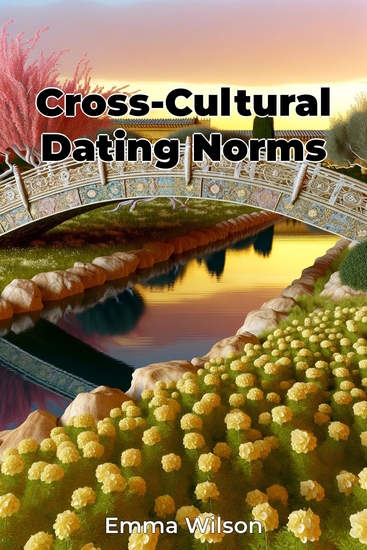
Cross-Cultural Dating Norms - cover

Cross-Cultural Dating Norms

Emma Wilson

Traducteur A Ai

Maison d'édition: Publifye

  • 0
  • 0
  • 0

Synopsis

Cross-Cultural Dating Norms provides a fascinating exploration of how different societies approach romantic relationships, challenging our assumptions about universal dating practices. Through extensive research across 30 countries, the book weaves together insights from anthropology, psychology, and sociology to create a comprehensive understanding of how cultural frameworks shape everything from initial attraction to long-term commitment. The analysis draws from 200 ethnographic studies and contemporary surveys, offering readers both historical context and modern perspectives on relationship formation.

 
The book progresses through three main sections, beginning with fundamental concepts in cross-cultural relationship formation, including traditional courtship rituals and mate selection criteria. It then examines how modern technology and globalization have transformed dating practices across different societies, with particular attention to the impact of dating apps and changing gender roles. The final section provides practical guidance for navigating cross-cultural relationships, addressing common challenges and offering evidence-based strategies for bridging cultural differences.

 
What makes this work particularly valuable is its balanced approach to examining both traditional cultural values and contemporary social changes. Using clear language and relevant examples, it serves multiple audiences from academic researchers to individuals personally involved in cross-cultural relationships. The book's analysis of emerging trends, such as the evolution of family involvement in partner selection and the impact of digital connectivity on traditional practices, provides crucial insights for understanding romantic relationships in our increasingly interconnected world.
Disponible depuis: 24/01/2025.
Longueur d'impression: 124 pages.

D'autres livres qui pourraient vous intéresser

  • Laboratories of Terror - The Final Act of Stalin's Great Purge in Soviet Ukraine - cover

    Laboratories of Terror - The...

    Marc-Stephan Junge, Lynne Viola

    • 0
    • 0
    • 0
    Laboratories of Terror explores the final chapter of Stalin's Great Terror in Soviet Ukraine. 


    When the Communist Party Central Committee and the Council of People's Commissars of the USSR halted mass operations in repression in November 1938, large numbers of mainly Communist purge victims whose cases remained incomplete were released. At the same time, hundreds of NKVD operatives who had carried out the Great Terror were scapegoated and arrested. 


    Drawing on materials from the largely closed archives of the Soviet security police, this collection of essays by an international team of researchers illuminates the previously opaque world of the NKVD perpetrator. It uncovers the mechanics and logistics of the terror at the local level by examining the criminal files of a series of mid-level NKVD operatives from across Ukraine. The result offers new perspectives on both Stalin's central role in the architecture of the terror and NKVD perpetrators' agency in implementing one of the most horrific episodes of twentieth-century mass violence.
    Voir livre
  • Anglo-Ashanti Wars and the Anglo-Zulu War The: The History of the British Empire’s Costliest Campaigns against Indigenous Africans - cover

    Anglo-Ashanti Wars and the...

    Editors Charles River

    • 0
    • 0
    • 0
    By the mid-19th century, other European powers became interested not only in the exploration of Africa but the exploitation of it, especially once the German Empire unified after the Franco-Prussian War. This began a rush, spearheaded mainly by European commercial interests in the form of chartered companies, to penetrate the African interior and woo its leadership with guns, trinkets and alcohol, and having thus obtained their marks or seals upon spurious treaties, begin establishing boundaries of future European colonies. The ease with which this was achieved was due to the fact that, at that point, traditional African leadership was disunited, and the people had just staggered back from centuries of concussion inflicted by the slave trade. Thus, to usurp authority, to intimidate an already broken society, and to play one leader against the other was a diplomatic task so simple, much of Africa would come under European influence in a short time.  
    	For almost a century, the British in West Africa were faced with a powerful and stubborn African opponent: the Ashanti Empire. The Ashanti were formed by alliance and the conquest of the Akan people in the rainforest zone between the West African coast and the Sahel country to the north. 	The Ashanti fought the British in five wars over the nineteenth century, and they were the only West African people inflicting more than one defeat on the British. War in tropical West Africa was different from most of the rest of the world. The prevalence of endemic diseases like malaria typically killed half of the Europeans posted there per year; it was called “The White Man’s Grave” for a reason. A second factor was the presence of the tsetse fly that carried a disease able to kill horses quickly. Military expeditions were left to move entirely on foot, carrying whatever drafted or hired laborers could carry. There were no carts, no wagons, no pack animals, and no cavalry. 
    Voir livre
  • Mississippian Culture The: The History and Legacy of the Ancient Indigenous Culture in North America - cover

    Mississippian Culture The: The...

    Editors Charles River

    • 0
    • 0
    • 0
    When most people think of “ancient American civilizations,” the Aztec, Maya, or Inca cultures probably come to mind immediately, because the societies in Mesoamerica have left behind permanent structures for millions of visitors from around the world to see each year. At the same time, however, from about 1000-1500 CE, an equally complex culture formed along the banks of the Mississippi, Missouri, and Ohio Rivers. From Red Wing, Minnesota to Greenhouse, Louisiana, and from Spiro, Oklahoma to Macon, Georgia, societies built impressive mound structures that served as ritual platforms, burial sites, and residences for the elites. These mounds also served as the focal points of urban areas of varying sizes that were connected to each other through trade and ideology, forming a culture that modern historians have since designated the “Mississippian culture.”  
    	It has only been recently that modern archaeological, anthropological, and historical methods were utilized to create a somewhat accurate image of the Mississippian culture’s reach and importance in the wider contexts of American and world history. Today, historians have a much better understanding of many aspects of Mississippian culture, including its chronology, the religion of the people, urbanization, and how the people lived, and the fact that there were fully functioning complex societies that had sophisticated forms of government and long-distance trade networks. 	The mounds they made, which continue to serve as standing testaments to their extraordinary accomplishments, continue to be studied by experts who still have plenty of questions about the societies that produced them. But one thing’s for sure: with no evidence of a written language and a high probability that the groups spoke different languages (based on the earliest lingual patterns encountered from each region), what the Mississippian culture accomplished in the span of a few centuries is nothing short of phenomenal. 
    Voir livre
  • Summer of 1876 The: Book Summary & Analysis - cover

    Summer of 1876 The: Book Summary...

    Alexander Pike

    • 0
    • 0
    • 0
    This content is an independent and unofficial summary created for informational and educational purposes only. It is not affiliated with, authorized, approved, licensed, or endorsed by the original author or publisher. All rights to the original work belong to its respective copyright holders. This summary is not intended to substitute the original book, but to offer a concise overview and interpretation of its main ideas.


    Step into one of the most pivotal seasons in American history—a time of invention, ambition, and reckoning. The Summer of 1876 brings to life a whirlwind of events that reshaped a nation on the edge of transformation. From the smoky battlefields of Little Bighorn to the clinking poker chips of Deadwood, from the rising hum of telegraphs to the thunder of trains racing across the plains, this gripping chronicle captures a summer when destiny galloped forward.
     
    Meet iconic figures like George Armstrong Custer, Wild Bill Hickok, and Wyatt Earp—not as legends, but as men driven by urgency, ego, and fate. Witness how innovation collided with conflict, and how small choices sparked massive consequences. With vivid detail and cinematic pace, this audiobook transforms the past into a blueprint for personal growth, leadership, and decision-making in high-stakes environments.
    Voir livre
  • Empire of Rum - The Unofficial Economy of Early Australia - cover

    Empire of Rum - The Unofficial...

    Ylia Callan

    • 0
    • 0
    • 0
    This audiobook is narrated by an AI Voice.   
    Empire of Rum – The Unofficial Economy of Early Australia is a gripping journey through the colony’s most intoxicating secret: that rum, not coin, built Australia. 
    In the fledgling settlement of New South Wales, alcohol was more than a drink - it was money, power, and survival. From the notorious Rum Corps to the only successful military coup in Australian history, this audiobook brings to life the corruption, rebellion and everyday struggles that flowed through the barrels of rum. 
    But the story doesn’t stop in the past. Linking colonial rum trading to modern Australia, this powerful work shows how alcohol still fuels crime, family breakdown, and an overwhelmed justice system. 
    Part history, part social critique, Empire of Rum pulls no punches in exposing how alcohol became and remains a currency of control. 
    Perfect for listeners of Australian history, true crime, and social justice narratives.
    Voir livre
  • Death Glitch - How Techno-Solutionism Fails Us in This Life and Beyond - cover

    Death Glitch - How...

    Tamara Kneese

    • 0
    • 0
    • 0
    An accessible yet erudite deep dive into how platforms are remaking experiences of death 


    Since the internet's earliest days, people have died and mourned online. In quiet corners of past iterations of the web, the dead linger. But attempts at preserving the data of the dead are often ill-fated, for websites and devices decay and die, just as people do. Death disrupts technologists' plans for platforms. It reveals how digital production is always collaborative, undermining the entrepreneurial platform economy and highlighting the flaws of techno-solutionism. 


    Big Tech has authority not only over people's lives but over their experiences of death as well. Ordinary users and workers, though, advocate for changes to tech companies' policies around death. Drawing on internet histories along with interviews with founders of digital afterlife startups, caretakers of illness blogs, and transhumanist tinkerers, the technology scholar Tamara Kneese takes listeners on a vibrant tour of the ways that platforms and people work together to care for digital remains. What happens when commercial platforms encounter the messiness of mortality?
    Voir livre