Rejoignez-nous pour un voyage dans le monde des livres!
Ajouter ce livre à l'électronique
Grey
Ecrivez un nouveau commentaire Default profile 50px
Grey
Abonnez-vous pour lire le livre complet ou lisez les premières pages gratuitement!
All characters reduced
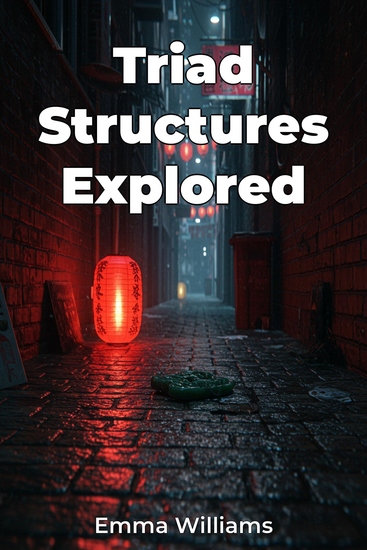
Triad Structures Explored - cover

Triad Structures Explored

Emma Williams

Traducteur A AI

Maison d'édition: Publifye

  • 0
  • 0
  • 0

Synopsis

Triad Structures Explored offers a deep dive into the clandestine world of Chinese Triads, examining their history, organizational structures, and impact on global crime. This book dissects how these criminal organizations have evolved from 17th-century resistance movements to modern transnational enterprises involved in activities from drug trafficking to political corruption. It reveals that Triads are not monolithic but rather dynamic networks with internal rivalries and shifting alliances. The book meticulously explores the Triads' internal mechanics, including their hierarchical arrangements and codes of conduct, providing a nuanced perspective often missed in traditional depictions. Readers will gain insights into the socio-political factors contributing to their resilience.

 
For example, the book highlights how periods of dynastic upheaval and economic reform have shaped Triad operations. Beginning with core concepts of Triad membership, the book progresses through the historical evolution of Triad societies, contemporary organizational structures, and diverse criminal activities. It concludes with an analysis of law enforcement challenges and recommendations for effective strategies. This comprehensive approach, grounded in law enforcement reports and academic research, makes it invaluable for academics, law enforcement, and anyone interested in understanding organized crime.
Disponible depuis: 21/02/2025.
Longueur d'impression: 71 pages.
D'autres livres qui pourraient vous intéresser

  • The Courage Connection - How to Build a Life You Love - cover

    The Courage Connection - How to...

    Caleb David

    • 0
    • 0
    • 0
    Unlock the secret to building a life you love with "The Courage Connection: How to Build a Life You Love". This inspiring guide provides a proven framework to help you develop the courage, confidence, and resilience needed to create a fulfilling life. With engaging stories, practical strategies, and expert insights, you'll learn how to overcome fear, build meaningful relationships, and pursue your passions. Get ready to connect with your inner strength, build a life of purpose, and live with courage and intention.
    Voir livre
  • The Kingdom of God Is Within You - cover

    The Kingdom of God Is Within You

    Leo Tolstoy

    • 0
    • 0
    • 0
    Banned in Russia, Tolstoy's The Kingdom of God Is Within You was deemed a threat to church and state. The culmination of a lifetime's thought, it espouses a commitment to Jesus's message of turning the other cheek. In a bold and original treatise, Tolstoy shows his readers clearly why they must reject violence of any sort—even that sanctioned by the state or the church—and urges them to look within themselves to find the answers to questions of morality.
    
    In 1894, one of the first English translations of this book found its way into the hands of a young Gandhi. Inspired by its message of nonresistance to evil, the Mahatma declared it a source of "independent thinking, profound morality, and truthfulness". Much of this work's emotional and moral appeal lies in its emphasis on fair treatment of the poor and working class. Its view of Christianity, not as a mystic religion but as a workable philosophy originating from the words of a remarkable teacher, extends its appeal to secular and religious listeners alike.
    Voir livre
  • Dust and Light - On the Art of Fact in Fiction - cover

    Dust and Light - On the Art of...

    Andrea Barrett

    • 0
    • 0
    • 0
    The celebrated National Book Award–winning writer's intimate exploration of how fact is transformed into fiction. 


    In this thoughtful collection of essays, Andrea Barrett draws from her experiences writing some of the most acclaimed historical fiction of our time to explore the mysteries and delights of the genre. Inspiration found in the past, she argues, can illuminate fiction, just as dust scatters light and makes the unseen visible. Delving into some of the largest questions in the genre—How does a writer find meaningful subject matter beyond the confines of their life? How are scraps of history transformed into a fully formed narrative?—Barrett explores how she came to create some of her beloved works and explores lessons gleaned from the work of such masters of historical fiction as Toni Morrison, Leo Tolstoy, Hilary Mantel, and Colm Tóibín. Candid and elegant, Dust and Light is the perfect book for anyone who loves reading fiction set in the past, as well as for anyone aspiring to write it.
    Voir livre
  • The Republic - cover

    The Republic

    Plato

    • 0
    • 0
    • 0
    The Republic (Greek: Politeia) is a Socratic dialogue, written by Plato around 380 BC, concerning the definition of (justice), the order and character of the just city-state and the just man, reason by which ancient readers used the name On Justice as an alternative title (not to be confused with the spurious dialogue also titled On Justice). The dramatic date of the dialogue has been much debated and though it must take place some time during the Peloponnesian War, "there would be jarring anachronisms if any of the candidate specific dates between 432 and 404 were assigned".    It is Plato's best-known work and has proven to be one of the most intellectually and historically influential works of philosophy and political theory. In it, Socrates along with various Athenians and foreigners discuss the meaning of justice and examine whether or not the just man is happier than the unjust man by considering a series of different cities coming into existence "in speech", culminating in a city (Kallipolis) ruled by philosopher-kings; and by examining the nature of existing regimes.    The participants also discuss the theory of forms, the immortality of the soul, and the roles of the philosopher and of poetry in society. Short Summary (Epilogue): X.1—X.8. 595a—608b. Rejection of Mimetic Art X.9—X.11. 608c—612a. Immortality of the Soul X.12. 612a—613e. Rewards of Justice in Life X.13—X.16. 613e—621d. Judgment of the Dead The paradigm of the city — the idea of the Good, the Agathon — has manifold historical embodiments, undertaken by those who have seen the Agathon, and are ordered via the vision. The centre piece of the Republic, Part II, nos. 2–3, discusses the rule of the philosopher, and the vision of the Agathon with the allegory of the cave, which is clarified in the theory of forms.    The centre piece is preceded and followed by the discussion of the means that will secure a well-ordered polis (City). Part II, no. 1, concerns marriage, the community of people and goods for the Guardians, and the restraints on warfare among the Hellenes. It describes a partially communistic polis. Part II, no. 4, deals with the philosophical education of the rulers who will preserve the order and character of the city-state. In Part II, the Embodiment of the Idea, is preceded by the establishment of the economic and social orders of a polis (Part I), followed by an analysis (Part III) of the decline the order must traverse. The three parts compose the main body of the dialogues, with their discussions of the "paradigm", its embodiment, its genesis, and its decline. The Introduction and the Conclusion are the frame for the body of the Republic.    The discussion of right order is occasioned by the questions: "Is Justice better than Injustice?" and "Will an Unjust man fare better than a Just man?" The introductory question is balanced by the concluding answer: "Justice is preferable to Injustice". In turn, the foregoing are framed with the Prologue (Book I) and the Epilogue (Book X). The prologue is a short dialogue about the common public doxai (opinions) about "Justice". Based upon faith, and not reason, the Epilogue describes the new arts and the immortality of the soul.
    Voir livre
  • Reality Check - In Pursuit of the Right Questions - cover

    Reality Check - In Pursuit of...

    Carlo Mahfouz

    • 0
    • 0
    • 0
    "Reality Check is a book I wish I had 15 years ago. It’s packed with examples and insights on how to get your questions right in order to improve and change. " — Ola Helland, Writer of the comedy/science TV show Brille. 
    Amidst the constant whirlwind of change, clarity feels elusive as we desperately grasp for answers when it’s the transformative power of questions that we truly need. Author Carlo Mahfouz, a fervent believer in the art of inquiry, invites us on a voyage to uncover the profound clarity within these catalytic moments—epiphanies he terms "Reality Checks." 
    Synthesizing decades of change leadership experience with research-backed frameworks, Carlo Mahfouz reverse-engineered these moments and laid bare the hidden preparations, allowing anyone to formulate the right strategic questions at the right time — bringing a philosophical perspective down to earth through Carlo's own immigrant journey, his unlikely opera training, and more to humanize each rich concept. 
    Mahfouz taps unconventional wisdom from interviews with global innovators from across the world, such as:CEO of the world’s first mind-controlled bionic arm;VP of strategy at a Fortune 500 science and technology innovator; Senior Executive at one of the world’s leading EdTech companies in Healthcare. 
    … and many more with experience ranging from working at NASA to Nonduality coaching and selfless leadership. 
    You’ll examine overlooked elements like context, time, and self-awareness through a potent new lens designed to upgrade your sense-making skills in chaotic times. Mahfouz aims to help you experience your own "Reality Check" to unlock the art of precision and presence in your leadership, innovation, and life.
    Voir livre
  • The Politics of Digital Pharmacology - Exploring the Craft of Collective Care - cover

    The Politics of Digital...

    Felix Heidenreich, Florian...

    • 0
    • 1
    • 0
    Digitization is transforming our world economically, culturally, and psychologically. The influx of new forms of communication, networking, and business opportunities, as well as new types of distraction, self-observation, and control into our societies represents an epochal challenge. Following Bernard Stiegler's concept of pharmacology, Felix Heidenreich and Florian Weber-Stein propose to view these new forms as digital pharmaka. Properly dosed, they can enable new self-relationships and forms of sociality; in the case of overdose, however, there is a risk of intoxication.
    In this essay, Felix Heidenreich, Florian Weber-Stein, and, in a detailed interview, Bernard Stiegler analyze this complex change in our world and develop new skills to use digital pharmaka.
    Voir livre