Join us on a literary world trip!
Add this book to bookshelf
Grey
Write a new comment Default profile 50px
Grey
Subscribe to read the full book or read the first pages for free!
All characters reduced
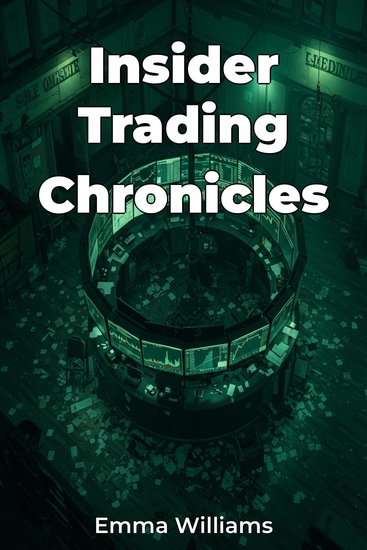
Insider Trading Chronicles - cover

Insider Trading Chronicles

Emma Williams

Translator A AI

Publisher: Publifye

  • 0
  • 0
  • 0

Summary

Insider Trading Chronicles explores the shadowy realm of corporate malfeasance, uncovering the methods and impacts of insider trading. This book reveals how individuals exploit confidential information for illicit profits, thereby undermining market integrity. One might be surprised to learn how far back the legal precedents go, with initial regulations often ambiguous, evolving into today's stringent enforcement mechanisms. The book also highlights the constant "cat-and-mouse game" between perpetrators and regulators, driven by the persistent human impulse to exploit informational advantages.

 
The book begins by defining insider trading and its various forms, using real-world examples, and then progresses to dissecting high-profile cases involving regulatory bodies like the SEC and FINRA. It examines the legal and ethical ramifications, including landmark legislation and judicial decisions. Finally, it considers the future of regulation, including AI's role. This approach, focusing on both the crime and the regulatory response, makes Insider Trading Chronicles a valuable resource for understanding this crucial aspect of financial crime.
Available since: 02/20/2025.
Print length: 80 pages.

Other books that might interest you

  • Unthinkable: Book Summary & Analysis - cover

    Unthinkable: Book Summary &...

    Briefly Summaries

    • 0
    • 0
    • 0
    This is a concise summary and analysis of Unthinkable, by Jamie Raskin.
     
    It is not the original book and is not affiliated with or endorsed by Jamie Raskin.
     
    Ideal those seeking a quick and insightful overview.
     
    In Unthinkable, a gripping and deeply personal account, a sitting U.S. congressman recounts his journey through unimaginable grief and political turmoil. Following the tragic loss of his son and the chaos of the January 6th Capitol insurrection, he confronts the collision of private pain and public responsibility. The book offers a compelling exploration of resilience, democracy, and the enduring hope for a better future, revealing the profound humanity behind public service in the face of crisis.
    Show book
  • Loss and What it Taught Me About Living - A Memoir of Love Grief Hope and Healing - cover

    Loss and What it Taught Me About...

    Ralph Riegel, Tracey Corbett-Lynch

    • 0
    • 0
    • 0
    Murder, cancer, Covid-19, an asthma attack and heart attacks: Tracey Corbett-Lynch has encountered loss in all its guises and has had to learn how to cope with life at its most difficult and overwhelming.
    In Loss and What It Taught Me About Living, Tracey describes these tragic losses, their impact on her and how she learnt to live alongside them with strength and grace. She recounts how she coped when it all seemed too much to bear and looks at how we can emerge from suffering forever changed by loss but filled with optimism.
    No two grief journeys are the same, but, as Tracey discovered, some of the stations along the route are. Her moving and uplifting story will offer comfort, practical advice and a ray of hope to anyone suffering their own loss, whatever that might be.
    Show book
  • Loss Adjustment - cover

    Loss Adjustment

    Linda Collins

    • 0
    • 0
    • 0
    “I have had nothing bad happen to me except my own doing. I have let this cowardice envelop me, and I can’t shake it off. I will commit the worst thing you can ever do to someone who loves you: killing yourself. The scary thing is, I’m okay with that.” —Victoria McLeod, Singapore, March 30, 2014 
     
    Loss Adjustment is a mother’s recount of her 17-year-old daughter’s suicide. 
     
    In the wake of Victoria McLeod’s passing, she left behind a remarkable journal in her laptop of the final four months of her life. Linda Collins, her mother, has woven these into her memoir, which is at once cohesive, yet fragmented, reflecting a survivor's state of mind after devastating loss. 
     
    Loss Adjustment involves the endless whys, the journey of Linda Collins and her husband in honouring Victoria, and the impossible question of what drove their daughter to this irretrievable act. A stunningly intimate portrait of loss and grief, Loss Adjustment is a breaking of silence—a book whose face society cannot turn away from.
    Show book
  • Benito Mussolini - cover

    Benito Mussolini

    Cyril Taylor-Carr

    • 0
    • 0
    • 0
    “It’s better to live one day as a lion than 100 years as a sheep.”"I am the most terrible animal that's ever existed.""Democracy is beautiful in theory; in practice, it is a fallacy. You in America will see that someday.""It's good to trust others but, not to do so is much better."“I feel, when we have no friends upon whom to lean, or to look for moral guidance." (Mussolini)Benito Amilcare Andrea Mussolini, born on July 29, 1883, who went by the nickname “Il Duce” (“the Leader”), was a deeply unbalanced tyrannical Italian dictator who created the dreaded Fascist Party in 1919. Eventually, he held all power in Italy as the country’s prime minister from 1922 to 1943. An ardent socialist as a youth, Mussolini followed in his father's political footsteps but was expelled by the party for his overt support of World War I. As an evil dictator during World War II (even murdering his own son by lethal injection) he greatly overextended his forces and was eventually killed by his own people in Mezzegra, Italy. Here, for the first time, are the words of the great dictator himself in his twisted manifesto on the political movement he started and is still so feared to this very day.
    Show book
  • Life as We Know It - Stories of People Climate and Hope in a Changing World - cover

    Life as We Know It - Stories of...

    Bill Weir

    • 0
    • 0
    • 0
    Award-winning journalist Bill Weir confronts the biggest threats to life as we know it and explores ideas for building a more promising future. 
     
    Bill Weir has spent decades telling the stories of unique people, places, cultures, and creatures on the brink of change. As the first Chief Climate Correspondent in network news, he is immersed in the latest scientific warnings and breakthroughs while often on the frontlines of disasters, natural and manmade. 
     
    After the birth of his son in April 2020, Bill began distilling these experiences into a series of Earth Day letters to his boy, weaving together worry and wonder into a poignant reminder that a better future can still be written. Life as We Know It (Can Be) digs into fascinating corners of history, psychology, technology, and Bill’s own biography to connect the lessons he’s collected from the happiest, healthiest, and most resilient societies. From the sun-powered town that kept its lights on in a hurricane to the Antarctic nests of the one penguin species thriving amid climate change, Bill takes readers around the world to collect dozens of practical ideas to help build a more resilient future.  
     
    Life as We Know It (Can Be) is a celebration of the wonders of our planet, a meditation on the human wants and needs that drive it out of balance, and an inspiration for communities to galvanize around nature and each other as the very best way to brace for what’s next. 
     
    “There is no other correspondent like Bill Weir, and there’s certainly no other book like this one. It’s moving, funny, frank, well-researched, beautifully written, and looks at climate change in a way I’ve never seen before.”—Anderson Cooper, CNN anchor, 60 Minutes correspondent, and New York Times–bestselling author
    Show book
  • A Lickpenny Lover - From their pens to your ears genius in every story - cover

    A Lickpenny Lover - From their...

    O Henry

    • 0
    • 0
    • 0
    William Sydney Porter was born on 11th September 1862 in Greensboro, North Carolina. At age 3 his mother died from tuberculosis. From an early age it was clear Porter had a large appetite for reading as he absorbed the world around him. 
    He first attended at a school run by his aunt before enrolling at the Lindsey Street High School and then worked at his uncle’s drugstore and gained a pharmacists’ license in 1881.  
    A persistent cough took him to Texas in the hope that a change of climate would help his symptoms. He took on various types of work, initially from ranch hand and cook and then as varied as pharmacist, draftsman, bank teller and journalist. He also began to write, though for now, purely as a hobby. 
    He was a member of several singing and dramatic groups when he met 17 year old Athol Estes, daughter of a wealthy Austin family. Despite her mother’s objection owing to Athol’s tuberculosis, they began courting and in July 1887, they eloped and soon married. 
    Athol, impressed by his writing, encouraged him to get them published. A job as a draftsman at the Texas General Land Office paid a healthy $100 dollars per month and life was good. 
    But then life turned cruel. His son died a few hours after birth although a daughter, Margaret, came the following year.  His job had to be vacated but another was found at the First National Bank of Austin. The bank operated informally and Porter was careless in keeping the books. He lost that job but began writing for the humourous weekly The Rolling Stone and the Houston Post. Some time later the federal Bank auditors went through his former accounts and he was arrested on charges of embezzlement. 
    Porter fled the day before his trial to Honduras. Holed up for several months he began to write.  Athol had become too ill to travel to meet him and learning that her health was deteriorating he surrendered to the court in February 1897.  Bail was obtained so that he could stay with Athol during her final days.  
    Porter was sentenced to five years at the Ohio Penitentiary in Columbus. His pharmacy qualifications got him the job of night druggist.  His sentence also gave him time to write and publish fourteen short stories. In December 1899 in McClure’s Magazine he published a short story as O Henry.  
    He was released two years early in July 1901, and reunited with Margaret, now 11, in Pittsburgh.  He now began his most prolific period of writing; a short story per week for the New York World, while also publishing works in other magazines.  Eventually over 600 of his short stories were published. 
    Porter was a heavy drinker and in 1908 his health, which had deteriorated for several years, took a dramatic turn for the worse, as did his writing.  
    O Henry died of cirrhosis of the liver complicated by diabetes and an enlarged heart on 5th June 1910.
    Show book