Join us on a literary world trip!
Add this book to bookshelf
Grey
Write a new comment Default profile 50px
Grey
Subscribe to read the full book or read the first pages for free!
All characters reduced
Babylonian Time - cover

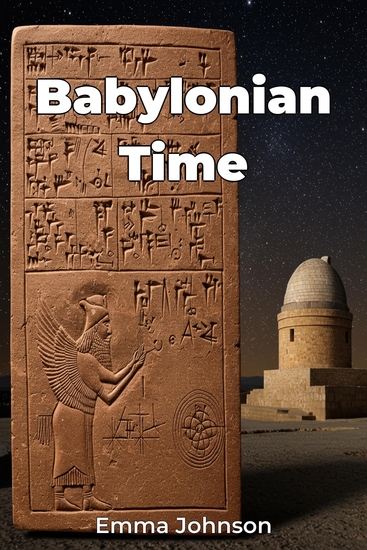
Babylonian Time

Emma Johnson

Translator A AI

Publisher: Publifye

  • 0
  • 0
  • 0

Summary

Babylonian Time explores the origins of our modern timekeeping methods, revealing the sophisticated astronomical and mathematical systems of ancient Mesopotamia. It details how the Babylonians ingeniously predicted eclipses and shaped our perception of time. The book highlights the development and application of their sexagesimal system, a base-60 number system, which influenced everything from measuring angles to dividing time into hours, minutes, and seconds – a legacy still present today. It further shows how meticulous observations, recorded on cuneiform tablets, enabled these predictions and advanced their calendar systems.

 
The book provides historical context, explaining the social and political structure of ancient Mesopotamia and the role of priests and scribes in astronomical observation. It progresses by examining Babylonian mathematical techniques for predicting eclipses, exploring their calendar systems used to regulate agricultural cycles and religious observances, and analyzing the transmission of Babylonian astronomical knowledge to other cultures, including the Greeks.

 
By examining cuneiform texts and archaeological findings, Babylonian Time demonstrates how echoes of Babylonian thought are still audible in our daily lives.
Available since: 03/04/2025.
Print length: 55 pages.

Other books that might interest you

  • The Essays of Arthur Schopenhauer - cover

    The Essays of Arthur Schopenhauer

    Arthur Schopenhauer

    • 0
    • 0
    • 0
    "The Essays of Arthur Schopenhauer" is a collection of philosophical writings by the renowned German philosopher. Schopenhauer delves into diverse topics such as ethics, aesthetics, metaphysics, and human nature. His essays explore the human condition, the power of art, the nature of suffering, and the concept of the "will." Schopenhauer's work is characterized by its profound insights and a pessimistic view of existence. These essays provide readers with a unique perspective on the complexities of life and the human experience. Read in English, unabridged.
    Show book
  • Crassus - The First Tycoon - cover

    Crassus - The First Tycoon

    Peter Stothard

    • 0
    • 0
    • 0
    The story of Rome's richest man, who died a humiliating desert death in search of military glory 


    Marcus Licinius Crassus (115–53 BCE) was a modern man in an ancient world, a pioneer disrupter of finance and politics, and the richest man of the last years of the Roman republic. Without his catastrophic ambition, this trailblazing tycoon might have quietly entered history as Rome's first modern political financier. Instead, Crassus and his son led an army on an unprovoked campaign against Parthia into what are now the borderlands of Turkey, Syria, and Iraq, losing a battle at Carrhae which scarred Roman minds for generations. 


    After Crassus was killed, historians told many stories of his demise. Some said that his open mouth, shriveled by desert air, had been filled with molten gold as testament to his lifetime of greed. His story poses both immediate and lasting questions about the intertwining of money, ambition, and power.
    Show book
  • How To Write Photoplays - cover

    How To Write Photoplays

    Embrie Zuver

    • 0
    • 0
    • 0
    Written during the formative years of motion pictures, How to Write Photoplays (Third Edition) by Embrie Zuver is a practical, no-nonsense guide to storytelling in the silent-film era—when images carried meaning, structure was everything, and writers learned to think in reels rather than words. 
    Designed for aspiring photoplaywrights, this instructional manual walks listeners step by step through the complete process of creating a market-ready scenario. Zuver defines the technical language of early studios and cameras, then explains how to generate ideas, shape plots, control pacing, and build emotion without dialogue. Topics include scenario formatting, titles and synopses, character lists, scene construction, continuity, entrances and exits, subtitles and inserts, crisis-to-climax structure, revision practices, manuscript preparation, sales etiquette, censorship considerations, and the realities of the production pipeline. 
    The book concludes with a full sample photoplay, Timid Teddy, illustrating every principle in action through a lighthearted romantic comedy of misunderstandings, social pressure, and earned affection—demonstrating how careful structure and visual storytelling could carry an audience to a satisfying conclusion. 
    Clear, encouraging, and firmly grounded in professional practice, How to Write Photoplays offers a rare inside look at how films were written before sound—and remains a valuable study in visual storytelling, narrative discipline, and the foundations of screenwriting itself.
    Show book
  • Gavin at War - The World War II Diary of Lieutenant General James M Gavin - cover

    Gavin at War - The World War II...

    Lewis Sorley

    • 0
    • 0
    • 0
    Lieutenant General James Gavin, commander of the 82nd Airborne Division during WWII, is one of the best-known figures of the war. Beginning as the commander of the 505th Parachute Combat Team that spearheaded the American assault on Sicily in July 1943, Gavin advanced to division command and finally command of US forces in Berlin. He kept a wartime diary that starts in April 1943, as the unit was preparing to go to northern Africa and continues through to his final entry on September 1, 1945, during the occupation of Berlin. 


    During the war years, Gavin came into close contact with virtually all the leading airborne commanders and many others who would advance to the top levels of Army leadership. His diary includes observations on fellow military and political leaders, army operations, and the general's personal life. Gavin was an officer who led by example: on four combat jumps, he was the first man out the door. 


    For decades, Gavin kept the existence of the journal a secret; the general's family discovered it among his belongings after his death. Editor Lewis "Bob" Sorley has worked closely with the Gavin family and the Army Heritage Center to prepare the diary for publication. His edited and annotated version includes a prologue and epilogue to frame the entries within the wider scope of the general's life.
    Show book
  • Ecce Homo - cover

    Ecce Homo

    Friedrich Nietzsche

    • 0
    • 0
    • 0
    “Without music, life would be a mistake.”“It is not a lack of love, but a lack of friendship that makes unhappy marriages.” ...“That which does not kill us makes us stronger.”“I'm not upset that you lied to me, I'm upset that from now on I can't believe you.” 
    Nietzsche 
     
    The philosopher Friedrich Nietzsche's autobiography, Ecce Homo, was the last prose work that he wrote before his illness in 1889. Coming at the end of an extraordinarily productive year in which he had produced The Twilight of the Idols and The Antichrist, Nietzsche shuns any pretense at modesty with chapter titles include “Why I am so Wise”, “Why I am so Clever” and “Why I Write Such Excellent Books”. His translator Anthony M. Ludovici states, Ecce Homo “is not only a coping-stone worthy of the wonderful creations of that year, but also a fitting conclusion to his whole life, in the form of a grand summing up of his character as a man, his purpose as a reformer, and his achievement as a thinker. 
     
    Friedrich Wilhelm Nietzsche was a German philosopher, cultural critic and philologist whose work has exerted a profound influence on modern intellectual history. He began his career as a classical philologist before turning to philosophy.
    Show book
  • Metamorphosis or The Golden Ass - cover

    Metamorphosis or The Golden Ass

    Lucius Apuleius

    • 0
    • 0
    • 0
    The Metamorphosis, also known as The Golden Ass, is one of the very few novels of the Ancient World that survived to our days; one of the two novels of Roman Literature that we can still read; and the only one preserved in its entirety (the other one being the extremely fragmentary Satyricon). 
     
    The story of the Metamorphosis, the tale of a man turned into a donkey that goes through many adventures to become a man again, inspired many other similar ones later on. However, more than just the plot, the style of the Golden Ass also made it famous.  
     
    Considered one of the precursors of the picaresque novel, The Metamorphosis was written in a language that can be humorous and energetic, while telling the misadventures of the credulous and curious main character, but also powerfully poetic, in moments such as in the episode of Cupid and Psyche, one of the most famous parts of this book, and of Latin literature as a whole. (Summary by Leni)
    Show book