Begleiten Sie uns auf eine literarische Weltreise!
Buch zum Bücherregal hinzufügen
Grey
Einen neuen Kommentar schreiben Default profile 50px
Grey
Jetzt das ganze Buch im Abo oder die ersten Seiten gratis lesen!
All characters reduced
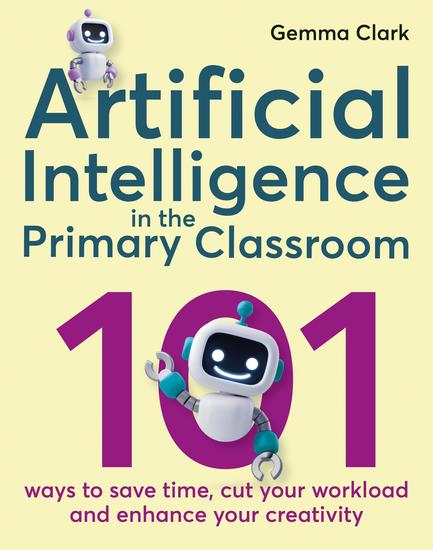
Artificial Intelligence in the Primary Classroom - 101 ways to save time cut your workload and enhance your creativity - cover

Artificial Intelligence in the Primary Classroom - 101 ways to save time cut your workload and enhance your creativity

Emma Clarke

Verlag: Crown House Publishing

  • 0
  • 0
  • 0

Beschreibung

Artificial intelligence (AI) undoubtedly sparks debate among teachers. Questions arise about the trajectory of this new technology: where will it take us?; how will we differentiate between student-authored work and AI-generated content?; what impact will it have on the dynamics of learning and teaching within schools? These are all crucial topics for discussion, yet AI has already become an integral part of our reality, and Gemma Clark firmly believes that embracing its potential is in our best interests.
In an era defined by technological advancements, Artificial Intelligence in the Primary Classroom stands as an indispensable resource that holds the key to transforming teaching and learning. For educators burdened by bureaucratic tasks that divert precious time from actual teaching, this book offers a lifeline. It showcases how AI-powered tools can alleviate administrative burdens, enabling teachers to focus more on crafting personalised and imaginative lessons that resonate with young minds. From automating report-writing processes to facilitating content creation, the book imparts tangible methods to streamline workflows and elevate teaching quality. Other examples include:

- Spelling Lessons: Save time when planning your spelling lessons by using AI to automatically generate a comprehensive list of phonemes or 'sounds suitable for teaching young children.'
- Mindfulness in the Classroom: If you are interested in incorporating mindfulness games and activities to assist children in relaxation and focus, AI can provide valuable suggestions for fostering pupil (and staff) wellbeing.
- PE Lessons: You don't have to be an expert in sport to teach PE. Whether it's tennis, football, rugby or running, AI can offer suggestions for activities, warm-ups and cool-downs to use in your PE lessons.
- Art Lessons: AI can be an excellent resource for planning art lessons, especially when seeking suggestions to emphasize one of the eight elements, such as line, shape, form, colour, value, texture, space, and value.
- Maths Lessons: As with spelling, AI can significantly reduce the time spent on creating maths questions and simplify the process of differentiation.Artificial Intelligence in the Primary Classroom is filled with practical strategies, engaging activities and useful tips and tricks that will save teachers time and energy as well as transferrable lesson plans with step-by-step instructions. Backed up by real-world examples throughout, this book empowers teachers to embrace AI as a tool in fostering enhanced learning experiences, while also reclaiming invaluable time for pedagogical creativity.
Suitable for primary school teachers of all levels of experience.
Verfügbar seit: 28.02.2024.
Drucklänge: 256 Seiten.
Weitere Bücher, die Sie mögen werden

  • Passport to Shame - From Asian Immigrant to American Addict - cover

    Passport to Shame - From Asian...

    MA Sam Louie

    • 0
    • 0
    • 0
    A psychotherapist's candid memoir of addiction and recovery, exploring the intersection of Asian culture, mental health, and assimilating into American culture as an ethnic minority. 


    Sam Louie grew up torn between cultures as part of a first-generation Chinese immigrant family from Hong Kong living in a predominantly African American neighborhood in the United States. He experienced the duality of existence with the tension of two vastly different worldviews, his identity intertwined with the country he lives in and his ancestral ties. What traditions and cultural beliefs get preserved, what gets discarded, and what gets lost in translation? Beneath it all was the presence of three generations of addiction, trauma, and shame. 


    In this insightful book, he documents the challenges of immigrant experiences and how maladaptive coping mechanisms in the form of compulsive behaviors were a means to gain a sense of adequacy due to the cultural tide of shame and ostracism within his own ethnic heritage and the world. 


    Louie's journey of resiliency in navigating multiple cultural forces in the face of adversity can give listeners a new understanding of hope, perseverance, and the resources to heal.
    Zum Buch
  • Democracy Under Fire - Donald Trump and the Breaking of American History - cover

    Democracy Under Fire - Donald...

    Lawrence R. Jacobs

    • 0
    • 0
    • 0
    Before Trump even ran for President, his disdain for the rules, procedures, and norms of American democracy and the US Constitution was well-known and led prominent Republicans to repudiate him as "unfit" for the GOP nomination. Given the clear-eyed assessment of candidate Trump, why did the Republican Party nominate him as its presidential candidate in 2016 and then stand by him during the next four years? 


    Much of the attention paid to Trump's rise to power has focused on his corrosive personality and divisive style of governing. But he alone is not the problem. The vulnerability is much broader and deeper. The ascendance of Trump is the culmination of nearly 250 years of political reforms that gradually ceded party nominations to small cliques of ideologically-motivated party activists, interest groups, and donors. 


    In Democracy under Fire, Lawrence Jacobs provides a highly engaging history of political reforms since the late-eighteenth century that over time dangerously weakened democracy, widened political inequality as well as racial disparities, and rewarded toxic political polarization. Jacobs's searing indictment of political reformers concludes with recommendations to restrain the unbridled ambition of politicians who thrive on division and instead generate broad citizen engagement with tangible policy making.
    Zum Buch
  • The Stories of Canada's Frontier - Stories and Adventure of the Indians Missionaries Fur-Traders & Settlers of Western Canada - cover

    The Stories of Canada's Frontier...

    Julian Ralph

    • 0
    • 0
    • 0
    On Canada's Frontier is an autobiographical sketch by Julian Ralph. The book is based on author's experiences from his journeys to West Canada. This book is composed of series of papers which recorded journeys and studies author made in Canada during the three years he stayed there. The author brings many interesting stories of adventures of Indigenous people of Canada, missionaries, fur-traders, and settlers to this theritory. 
    Contents:
    Titled Pioneers
    Chartering a Nation
    A Famous Missionary
    Antoine's Moose-yard
    Big Fishing
    "A Skin for a Skin"
    "Talking Musquash"
    Canada's El Dorado
    Dan Dunn's Outfit
    Zum Buch
  • Sigma Male & Mental Toughness 2 BOOKS IN 1 - Ultimate Guidebook Of The Lonewolf Dating With Self-Confidence Enhanced Mental State - cover

    Sigma Male & Mental Toughness 2...

    CHARLES REMINGTON VIKRAM PATEL

    • 0
    • 0
    • 0
    By developing certain personality traits, a person can become a Sigma male. But to develop these skills and personality traits, one must be open to change and accept it. 
    Without an open mindset, it can become impossible for a person to learn new personality traits. 
    Nobody is born a natural leader. Leadership qualities are learned. Similarly, nobody is born as a Sigma male. These qualities have to be learned as one goes through life. While some people put in efforts to develop their personalities, most people don't. 
    Those who go the extra mile to develop their personality, end up being identified as a Sigma male, while the rest fall into the beta category. 
    Here is a brief summarized version incorporating all the vital points that are discussed in this particular book – 
    A brief discussion about the SMART goals method 
    Understanding why finding out your inner potential is essential for unlocking your mental toughness 
    Advantages of being self-aware 
    The reason behind celebrating minor victories 
    A better comprehension of the connection between full potential and success 
    Tips to prepare a to-do list 
    Advantages of keeping an achievement list 
    Gathering knowledge regarding the necessity of starting with baby steps 
    Several tips to look for your potential in the best possible way 
    Ways of reaching your full potential with the assistance of discipline and simplicity 
    Scroll up and click on the Buy Now button!
    Zum Buch
  • Unmasking Deception - A Modern Guide to Media Literacy in an Age of Misinformation - cover

    Unmasking Deception - A Modern...

    Aaron Jaeger

    • 0
    • 0
    • 0
    In a world flooded with fake news, clickbait, and manipulated narratives, how do we separate truth from deception? This book takes you on a journey through the murky waters of modern media and politics, exposing the tactics used to misinform and divide us. 
    From Orwellian levels of doublespeak to the rise of AI-generated propaganda, Unmasking Deception offers a no-nonsense, deeply critical look at how we got here - and how we can fight back. Drawing on history, psychology, and the author's two decades of media experience, this guide arms readers with the tools to spot manipulation, challenge disinformation, and build bridges in an ever increasingly polarised world. 
    Packed with real-world examples, practical takeaways, and sharp insights, this book is not just a call to action - it’s a toolkit for anyone ready to champion truth in an era of misinformation and lies. 
    Knowledge is power. Action is freedom. It’s time to unmask the lies.
    Zum Buch
  • Presidential Assassinations: The History of the Killing of Abraham Lincoln James Garfield William McKinley and John F Kennedy - cover

    Presidential Assassinations: The...

    Editors Charles River

    • 0
    • 0
    • 0
    Until April 14, 1865, John Wilkes Booth was one of the most famous actors of his time, and President Abraham Lincoln had even watched him perform. But his most significant performance at a theater did not take place on the stage. That night, Booth became one of history’s most infamous assassins when he assassinated President Lincoln at Ford's Theatre in Washington, D.C. 
    	In 1880, Civil War veteran James Garfield was running as a Republican for president, and one of his supporters was a man named Charles Guiteau, who wrote and circulated a speech called “Garfield vs. Hancock” that aimed to rally support for the Republican candidate. Though few knew it, Guiteau’s family had already deemed him insane and attempted to keep him committed in an asylum, only to have him manage an escape from confinement.  
    	In September 1901, the city of Buffalo was full of celebration. The Pan-American Exposition was ongoing, and it brought notable figures to northern New York, including President William McKinley, who had been reelected less than a year earlier. But also in Buffalo was Leon Czolgosz, a young man who had turned to anarchy years earlier after losing his job, Embracing his philosophy wholeheartedly, Czolgosz believed it was his mission to take down a powerful leader he considered oppressive, and McKinley’s attendance gave him the chance. 
    	In the annals of American history, few moments have been so thoroughly seared into the nation’s conscience that Americans can remember exactly where and when they heard about an earth-shattering event. In the 20th century, there was Pearl Harbor and the assassination of President John F. Kennedy. November 22, 1963 started as a typical Friday, and many Americans were unaware that President Kennedy was even heading to Dallas, Texas. 
    Zum Buch