Begleiten Sie uns auf eine literarische Weltreise!
Buch zum Bücherregal hinzufügen
Grey
Einen neuen Kommentar schreiben Default profile 50px
Grey
Jetzt das ganze Buch im Abo oder die ersten Seiten gratis lesen!
All characters reduced
Wuthering Heights (Unabridged edition) - cover

Wuthering Heights (Unabridged edition)

Emily Brontë

Verlag: Stargatebook

  • 0
  • 0
  • 0

Beschreibung

WUTHERING HEIGHTS is Emily Brontë’s only novel. Written between October 1845 and June 1846, Wuthering Heights was published in 1847 under the pseudonym “Ellis Bell”; Brontë died the following year, aged 30. Wuthering Heights and Anne Brontë’s Agnes Grey were accepted by publisher Thomas Newby before the success of their sister Charlotte's novel, Jane Eyre. After Emily’s death, Charlotte edited the manuscript of Wuthering Heights, and arranged for the edited version to be published as a posthumous second edition in 1850. Although Wuthering Heights is now widely regarded as a classic of English literature, contemporary reviews for the novel were deeply polarised; it was considered controversial because its depiction of mental and physical cruelty was unusually stark, and it challenged strict Victorian ideals of the day, including religious hypocrisy, morality, social classes and gender inequality.

 
Verfügbar seit: 07.10.2024.

Weitere Bücher, die Sie mögen werden

  • Much Ado About Nothing - cover

    Much Ado About Nothing

    William Shakespeare

    • 0
    • 0
    • 0
    Much Ado About Nothing appears to have been written around 1599, shortly before As You Like It and Twelfth Night. The action combines two narrative threads: the spirited comedy of the courtship of Benedick and Beatrice, and the sombre tale of confused love between Hero and Claudio. The first is a creation by Shakespeare and the second appears to have been drawn from an Italian source, either by Bandello or Ariosto. 
    The action takes place in Messina. Eponymous lovers Hero and Claudio seem to be ideally matched and nearly everyone is looking forward to their impending marriage. The odd man out is the sinister Don John, brother and former enemy of Don Pedro, Prince of Aragon, but recently restored to the Prince’s favour. Being of a morose and jealous temperament, Don John plots to disrupt the wedding and cause division between the lovers, with the aid of his fellow conspirators, Borachio and Conrade. However, this evil plan is thwarted by an unexpected incursion by the bumbling constables Dogberry and Verges. The young couple are finally reunited, but only after Claudio has first been led to believe that his rejected spouse, Hero, has died of shame and grief.  
    The matching of Beatrice and Benedick, encouraged by some artful chicanery by Hero and Claudio, and marked by many witty and sardonic exchanges of repartee, serves to lighten the texture of the darker elements of the action. 
    Featuring Emma Faye as Hero, Kendra Murray as Beatrice, Dara Brown as Claudio, Lillian Rachel as Benedick, Cate Barratt as Dogberry, and Gary Macfadden as Don John. Also featuring the voices of Catherine Bilson, Ron Altman, Alan Weyman, P J Morgan, Claudio Anglade, John Burlinson and Linda Barrans. 
    Songs arranged by Alan Weyman 
    Audio edited by Denis Daly 
    Text kindly provided by playshakespeare.com
    Zum Buch
  • Theological Orations - cover

    Theological Orations

    Gregory of Nazianzus

    • 0
    • 0
    • 0
    After the death of the Arian Emperor Valens, the synod of Antioch in 379 asked Gregory to help resurrect Constantinople to Nicene orthodoxy. While the most important churches were still headed by Arian bishops, Gregory transformed his cousin's villa into the Anastasia chapel. From this little chapel he delivered five powerful discourses on Nicene doctrine, explaining the nature of the Trinity and the unity of the Godhead. These are called the "Theological Orations." By the time he left Constantinople two years later, there did not remain one Arian church in all of the city. (Jonathan Lange).
    Zum Buch
  • Bel Ami or the History of a Scoundrel - cover

    Bel Ami or the History of a...

    Guy de Maupassant

    • 0
    • 0
    • 0
    "Bel-Ami ([bɛlami], "Dear Friend") is the second novel by French author Guy de Maupassant, published in 1885. An English translation titled Bel Ami, or, The History of a Scoundrel: A Novel first appeared in 1903.    The story chronicles journalist Georges Duroy's corrupt rise to power from a poor former cavalry NCO in France's African colonies to one of the most successful men in Paris. Duroy achieves this by manipulating a series of powerful, intelligent, and wealthy women. The novel is set in Paris among the upper-middle class environment of leading journalists and their friends."
    Zum Buch
  • Pickman’s Model - cover

    Pickman’s Model

    H.P. Lovecraft

    • 0
    • 0
    • 0
    Widely regarded as one of the one of the greatest horror writers of the twentieth century, H. P. Lovecraft's stories are known for their profound indifference to human beliefs and affairs. Here is "Pickman's Model," one of his more terrifying stories.  
    Richard Upton Pickman is a Bostonian painter, notorious for creating horrifying paintings. His ghoulish works are brilliant, but they're so graphic that his membership in the Boston Art Club is revoked and he finds himself shunned by his fellow artists. Then Pickman mysteriously disappears, and his friend finds himself on a mission of horror and evil to discover the truth. 
    Proceeds from sale of this title go to Reach Out and Read, an innovative literacy advocacy organization.
    Zum Buch
  • The Hidden History Of Mark Twain - By His Daughter Susy Clemens - cover

    The Hidden History Of Mark Twain...

    Susy Clemens

    • 0
    • 0
    • 0
    Samuel Langhorne Clemens known by his pen name Mark Twain, was an American writer, humorist, entrepreneur, publisher, and lecturer. He was lauded as the "greatest humorist the United States has produced,"[and William Faulkner called him "the father of American literature" His novels include The Adventures of Tom Sawyer (1876) and its sequel, the Adventures of Huckleberry Finn (1884), the latter often called "The Great American Novel". Twain was raised in Hannibal, Missouri, which later provided the setting for Tom Sawyer and Huckleberry Finn. He served an apprenticeship with a printer and then worked as a typesetter, contributing articles to the newspaper of his older brother Orion Clemens. He later became a riverboat pilot on the Mississippi River before heading west to join Orion in Nevada. He referred humorously to his lack of success at mining, turning to journalism for the Virginia City Territorial Enterprise. His humorous story, "The Celebrated Jumping Frog of Calaveras County", was published in 1865, based on a story that he heard at Angels Hotel in Angels Camp, California, where he had spent some time as a miner. The short story brought international attention and was even translated into French. His wit and satire, in prose and in speech, earned praise from critics and peers, and he was a friend to presidents, artists, industrialists, and European royalty. Twain earned a great deal of money from his writings and lectures, but he invested in ventures that lost most of it—such as the Paige Compositor, a mechanical typesetter that failed because of its complexity and imprecision. He filed for bankruptcy in the wake of these financial setbacks, but in time overcame his financial troubles with the help of Henry Huttleston Rogers. He eventually paid all his creditors in full, even though his bankruptcy relieved him of having to do so.
    Zum Buch
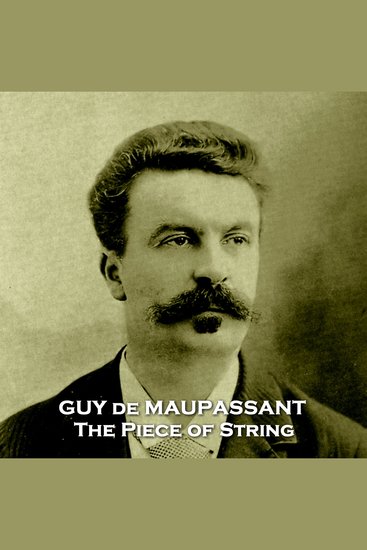
  • The Piece of String - From their pens to your ears genius in every story - cover

    The Piece of String - From their...

    Guy de Maupassant

    • 0
    • 0
    • 0
    Henri René Albert Guy de Maupassant was born on August 5th, 1850 near Dieppe in France.  
    Maupassant’s early life was badly torn when at age 11 (his younger brother Hervé was then five) his mother, Laure, a headstrong and independent-minded woman, risked social disgrace in order to obtain a legal separation from her husband. 
    After the separation, Laure kept custody of her two boys. With the father now forcibly absent, Laure became the most influential and important figure in the young boy's life.   
    Maupassant’s education was such that he rebelled against religion and other societal norms but a developing friendship with Gustave Flaubert began to turn his mind towards creativity and writing. 
    After graduation he volunteered for the Franco-Prussian war. With its end he moved to Paris to work as a clerk in the Navy Department.  Gustave Flaubert now took him under his wing.  Acting as a literary guardian to him, he guided the eager Maupassant to debuts in journalism and literature.  For Maupassant these were exciting times and the awakening of his creative talents and ambitions. 
    In 1880 he published what is considered his first great work, ‘Boule de Suif’, (translated as as ‘Dumpling’, ‘Butterball’, ‘Ball of Fat’, or ‘Ball of Lard’) which met with a success that was both instant and overwhelming.  Flaubert at once acknowledged that it was ‘a masterpiece that will endure.’ Maupassant had used his talents and experiences in the war to create something unique.  
    This decade from 1880 to 1891 was to be the most pivotal of his career.  With an audience now made available by the success of ‘Boule de Suif’ Maupassant organised himself to work methodically and relentlessly to produce between two and four volumes of work a year.  The melding of his talents and business sense and the continual hunger of sources for his works made him wealthy. 
    In his later years he developed a desire for solitude, an obsession for self-preservation, and a fear of death as well as a paranoia of persecution caused by the syphilis he had contracted in his youth.  
    On January 2nd, 1892, Maupassant tried to commit suicide by cutting his throat.  Unsuccessful he was committed to the private asylum of Esprit Blanche at Passy, in Paris.  It was here on July 6th, 1893 that Henri René Albert Guy de Maupassant died at the age of only 42.
    Zum Buch