Begleiten Sie uns auf eine literarische Weltreise!
Buch zum Bücherregal hinzufügen
Grey
Einen neuen Kommentar schreiben Default profile 50px
Grey
Jetzt das ganze Buch im Abo oder die ersten Seiten gratis lesen!
All characters reduced
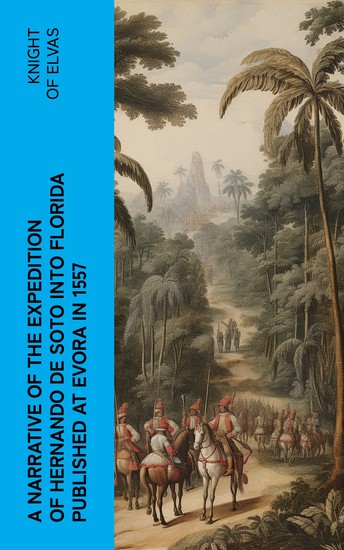
A Narrative of the expedition of Hernando de Soto into Florida published at Evora in 1557 - cover

A Narrative of the expedition of Hernando de Soto into Florida published at Evora in 1557

Elvas Knight of

Übersetzer Richard Hakluyt

Verlag: e-artnow

  • 0
  • 0
  • 0

Beschreibung

A Narrative of the expedition of Hernando de Soto is about Spanish explorer and conquistador de Soto who was involved in expeditions in Nicaragua and the Yucatan Peninsula. He played an important role in Francisco Pizarro's conquest of the Inca Empire in Peru but is best known for leading the first European expedition deep into the territory of the modern-day United States (through Florida, Georgia, Alabama, Mississippi, and most likely Arkansas).
Verfügbar seit: 29.11.2023.
Drucklänge: 186 Seiten.

Weitere Bücher, die Sie mögen werden

  • The Art of Public Speaking - cover

    The Art of Public Speaking

    Dale Carnegie

    • 0
    • 2
    • 0
    The bestselling author of How to Win Friends and Influence People shares the essentials for public speaking in this classic self-help guide.Good oral communication skills are critical in life. Whether you’re speaking to an audience of one at a party or one hundred at a business conference, you must be able to get your point across effectively. In order to do that, you need a worthwhile topic and the knowledge of what makes a great public speaker.In The Art of Public Speaking, authors Dale Carnegie and J. Berg Esenwein lay out what readers need to improve their communication skills in both personal and professional settings. They offer advice on a multitude of topics, including overcoming stage fright, avoiding monotony, and showing enthusiasm. Learn about methods of delivery and the power of pitch, pace, and gestures. They also discuss strengthening your memory and expanding your vocabulary.The Art of Public Speaking was first published in 1915, but its message is still relevant today. With the help of practice and the lessons herein, readers will be on their way to wowing audiences.
    Zum Buch
  • Waterloo - cover

    Waterloo

    Thomas E. Watson

    • 0
    • 0
    • 0
    Excerpt from Chapter One 
    In 1815 the Emperor was no longer a lean, sinewy, tireless, eternally vigilant human tiger—the Napoleon of Rivoli and Marengo. He was no longer the consummate General-in-Chief of Austerlitz and Wagram. The mysterious lethargy which had overwhelmed him at the critical hour of Borodino, when he withheld the order for the Old Guard to charge and convert the Russian defeat into a decisive disaster, had been the first visit of the Evil Genius which was to come again. The strange loss of the power to decide between two totally different lines of action, which, at the Château Düben had kept him idle two days, lolling on a sofa, or sitting at his writing-table tracing on the paper big school-boy letters, was to become a recurrent calamity, puzzling all who knew him, and paralyzing the action of his lieutenants in the most critical emergencies'. 
    At Leipsic the reins had fallen from his hands; only one permanent bridge over the deep river in his rear had been provided to let him out of the death trap; and when the strong currents of the rout tore through the frantic city, the great Napoleon drifted with the furious tide, whistling vacantly. 
    The same unexplainable eclipse of genius, which General E. P. Alexander described as occurring to Stonewall Jackson, in the Malvern Hill movements of our Civil War, happened to the French Emperor, time and again, after that first collapse at Borodino. 
    In Spain he ordered a madly reckless charge of his Polish Light Cavalry against the heights of Sommo Sierra, where the Spanish army was entrenched and where the position easily admitted of successful flanking, got his best troops wastefully butchered—and could not afterward remember who gave the order to charge! 
    In Dresden, in 1813, he had won a brilliant victory which needed only to be ruthlessly pushed; and he was pushing it with all his tremendous driving power when, in the twinkle of an eye, his Evil Genius descended upon him, took his strength away...
    Zum Buch
  • Clausewitz : War and Politics - cover

    Clausewitz : War and Politics

    Saurabh Kumar

    • 0
    • 0
    • 0
    This book tells us about the man, Karl von Clausewitz. His personal life and career. His theories on war and how politics affect war. This book also tells Clauswitz’s cogent determinants  that prevent absolute war.
    Zum Buch
  • The Chemical Marriage - cover

    The Chemical Marriage

    Manly Palmer Hall

    • 0
    • 0
    • 0
    The self-admitted author of The Chemical Marriage, Johann Valentin Andreæ, born in Württemberg in 1586, was twenty-eight years of age when that work was first published. It was presumably written about twelve years prior to its publication--or when the author was fifteen or sixteen years old. The fact is almost incredible that one so young could produce a volume containing the wealth of symbolic thought and philosophy hidden between the lines of The Chemical Marriage. This book makes the earliest known reference to Christian Rosencreutz, and is generally regarded as the third of the series of original Rosicrucian manifestoes. As a symbolic work, the book itself is hopelessly irreconcilable with the statements made by Andreæ concerning it. The story of The Chemical Marriage relates in detail a series of incidents occurring to an aged man, presumably the Father C.R.C. of the Fama and Confessio. If Father C.R.C. was born in 1378, as stated in the Confessio, and is identical with the Christian Rosencreutz of The Chemical Marriage, he was elevated to the dignity of a Knight of the Golden Stone in the eighty-first year of his life (1459). In the light of his own statements, it is inconceivable that Andreæ could have been Father Rosy Cross.
    Zum Buch
  • The Fenway Effect - A Cultural History of the Boston Red Sox - cover

    The Fenway Effect - A Cultural...

    David Krell

    • 0
    • 0
    • 0
    To be a part of Red Sox Nation is to be a hopeful romantic who neither betrays loyalty nor surrenders hope in the direst of circumstances. From Bangor to Back Bay, New Englanders endure in baseball matters. And life. The team's history has intersected with the history of Boston and well beyond it, through the Curse of the Bambino, the military service of Ted Williams during World War II, and the Boston Marathon bombing. The Fenway Effect chronicles these stories and others that have built the incredible saga of the Boston Red Sox. 


    How did Cheers depict the passion of Boston's sports fans? Why is Narragansett beer so important to New England? What's the architectural impact of The Teammates—the statue of Bobby Doerr, Johnny Pesky, Ted Williams, and Dom DiMaggio outside Fenway Park? What did the Boston press really think about Red Sox owner Harry Frazee selling Babe Ruth to the Yankees? What was the origin of Fenway Park's predecessor—Huntington Avenue Grounds? 


    Even Yankees fans will tip their caps to the rich impact of the Red Sox on music, movies, branding, broadcasting, and more. Plus, there's a chapter focusing on the oral history of Red Sox fans, some of whom share here anecdotes that are funny, insightful, and heartwarming.
    Zum Buch
  • Algren - A Life - cover

    Algren - A Life

    Mary Wisniewski

    • 0
    • 0
    • 0
    Chicago Writers Association Nonfiction Book of the Year (2017) Society of Midland Authors Literary Award in Biography (2017)
    
    A tireless champion of the downtrodden, Nelson Algren, one of the most celebrated writers of the 20th century, lived an outsider's life himself. He spent a month in prison as a young man for the theft of a typewriter; his involvement in Marxist groups earned him a lengthy FBI dossier; and he spent much of his life palling around with the sorts of drug addicts, prostitutes, and poor laborers who inspired and populated his novels and short stories. Most today know Algren as the radical, womanizing writer of The Man with the Golden Arm, which won the first National Book Award, in 1950, but award-winning reporter Mary Wisniewski offers a deeper portrait. Starting with his childhood in the City of Big Shoulders, Algren sheds new light on the writer's most momentous periods, from his on-again-off-again work for the WPA to his stint as an uninspired soldier in World War II to his long-distance affair with his most famous lover, Simone de Beauvoir, to the sense of community and acceptance Algren found in the artist colony of Sag Harbor before his death in 1981. Wisniewski interviewed dozens of Algren's closest friends and inner circle, including photographer Art Shay and author and historian Studs Terkel, and tracked down much of his unpublished writing and correspondence. She unearths new details about the writer's life, work, personality, and habits and reveals a funny, sensitive, and romantic but sometimes exasperating, insecure, and self-destructive artist. The first new biography of Algren in over 25 years, this fresh look at the man whose unique style and compassionate message enchanted readers and fellow writers and whose boyish charm seduced many women is indispensable to anyone interested in 20-century American literature and history.
    Zum Buch