Rejoignez-nous pour un voyage dans le monde des livres!
Ajouter ce livre à l'électronique
Grey
Ecrivez un nouveau commentaire Default profile 50px
Grey
Abonnez-vous pour lire le livre complet ou lisez les premières pages gratuitement!
All characters reduced
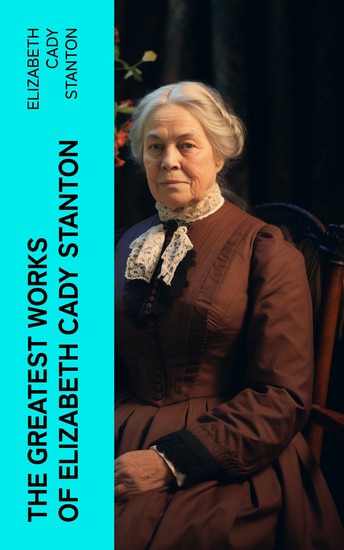
The Greatest Works of Elizabeth Cady Stanton - The Woman's Bible The History of Women's Suffrage From 1848 to 1885 Eighty Years and More: Reminiscences 1815-1897 - cover

The Greatest Works of Elizabeth Cady Stanton - The Woman's Bible The History of Women's Suffrage From 1848 to 1885 Eighty Years and More: Reminiscences 1815-1897

Elizabeth Cady Stanton

Maison d'édition: e-artnow

  • 0
  • 0
  • 0

Synopsis

Elizabeth Cady Stanton (1815-1902) was an American suffragist, social activist, abolitionist, and leading figure of the early women's rights movement. Her Declaration of Sentiments, presented at the Seneca Falls Convention held in 1848 in Seneca Falls, New York, is often credited with initiating the first organized women's rights and women's suffrage movements in the United States. Stanton was president of the National Woman Suffrage Association from 1892 until 1900. Contents: The Woman's Bible Comments on Genesis, Exodus, Leviticus, Numbers and Deuteronomy Comments on the Old and New Testaments from Joshua to Revelation The History of Women's Suffrage From 1848 to 1885 Eighty Years and More: Reminiscences 1815-1897
Disponible depuis: 14/12/2023.
Longueur d'impression: 4344 pages.
D'autres livres qui pourraient vous intéresser

  • Book Summary of Ego Is The Enemy by Ryan Holiday - cover

    Book Summary of Ego Is The Enemy...

    FlashBooks

    • 0
    • 1
    • 0
    This is a summary of Ego Is the Enemy by Ryan Holiday. 
    Original book description: 
    "While the history books are filled with tales of obsessive visionary geniuses who remade the world in their images with sheer, almost irrational force, I've found that history is also made by individuals who fought their egos at every turn, who eschewed the spotlight, and who put their higher goals above their desire for recognition." (From the prologue) 
    Many of us insist the main impediment to a full, successful life is the outside world. In fact the most common enemy lies within: our ego. Early in our careers, it impedes learning and the cultivation of talent. With success, it can blind us to our faults and sow future problems. In failure, it magnifies each blow and makes recovery more difficult. At every stage, ego holds us back. 
    Ego Is the Enemy draws on a vast array of stories and examples, from literature to philosophy to history. We meet fascinating figures such as George Marshall, Jackie Robinson, Katharine Graham, Bill Belichick, and Eleanor Roosevelt, who all reached the highest levels of power and success by conquering their own egos. Their strategies and tactics can be ours as well. 
    In an era that glorifies social media, reality TV, and other forms of shameless self-promotion, the battle against ego must be fought on many fronts. Armed with the lessons in this book, as Holiday writes, "you will be less invested in the story you tell about your own specialness, and as a result you will be liberated to accomplish the world-changing work you've set out to achieve."
    Voir livre
  • Democracy Unmoored - Populism and the Corruption of Popular Sovereignty - cover

    Democracy Unmoored - Populism...

    Samuel Issacharoff

    • 0
    • 0
    • 0
    The 2016 election of Donald Trump focused people's minds on populism, and most of the attention paid to the subject since has been on the threat it poses to wealthy democracies. In Democracy Unmoored, Samuel Issacharoff takes a far wider-angle view of the phenomenon, covering countries from across the globe: Brazil, Poland, Argentina, Turkey, India, Hungary, Venezuela, and more. Just as importantly, he focuses on populism's attack on the institutions of governance. Democracy requires two critical features: first, a commitment to repeat play such that political actors understand that what goes around comes around; and, second, institutional constraints so that the majority can prevail, albeit not by too much. Democracies must avoid the doomsday scenario in which the contending parties see the next election as the final choice between salvation and perdition. Issacharoff shows how populist governance undermines each of these two critical underpinnings of stable democracy, first by compressing the time horizon to the immediate, and second by eroding institutional constraints on strongman rule. At the same time, Issacharoff highlights the fact that ascendent populists were pushing in an open door as they found democracies in states of disrepair in the post-2008 world.
    Voir livre
  • Belisarius & Antonina - Love and War in the Age of Justinian - cover

    Belisarius & Antonina - Love and...

    David Alan Parnell

    • 0
    • 0
    • 0
    Belisarius and Antonina were titans in the Roman world some 1,500 years ago. Belisarius was the most well-known general of his age, victor over the Persians, conqueror of the Vandals and the Goths, and as if this were not enough, wealthy beyond imagination. She made a name for herself by traveling with Belisarius on his military campaigns, deposing a pope, and scheming to disgrace important Roman officials. This unadulterated power and wealth did not mean that Belisarius and Antonina were universally successful in all that they undertook. These failures knock them from their lofty perch, humanize them, and make them even more relatable and intriguing to us today. 


    Belisarius & Antonina is the first modern portrait of this unique partnership. They were not merely husband and wife but also partners in power. This is a paradigm which might seem strange to us, as we reflexively imagine that marriages in the ancient world were staunchly traditional, relegating wives to the domestic sphere only. Their private and public lives blended as they traveled together, sometimes bringing their children, and worked side-by-side. Theirs was without a doubt the most important nonroyal marriage of the late Roman world, and one of the very few from all of antiquity that speaks directly to contemporary listeners.
    Voir livre
  • The Timeline of Intelligent Life on Earth - cover

    The Timeline of Intelligent Life...

    Martin K. Ettington

    • 0
    • 0
    • 0
    I’m fascinated with Ancient History because there are continuous new discoveries which push back the dawn of civilization by thousands of years. In the last couple of decades, the discoveries at Gobekli Tepe in eastern Turkey pushed back man-made structures to the time period of 9,000-11,000 B.C. Thousands of years before the next know civilizations existed.This book includes my research on ancient sites around the world, underground structures, giants, the destruction of civilization about 10,500 B.C., the real Atlantis, and out of place objects which can be millions of years old.With this collection of a wide variety of information I decided that what is needed is a full timeline of intelligent life on Earth from millions of years ago to the present. There are a lot of gaps in this information but enough records, findings, and discoveries exist to propose an initial timeline of intelligent life on Earth going back hundreds of millions of years.Yes-I’m saying intelligent life has existed on Earth that long, and since humanity and even primates don’t exist in those times at all, aliens must have lived on the Earth at that time. There are three parts to this book:Part One - Millions of Years AgoThis includes stories of aliens existing on Earth in our history, and many out of place objects made by intelligent beings, and the fossil record which provides supporting evidence that intelligent life did exist at those times.Part Two - The Unknown Civilizations of ManHere we have evidence of structures built by man but way before any accepted records that civilization or man made constructions existed. Some of these things may go back 100,000 years ago.Part Three – Post Ice Age CivilizationsThis part includes evidence that the Younger Dryas event was actually comets striking the Earth which caused major disasters and probably the destruction of civilizations about 10,500 B.C.My intention is that this timeline will provide a skeleton to be filled in.
    Voir livre
  • Zen Morning: Energizing Music to Start Your Day with Peace - cover

    Zen Morning: Energizing Music to...

    ZEN Morning Music

    • 0
    • 0
    • 0
    Start your day with clarity and purpose with Zen Morning, a vibrant selection of energizing music that awakens your mind, body, and spirit.


    Designed to accompany your morning rituals, meditation, or yoga practice, these uplifting tracks blend gentle ethereal melodies with refreshing rhythms to set a positive tone for the day ahead.


    Whether you're sipping your morning tea, journaling, or practicing mindfulness, Zen Morning will fill you with calm energy and focus, helping you embrace the day with peace and confidence.
    Voir livre
  • Apocalypse Television - How The Day After Helped End the Cold War - cover

    Apocalypse Television - How The...

    David Craig, Robert Iger

    • 0
    • 0
    • 0
    On November 20, 1983, a three-hour made-for-TV movie, The Day After, premiered on ABC. Set in the heartland of Lawrence, Kansas, the film depicted the events before, during, and after a Soviet nuclear attack with vivid scenes of the post-apocalyptic hellscape that would follow. The film was viewed by over 100 million Americans and remains the highest rated TV movie in history. 


    The path to primetime for The Day After proved nearly as treacherous as the film's narrative. Battles ensued behind the scenes at the network, between the network and the filmmakers. But these skirmishes pale in comparison to the culture wars triggered by the film in the press, alongside a growing Nuclear Freeze movement, and from a united, pro-nuclear Right. Once efforts to alter the script failed, the White House conducted a full-throttled propaganda campaign to hijack the film's message. 


    Apocalypse Television features a dramatic insider's account of the making of and backlash against The Day After. No other book has told this story in similar fashion, venturing behind-the-scenes of the programming and news divisions at ABC, the backlash from the conservative movement and Religious Right, the challenges encountered by the film's production team, and the experiences of the citizens of Lawrence, Kansas, where the film was set and shot.
    Voir livre