Unisciti a noi in un viaggio nel mondo dei libri!
Aggiungi questo libro allo scaffale
Grey
Scrivi un nuovo commento Default profile 50px
Grey
Iscriviti per leggere l'intero libro o leggi le prime pagine gratuitamente!
All characters reduced
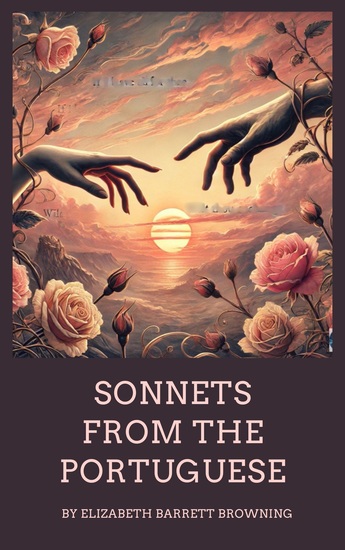
Sonnets from the Portuguese - Timeless Verses of Love and Devotion - cover

Sonnets from the Portuguese - Timeless Verses of Love and Devotion

Elizabeth Barrett Browning, Zenith Crescent Moon Press

Casa editrice: Zenith Crescent Moon Press

  • 0
  • 0
  • 0

Sinossi

💕 Experience the unparalleled beauty of Elizabeth Barrett Browning's Sonnets from the Portuguese, one of the most exquisite collections of love poetry ever written. Filled with heartfelt emotion and lyrical grace, these timeless sonnets capture the depth, intimacy, and transcendence of true love 🌟.

📖 Written during Barrett Browning's courtship with her husband, Robert Browning, these sonnets offer a deeply personal yet universal exploration of devotion and passion 💌. 

The famous line "How do I love thee? Let me count the ways…" has inspired romantics for generations ❤️.

✨ Perfect for poetry lovers, literary enthusiasts, and anyone moved by the power of love. This classic is a must-have for your bookshelf, offering wisdom, beauty, and emotion in every verse 🌹.

🎁 Celebrate love in its purest form—order your copy of Sonnets from the Portuguese today! 💖
Disponibile da: 28/03/2025.
Lunghezza di stampa: 90 pagine.

Altri libri che potrebbero interessarti

  • Hunchback of Notre-Dame The (Volume 1) - cover

    Hunchback of Notre-Dame The...

    Victor Hugo

    • 0
    • 0
    • 0
    The Hunchback of Notre-Dame or Notre-Dame de Paris is a French Gothic novel by Victor Hugo, published in 1831.
    The story is set in Paris in 1482 during the reign of Louis XI. The gypsy Esmeralda (born as Agnes) captures the hearts of many men, including those of Captain Phoebus and Pierre Gringoire, but especially Quasimodo and his guardian Archdeacon Claude Frollo. Frollo is torn between his obsessive lust for Esmeralda and the rules of Notre Dame Cathedral. He orders Quasimodo to kidnap her, but Quasimodo is captured by Phoebus and his guards, who save Esmeralda. Gringoire, who attempted to help Esmeralda but was knocked out by Quasimodo, is about to be hanged by beggars when Esmeralda saves him by agreeing to marry him for four years.
    Mostra libro
  • George Orwell 1984+ - cover

    George Orwell 1984+

    George Orwell

    • 0
    • 0
    • 0
    It was George Orwell's early writing that helped shape his worldview and writing style. Here we focus on his works "The Spike" and "A Hanging," and his time as a police officer in Burma. Orwell's first published work was an essay titled "The Spike," which appeared in 1931. The essay is a vivid and harrowing account of his time spent in a homeless shelter in London. Orwell, who was struggling financially at the time, chose to experience a homeless shelter firsthand, and his account is an indictment of the dehumanizing conditions he encountered. In "The Spike," Orwell describes the brutal reality of life in the shelter, where men were treated like animals and forced to endure hunger, cold, and violence. "Shooting An Elephant" is too tragically eye-opening.This would later inform his political views and writing, particularly his belief in the importance of social justice and his struggle against oppression. In his essay "How the Poor Die," Orwell describes his observations of the poor and their struggle with illness and death. He portrays a society where the poor are neglected and left to suffer in silence and without dignity. This essay is another example of Orwell's commitment to social justice and his belief in the importance of empathy and compassion. In 1931, Orwell joined the Indian Imperial Police in Burma, where he served for five years. There he witnessed the brutal realities of colonialism and oppression. In his essay A Hanging," (1931), Orwell recounts the experience of attending the execution of a prisoner. Orwell describes the prisoner's final moments with empathy and his account of the execution is a moving critique of the dehumanizing effects of state-sanctioned violence.Orwell's experiences with poverty oppression and violence informed his later political and social beliefsAs read by Emmy-nominated actor Geoffrey Giuliano. With a full biography of Orwell and selected quotations.
    Mostra libro
  • George Silverman's Explanation - cover

    George Silverman's Explanation

    Charles Dickens, Dominic Gerrard

    • 0
    • 0
    • 0
    George Silverman’s Explanation (published in The Atlantic in 1868) is one of Charles Dickens’ rarer short stories. Here the author immerses himself entirely in his character of George Silverman: addressing the reader in a dramatic monologue in which he is reticent, perhaps even unwilling to open up to us, but at the same time compelled to unburden his heart.  
    So deeply does Dickens embody the role of Silverman that in a letter to an editor he writes that: 'I feel as if I had read something (by somebody else) which I should never get out of my head …’ 
    This tale is an indictment against poverty as powerful as you will find in any of Dickens’ larger works. It is also a biting satire against the 'daring ignorance' and little 'meannesses' found in many non-conformist movements. Above all it is a deeply affecting examination of how far a childhood of of both want and punishing religious control can impact a man’s self-worth and future happiness. 
    Narrated by Dominic Gerrard 
    Cover Art by Léna Gibert
    Mostra libro
  • Call of Cthulhu The (Unabridged) - cover

    Call of Cthulhu The (Unabridged)

    H. P. Lovecraft

    • 0
    • 0
    • 0
    "The Call of Cthulhu" is one of H. P. Lovecraft's best-known short stories. Written in the summer of 1926, it was first published in Weird Tales, February 1928. It is the only story written by Lovecraft in which the extraterrestrial entity Cthulhu himself makes a major appearance. It is written in a documentary style, with three independent narratives linked together by the device of a narrator discovering notes left by a deceased relative. The narrator pieces together the whole truth and disturbing significance of the information he possesses, illustrating the story's first line: "The most merciful thing in the world, I think, is the inability of the human mind to correlate all its contents. We live on a placid island of ignorance in the midst of black seas of infinity; and it was not meant that we should voyage far."
    Mostra libro
  • Pains of Marriage The (Unabridged) - cover

    Pains of Marriage The (Unabridged)

    H. G. Wells

    • 0
    • 0
    • 0
    Herbert George "H. G." Wells (1866 - 1946) was an English writer.
    He was prolific in many genres, including the novel, history, politics, social commentary, and textbooks and rules for war games. Wells is now best remembered for his science fiction novels and is called a "father of science fiction"
    THE PAINS OF MARRIAGE: My uncle came to a stop outside a stationer's shop in Oxford-street. When I saw what had caught his attention I reproached myself for my thoughtlessness.
    Mostra libro
  • The Case of Vincent Pyrwhtt - From their pens to your ears genius in every story - cover

    The Case of Vincent Pyrwhtt -...

    Barry Pain

    • 0
    • 0
    • 0
    Barry Eric Odell Pain was born at 3 Sydney Street in Cambridge on 28th September 1864. He was one of 4 children. 
    He was educated at Sedbergh School and then Corpus Christi College, Cambridge. 
    In 1889, Cornhill Magazine published his short story ‘The Hundred Gates’.  This opened the way for Pain to advance his literary career on several fronts. He became a contributor to Punch and The Speaker, as well as joining the staff of both the Daily Chronicle and Black and White.  
    Pain was also a noted and prominent contributor to The Granta and from 1896 to 1928 a regular contributor to the Windsor Magazine. 
    It is often said that Pain was discovered by Robert Louis Stevenson, who compared his work to that of Guy de Maupassant.  It’s an apt comparison. Pain was a master of disturbing prose but was also able to inject parody and light comedy into many of his works.  A simple premise could in his hands suddenly expand into a world very real but somehow emotionally fraught and on the very edge of darkness. 
    Barry Pain died on 5th May 1928 in Bushey, Hertfordshire.
    Mostra libro