Join us on a literary world trip!
Add this book to bookshelf
Grey
Write a new comment Default profile 50px
Grey
Subscribe to read the full book or read the first pages for free!
All characters reduced
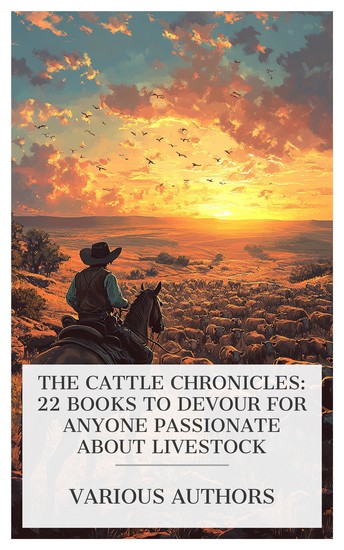
The Cattle Chronicles: 22 Books to Devour for Anyone Passionate about Livestock - Cowboy Life on the Sidetrack The Rustler of Wind River On the cattle plague Wells Brothers etc - cover

The Cattle Chronicles: 22 Books to Devour for Anyone Passionate about Livestock - Cowboy Life on the Sidetrack The Rustler of Wind River On the cattle plague Wells Brothers etc

Edward Sylvester Ellis, Andy Adams, Frank H. Spearman, B. M. Bower, Clarence Young, George W. Ogden, Carlos Rodriguez, Horace Annesley Vachell, Vingie E. Roe, Frank Benton, Charles James Korinek, Association Florida State Live Stock, Frank Webster Farley, George W. Pope, Company Pratt Food, William Carter Stubbs, Ward J. MacNeal, Willis P. Hazard, W. J. Miller, W. C. Kinney, M. E. Friedman, N. L. VanDemark, James Captain Carson, Honoré Bourguignon

Publisher: e-artnow

  • 0
  • 0
  • 0

Summary

The Cattle Chronicles: 22 Books to Devour for Anyone Passionate about Livestock is a comprehensive anthology that explores the expansive world of cattle and livestock through various literary lenses. Delving into themes such as pastoral life, agricultural innovation, and human-animal relationships, this collection provides a multifaceted look into the intersection of culture and cattle. With a diverse range of literary styles, from historical treatises to fictional narratives, the anthology captures the integral role of livestock in shaping economic and cultural histories. Standout pieces within this volume illustrate the nuanced challenges and triumphs faced by those who live alongside the land and their herds. The contributing authors of The Cattle Chronicles represent a wide array of historical and cultural backgrounds, each bringing a unique perspective to the anthology. From well-known figures like B. M. Bower, known for western fiction, to experts like William Carter Stubbs, noted in agricultural science, the authors collectively contribute invaluable insights into the intricacies of livestock management and the evolution of the cattle industry. This collection is invigorated by voices that span different literary movements and historical contexts, enriching readers' understanding of cattle's pivotal role across various societal frameworks. For readers seeking an insightful exploration of livestock's impact, this anthology is an unparalleled resource. Offering a unique opportunity to experience a broad spectrum of perspectives, The Cattle Chronicles enriches one's appreciation of agricultural life and its literature. The dialogue generated through the intersection of these varied works fosters an educational platform that benefits anyone interested in the evolution of livestock's cultural and economic significance. Dive into this collection to gain a deeper, multidisciplinary understanding of what cattle mean to our world and societies.
Available since: 03/04/2025.
Print length: 3000 pages.

Other books that might interest you

  • A Dead Secret - From their pens to your ears genius in every story - cover

    A Dead Secret - From their pens...

    Lafcadio Hearn

    • 0
    • 0
    • 0
    Lafcadio Hearn was born on the 27th June 1850 on the Ionian isle of Levkás in Greece to a British Army officer and a Greek Mother. 
    His father, fearing for his career prospects at being married to a Greek Orthodox wife, sent them to Dublin whilst he continued to advance his career with further postings.  Life there was difficult for mother and son.  His father returned, wounded and traumatised, when Lafcadio was three.  He annulled the marriage and she remarried but had to give up care of Lafcadio to her sister-in law.   
    After brief periods for Catholic education in England and France he emigrated to Ohio in the United States when he was 19, taking on a series of casual jobs before embarking on a career as a journalist, publishing poems and essays in Cincinnati.  It was whilst here that he began a side-line in translating, starting with Gautier and Flaubert.  He married in 1874 to a 20 year old African-American woman in violation of Ohio's anti-miscegenation law.  The marriage soon failed. 
    In 1877 he relocated to New Orleans to write on a variety of themes before picking up a two year assignment from Harper’s to write in the West Indies, where he also wrote his first novel. 
    In 1890 Harper’s sent him to Japan.  Here he left journalism and took the remarkable decision to become a schoolteacher in the north of Japan.   Enraptured by the culture he was driven to explain it in various Western publications to those who had little, if any, knowledge of its culture.  Within the year he had fallen in love with, and married, a high-born Japanese lady, together they would have four children.   
    In 1895 he became a Japanese national and took the name Koizumi Yakumo, Koizumi being his wife’s family name. 
    The following few years, whilst a professor of Literature at the Imperial University of Japan, were his most creative and admired period.   
    Lafcadio Hearn died of heart failure on the 26th of September 1904, in Tokyo, Japan shortly before leaving to deliver a series of lectures at Cornell University in New York State.  He was 54.
    Show book
  • Flint Kill Creek - Stories of Mystery and Suspense - cover

    Flint Kill Creek - Stories of...

    Joyce Carol Oates

    • 0
    • 0
    • 0
    A new collection of stories by one of America's greatest writers 


    These new, recent, and reformulated stories by Joyce Carol Oates showcase a wide range of crime fiction and psychological suspense. A young, insecure woman finds her relationship changing as she grows more and more dependent on a man who likes to take her on long walks beside a dangerously roaring creek. Another woman, nervous around men, not quite knowing how to act when paid a compliment, becomes flustered when a doctor suggests they go out for coffee, or possibly a drink. She finally decides that she will join him when he suggests they meet at his home. A man is so forgetful that his wife panics and yells into his phone, asking where their daughter has gone. A young man is curious to see why sirens have filled the night and the police arrest him, beginning an unimaginable nightmare. A woman resents that a colleague has achieved greater success and thinks she ought to do something about it. 


    It is impossible to know where a story by the creative genius of Joyce Carol Oates will end and what frightening paths will lead to that end.
    Show book
  • Herman Melville - Chapter & Verse - Poetry and prose together from literary greats - cover

    Herman Melville - Chapter &...

    Herman Melville

    • 0
    • 0
    • 0
    Literature is a world of words and wonder, able to take us on almost unimaginable journeys from the wild and fantastic to the grind and minutiae of life. 
     
    An author’s ideas are his building blocks, his architecture of the mind, building a structure on which all else will rest; the narrative, the characters, the words - those few words that begin the adventure. 
     
    In this series we look at some of our leading classic authors across two genres: the short story and the poem.  In this modern world there is an insatiable need to categorise and pigeon-hole everyone and everything.  But ideas, these grains and saplings of the brain, need to roam, to explore and find their perfect literary use vehicle.  Our authors are masters of many literary forms, perhaps known for one but themselves favouring another. 
     
    Story. Poems. Story.  Within these boundaries come all manner of invention and cast of characters.  And, of course, each author has their own way of revealing their own chapter and verse.    
     
    1 - Chapter & Verse - Herman Melville - An Introduction 
    2 - Bartleby the Scrivener - Part 1 by Herman Melville 
    3 - Bartleby the Scrivener - Part 2 by Herman Melville 
    4 - Billy in the Darbies by Herman Melville 
    5 - The Eagle of the Blue by Herman Melville 
    6 - John Marr and Other Sailors by Herman Melville 
    7 - A Dirge for McPherson by Herman Melville 
    8 - Gettysburg by Herman Melville 
    9 - The March into Virginia by Herman Melville 
    10 - The Released Rebel Prisoner by Herman Melville 
    11 - The Martyr by Herman Melville 
    12 - Monody by Herman Melville 
    13 - Immolated by Herman Melville 
    14 - The Fiddler by Herman Melville
    Show book
  • Dracula's Guest - From their pens to your ears genius in every story - cover

    Dracula's Guest - From their...

    Bram Stoker

    • 0
    • 0
    • 0
    Abraham Stoker was born in Dublin, Ireland on the 8th of November 1847, the third of seven children.  
    His early years were plagued with such ill-health that he was unable to start school until the age of seven.  He turned the long periods of recovery into an opportunity for thinking and said “I was naturally thoughtful, and the leisure of long illness gave opportunity for many thoughts which were fruitful according to their kind in later years”.  
    Strikingly at Trinity College, Dublin his health had returned with such vigour that he was named their University Athlete whilst also achieving a BA in Mathematics with honours.  
    At this time his interest in theatre became a job offer to be the Dublin Evening Mail’s theatre critic, co-owned by Sheridan Le Fanu.  He now began to also write short stories and in 1872 ‘The Crystal Cup’ was published.  An interest in art developed and he co-founded the Dublin Sketching Club.  
    In 1878 came marriage to Florence Balcombe.  She had formerly been courted by Stoker’s acquaintance, Oscar Wilde.  The marriage produced one child.   
    Stoker had some years before reviewed Henry Irving’s Hamlet and had dined with him.  That friendship now resulted in a proposal from Irving to move to London and to manage his Lyceum Theatre.  His numerous commercial innovations ensured both he and the theatre thrived.  Irving would also often take Stoker with him when he toured abroad. 
    Despite this busy life Stoker continued to write and these works paved the way for his most famous creation, published in 1897, ‘Dracula’.  It is rightly recognised as one of the greatest horror novels of all time and although not the first with a theme of Vampires, it is undoubtedly the most well-known. 
    Stoker also wrote poetry and many excellent short stories and continued to write novels and other works throughout his career. 
    Politically Stoker supported Home Rule, though only by peaceful means.  He was also keen on following scientific trends particularly in medicine. 
    In 1902 his tenure at the Lyceum Theatre ended and although he continued to write his health was deteriorating, mainly due to a series of debilitating strokes. 
    Bram Stoker died on the 20th April 1912, in Pimlico, London.  He was 64.
    Show book
  • Spanking Naughty Girls 3 - James spanks Evelyn and her naughty daughter Emma - cover

    Spanking Naughty Girls 3 - James...

    Peter Michaels

    • 0
    • 0
    • 0
    James spanks Evelyn and her naughty daughter Emma 
    Evelyn Harris hears that James solved Kate’s problem and she asks him to do the same for her. Emma, her daughter, has got into bad company and needs some parental guidance, but Evelyn is a single mum and finds it challenging to spank Emma when she is naughty. James comes up with an idea and Evelyn agrees to be spanked when Emma is naughty until Emma agrees she should take the spanking. Emma agrees but calls the police to accuse James of assault. Luckily James has been recording all the spanking sessions so Emma is proven to be a liar so she gets an extra spanking for that. Soon Emma agrees that she has been naughty and her behaviour improves. Evelyn eventually marries the policeman who helped solve their problem.
    Show book
  • Drowning In Their Darkness - cover

    Drowning In Their Darkness

    M.H. Lee

    • 0
    • 0
    • 0
    What If You Couldn't Say No To Others But They Never Knew?Empathy should have its limits. But for Freya it doesn't. When others are around she finds herself bending to their will, unable to tell anyone what she wants, unable to assert herself or defend herself. Can she find a way forward or will she forever be drowning in their darkness?PG-13
    Show book