Begleiten Sie uns auf eine literarische Weltreise!
Buch zum Bücherregal hinzufügen
Grey
Einen neuen Kommentar schreiben Default profile 50px
Grey
Jetzt das ganze Buch im Abo oder die ersten Seiten gratis lesen!
All characters reduced
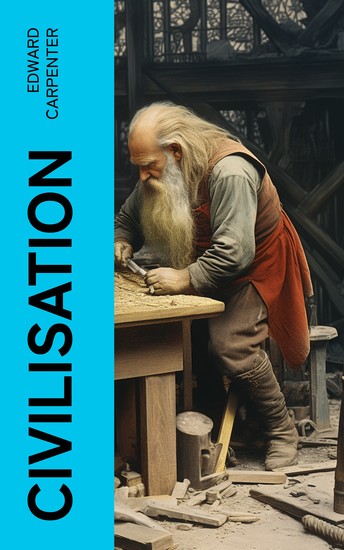
Civilisation - Its Cause and Cure; and Other Essays - cover

Civilisation - Its Cause and Cure; and Other Essays

Edward Carpenter

Verlag: e-artnow

  • 0
  • 0
  • 0

Beschreibung

In this book, the American philosopher Edward Carpenter reassesses the meaning of civilization and its role in the development of humanity and morality. As the author says: "hospitality of the wild Arab, the courage of the North American Indian, and the faithful friendships of some of the Polynesian nations, far surpass anything of a similar kind among the polished communities of Europe." Further, Carpenter reflects his acquaintance with the people of the indigenous tribes like Bushmen, Eskimo, Samoyedes, Zulu.
Verfügbar seit: 25.11.2023.
Drucklänge: 190 Seiten.


Weitere Bücher, die Sie mögen werden

  • After Apollo: The History of NASA’s Missions Since Landing on the Moon - cover

    After Apollo: The History of...

    Charles River Editors

    • 0
    • 0
    • 0
    Today the Space Race is widely viewed poignantly and fondly as a race to the Moon that culminated with Apollo 11 “winning” the Race for the United States. In fact, it encompassed a much broader range of competition between the Soviet Union and the United States that affected everything from military technology to successfully launching satellites that could land on Mars or orbit other planets in the Solar System. Moreover, the notion that America “won” the Space Race at the end of the 1960s overlooks just how competitive the Space Race actually was in launching people into orbit, as well as the major contributions the Space Race influenced in leading to today’s International Space Station and continued space exploration.  
    Space exploration was always an expensive business, and throughout NASA’s history, the agency has had to justify to Congress its need for every dollar it intended to spend. This problem has helped NASA to be more careful and more creative with the money they did receive, and scientists had to justify the equipment they wanted to include on each space probe. They had to justify the size and the power demand, too. If they wanted too much, the entire mission might be scrubbed, and all their work would have been for naught. This made planning and designs leaner and more efficient, as scientists and engineers were more careful with their recommendations. 
    Although Apollo 11’s successful mission to the Moon is seen as the culmination of the Space Race, and the Apollo program remains NASA’s most famous, one of the space agency’s most successful endeavors came a few years later. In fact, the Pioneer program was the most diversified sequence of any of NASA’s programs, and though they’re now remembered for being among the first probes in history to reach the Outer Solar System, the elaborate planning changed goals several times over several years before resulting in historic successes. 
    Zum Buch
  • The Newspaper Axis - Six Press Barons Who Enabled Hitler - cover

    The Newspaper Axis - Six Press...

    Kathryn S. Olmsted

    • 0
    • 0
    • 0
    How six conservative media moguls hindered America and Britain from entering World War II 
    How six conservative media moguls hindered America and Britain from entering World War II 


    “A landmark in the political history of journalism.”—Michael Kazin, author of What It Took to Win: A History of the Democratic Party 


    As World War II approached, the six most powerful media moguls in America and Britain tried to pressure their countries to ignore the fascist threat. The media empires of Robert McCormick, Joseph and Eleanor Patterson, and William Randolph Hearst spanned the United States, reaching tens of millions of Americans in print and over the airwaves with their isolationist views. Meanwhile in England, Lord Rothermere’s Daily Mail extolled Hitler’s leadership and Lord Beaverbrook’s Daily Express insisted that Britain had no interest in defending Hitler’s victims on the continent. 


    Kathryn S. Olmsted shows how these media titans worked in concert—including sharing editorial pieces and coordinating their responses to events—to influence public opinion in a right-wing populist direction, how they echoed fascist and anti‑Semitic propaganda, and how they weakened and delayed both Britain’s and America’s response to Nazi aggression.
    Zum Buch
  • How to Make Money - An Ancient Guide to Wealth Management (series: Ancient Wisdom for Modern Readers) - cover

    How to Make Money - An Ancient...

    PLINY

    • 0
    • 0
    • 0
    Ancient Romans liked money. But how did they make a living and sometimes even become rich? The Roman economy was dominated by agriculture, but it was surprisingly modern in many ways: the Romans had companies with CEOs, shareholders, and detailed contracts regulated by meticulous laws; systems of banking and taxation; and a wide range of occupations, from merchant and doctor to architect and teacher. The Romans also enjoyed a relatively open society, where some could start from the bottom, work, invest, and grow rich. How to Make Money gathers a wide variety of ancient writings that show how Romans thought about, made, invested, spent, lost, and gave away money. 


    The Roman elite idealized farming and service to the state but treated many other occupations with suspicion or contempt, from money lending to wage labor. But whatever their attitudes, pecunia made the Roman world go round. In the Satyricon, Trimalchio brags about his wealth. Seneca accumulated a fortune—but taught that money can't buy happiness. Eumachia inherited a brick factory from her father, married well, and turned to philanthropy after she was widowed. How to Make Money also takes up some of the most troubling aspects of the Roman economy, slavery and prostitution, which the elite deemed unrespectable but often profited from.
    Zum Buch
  • The DBT Workbook for Narcissistic Abuse and Gaslighting - Dialectical Behavior Therapy Skills to Stay Emotionally Centered Overcome Self-Doubt and Reclaim Your Self-Worth - cover

    The DBT Workbook for...

    LCSW Katelyn Baxter-Musser, PsyD...

    • 0
    • 0
    • 0
    Are you caught in an emotionally abusive relationship with a narcissist, or attempting to recover from one? Are you being gaslit by an intimate partner, family member, or coworker? Narcissistic abuse and gaslighting can have devastating impacts on mental health and wellbeing. You may experience feelings of shame, guilt, humiliation, and a sense that something is wrong with you. Even if you've managed to escape the abusive dynamic, the emotional, physical, and psychological impact can carry on long after the relationship ends. So, how can you start healing? 


    Using this workbook, you'll learn practical skills grounded in proven-effective dialectical behavior therapy (DBT) to help you heal and move forward after narcissistic abuse. You'll find targeted exercises for specific trauma symptoms to help you rebuild your shattered self-esteem and confidence, learn how to trust again, and make certain you can recognize red flags in the future. You'll also discover essential and easy-to-apply mindfulness skills for developing self-compassion, setting healthy boundaries, and managing negative thoughts. 


    If you're ready to start healing your emotional wounds so you can finally move on, this gentle guide can help you replace the guilt, self-doubt, and shame of abuse with self-esteem, unshakable confidence, and trust.
    Zum Buch
  • Feminism is Queer - The Intimate Connection between Queer and Feminist Theory 2nd Edition - cover

    Feminism is Queer - The Intimate...

    Mimi Marinucci

    • 0
    • 0
    • 0
    In Feminism is Queer, Mimi Marinucci provides a valuable introduction to the intimately related disciplines of gender and queer theory, and develops the innovative concept of queer feminism, which treats queer theory as being continuous with feminist theory. While there were significant conceptual tensions between second-wave feminism and traditional lesbian and gay studies, queer feminism offers a paradigm for understanding gender, sex, and sexuality that overcomes this conflict in order to foster solidarity between those campaigning for women's rights and those for LGBTQ rights. 


    This updated and expanded edition engages with the latest developments in feminism and queer theory, including the new forms of both feminism and 'antifeminism' which have developed within online communities, the growing prominence of trans experiences in popular media, and the relevancy of queer feminism to a new generation of feminist activists. Feminism is Queer remains the indispensable guide for anyone with an interest in gender, sexuality, and the connections between feminism and queer issues.
    Zum Buch
  • Gettysburg - The Story of the Battle with Maps - cover

    Gettysburg - The Story of the...

    Books Editors of Stackpole

    • 0
    • 0
    • 0
    A unique visual account: “The hour-by-hour maps of the maneuvering and fighting provide the clearest cartographic picture of the battle in existence.” —James M. McPherson, Pulitzer Prize-winning author of Battle Cry of Freedom   In this extraordinary book, seventy crystal-clear color maps and insightful text tell the hour-by-hour story of the three-day Battle of Gettysburg. Each map shows the same three-and-a-half-by-four-and-a-half-mile view of the battlefield, allowing the reader to visualize the battle as it developed over the entire area, including key engagements, troop movements and positions, and locations of commanders. It sheds new light on important events such as the first clash west of town on July 1, the fighting for Cemetery Hill, the defense of Little Round Top, Pickett’s Charge, and more.   “The accompanying text brings the battle alive and nicely compliments the maps.” —D. Scott Hartwig, author of To Antietam Creek   “The movements are depicted clearly, and in full color, so that even a complete newcomer to the battle can follow the action easily.”—Craig L. Symonds, author of The American Heritage History of the Battle of Gettysburg
    Zum Buch