Rejoignez-nous pour un voyage dans le monde des livres!
Ajouter ce livre à l'électronique
Grey
Ecrivez un nouveau commentaire Default profile 50px
Grey
Abonnez-vous pour lire le livre complet ou lisez les premières pages gratuitement!
All characters reduced
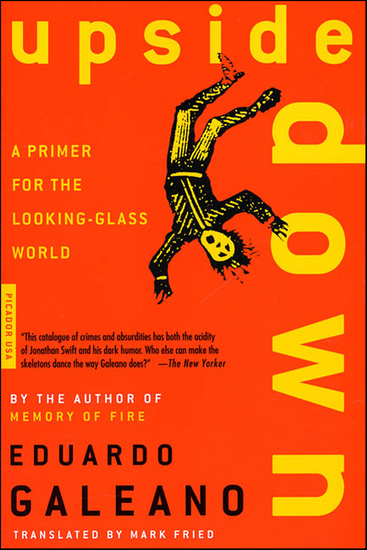
Upside Down - A Primer for the Looking-Glass World - cover

Upside Down - A Primer for the Looking-Glass World

Eduardo Galeano

Traducteur Mark Fried

Maison d'édition: Metropolitan Books

  • 0
  • 0
  • 0

Synopsis

From the winner of the first Lannan Prize for Cultural Freedom, a bitingly funny, kaleidoscopic vision of the First World through the eyes of the Third.Eduardo Galeano, author of the incomparable Memory of Fire Trilogy, combines a novelist's intensity, a poet's lyricism, a journalist's fearlessness, and the strong judgments of an engaged historian. Now his talents are richly displayed in Upside Down, an eloquent, passionate, sometimes hilarious exposé of our first-world privileges and assumptions.In a series of lesson plans and a “program of study” about our beleaguered planet, Galeano takes the reader on a wild trip through the global looking glass. From a master class in “The Impunity of Power” to a seminar on “The Sacred Car” —with tips along the way on “How to Resist Useless Vices” and a declaration of “The Right to Rave” —he surveys a world unevenly divided between abundance and deprivation, carnival and torture, power and helplessness. We have accepted a reality we should reject, Galeano teaches us, one where machines are more precious than humans, people are hungry, poverty kills, and children toil from dark to dark.A work of fire and charm, Upside Down makes us see the world anew and even glimpse how it might be set right.“Galeano's outrage is tempered by intelligence, an ineradicable sense of humor, and hope.” —Los Angeles Times
Disponible depuis: 06/08/2024.
Longueur d'impression: 369 pages.


D'autres livres qui pourraient vous intéresser

  • A Small Stubborn Town - Life death and defiance in Ukraine – As heard on BBC Radio 4 - cover

    A Small Stubborn Town - Life...

    Andrew Harding

    • 0
    • 0
    • 0
    A Telegraph Book of the Year, soon to be a BBC Radio 4 dramatisation.'Extraordinary.' Philippe Sands'We are touched by the courage and dignity of Andrew Harding's characters - qualities that the author must surely possess in equal measure.' - Andrey Kurkov'A  story of extraordinary heroism by ordinary people. - James Meek'This gripping account is the Russian invasion of Ukraine in microcosm.' - Lindsey HilsumIt's March 2022 and Russian tanks are roaring across the vast, snow-dusted fields of Ukraine. Their destination: Voznesensk, a town with a small bridge that could change the course of the war.The heavily-armed Russians are expecting an easy fight - or no fight at all. After all, Voznesensk is a quiet farming town, full of pensioners. But the locals appear to have other ideas.Svetlana, a grandmother with arthritis, reacts in fury when Russian troops turn her cottage into their blood-soaked headquarters. Valentin, a quick-talking lawyer, joins the town's 'Dads Army' defenders, crouching in a trench with an AK47. Meanwhile, 21-year-old Sergei grabs a Molotov cocktail and lies in wait for Russian tanks as they push towards Dead Water Bridge.The odds are terrible. But a plan is emerging, and there's a chance it could save not just Voznesensk, but the rest of southern Ukraine. Meanwhile, inside the tanks, an inner battle rages. As Russian officer Igor Rudenko prepares to invade, he has a secret. He is Ukrainian himself.A gripping work of reportage that tells the story of a pivotal moment in Ukraine's war, this is a real-life thriller about ordinary people facing extraordinary circumstances with resilience, humour and ingenuity.'[Andrew Harding is] one of our most gifted and sensitive journalists' - Jon Snow
    Voir livre
  • Our Common Cause - Establishing the Political Power We Lack - cover

    Our Common Cause - Establishing...

    Étienne Chouard

    • 0
    • 0
    • 0
    I want to talk to you about democracy. The real one. The one that does not exist, and the one we really need today. My research method is that of Hippocrates, who said, look for the cause of causes. In other words, to cure a disease, to solve a problem, it is useless to attack the consequences, it is useless to attack the different causes. There is always a determining cause (the one that determines all the others)—and that is our common cause.
    The first decisive battle is to push the important words "right side up":
    First. I am not a "citizen" (a citizen is autonomous; he votes himself his laws). I am only a "voter;" that is to say, a political child—because I am subject to the law voted into existence by someone other than me.
    Second. My "parents" in politics, the elected officials, do not want me to emancipate myself from them—they do not allow me to vote for or against the laws to which I have to submit myself.
    We are "the incompetents." They treat us like children. But it is our fault, because children also believe in "Santa Claus," and so voters believe in "universal suffrage," which we accept to call "democracy" (demos kratos, power belongs to the people). The so-called modern "democracy".
    Voir livre
  • Reclaiming Our Democracy - Every Citizen’s Guide to Transformational Advocacy 2024 Edition - cover

    Reclaiming Our Democracy - Every...

    Sam Daley-Harris

    • 0
    • 0
    • 0
    Almost everyone shies away from advocacy as a way to make a difference. We donate to climate change organizations, but we don’t meet with a member of Congress or write a letter to the editor. We donate to groups working to end gun violence, anti-hunger organizations, groups dedicated to racial justice, and many others, but we don’t become advocates on those issues beyond signing an online petition or going to an occasional rally.   
    	Why? Because most of us see advocacy as too hard or too frustrating, too complicated, or too partisan, too dirty or too time-consuming, too ineffective or too costly. 
    	But what if that’s all wrong? What if deep engagement dissolves discouragement and can actually bring joy? What if you can become an advocate for a cause you care about and feel fulfilled, not frustrated? And what if engaging as an advocate is essential to protecting our democracy? 
    	President Jimmy Carter called the first edition of Reclaiming Our Democracy “A road map for global involvement in planning a better future.” In this completely revised and updated 2024 edition, Sam Daley-Harris uses his decades of experience leading and coaching citizens’ advocacy groups to expand that road map and create an indispensable guide to engaged citizenship, an inspiring master class in transformational advocacy. 
    	Reclaiming Our Democracy provides a powerful way to make a difference and heal our democracy in the process. It’s not the only solution needed, but is one essential, missing piece: citizens awakening to their power.
    Voir livre
  • The Last Plantation - Racism and Resistance in the Halls of Congress - cover

    The Last Plantation - Racism and...

    James R. Jones

    • 0
    • 0
    • 0
    Racism continues to infuse Congress's daily practice of lawmaking and shape who obtains congressional employment. In this timely and provocative book, James Jones reveals how and why many who work in Congress call it the "Last Plantation." He shows that even as the civil rights movement gained momentum and antidiscrimination laws were implemented, Congress remained exempt from federal workplace protections. These exemptions institutionalized inequality in the congressional workplace well into the twenty-first century. 


    Jones uncovers the hidden dynamics of power, privilege, and resistance in Congress. He reveals how failures of racial representation among congressional staffers reverberate throughout the American political system and demonstrates how the absence of diverse perspectives hampers the creation of just legislation. Centering the experiences of Black workers within this complex landscape, he provides insights into the problems they face, the barriers that hinder their progress, and the ways they contest entrenched inequality. 


    A must-listen for anyone concerned about social justice and the future of our democracy, The Last Plantation exposes the mechanisms that perpetuate racial inequality in the halls of Congress and challenges us to confront and transform this unequal workplace that shapes our politics and society.
    Voir livre
  • State of the Union 1983 - cover

    State of the Union 1983

    Ronald Reagan

    • 0
    • 0
    • 0
    The 1983 State of the Union address, delivered January 25, 1983, focuses on “what we can do together -- not as Republicans and Democrats, but as Americans -- to make tomorrow's America happy and prosperous at home, strong and respected abroad, and at peace in the world.” 
    Reagan praises a bipartisan proposal to save social security. He blames deficits on domestic spending and not on defense spending or tax cuts. A four-part plan is proposed to reduce the deficit: first, a federal spending freeze; second, reducing fraud and waste in programs such as food stamps; third, reductions in defense spending; and fourth, a future tax increase but only if Congress approves the spending freeze. 
    Reagan proposes the Employment Act of 1983 to provide training for the long-term unemployed. Educational reforms are proposed to promote math and science and tax credits for parents who send their children to private or religiously affiliated schools. Many other reforms relating to port modernization, women’s rights, civil rights, crime, agriculture, job training, health care, and technology are proposed.  
    In the international arena, we export over 20 percent of our industrial production and 40 percent of our farm produce. As the leader of the West, “America must be an unrelenting advocate of free trade.” While pursuing arms reduction with the Soviet Union, Reagan insists that agreements be verifiable, noting “the overwhelming evidence of Soviet violations of international treaties”. 
    Reagan asserts that “America is on the mend” and asks Congress “to make government a help, not a hindrance to our people in the challenging but promising days ahead.” 
    Audio recording courtesy of the Ronald Reagan Presidential Library. 
    AspenLeafMedia.com
    Voir livre
  • American Patriarchy - cover

    American Patriarchy

    Laurel A. Rockefeller

    • 0
    • 0
    • 0
    Following the structure of American Poverty, American Patriarchy takes on the hottest topics affecting women living in 21st century America today. From abortion to femicide to mansplaining to education, this micro history takes you into women’s lives and experiences with the insights and analyses you have grown to trust in Laurel A. Rockefeller.
    Voir livre