Begleiten Sie uns auf eine literarische Weltreise!
Buch zum Bücherregal hinzufügen
Grey
Einen neuen Kommentar schreiben Default profile 50px
Grey
Jetzt das ganze Buch im Abo oder die ersten Seiten gratis lesen!
All characters reduced
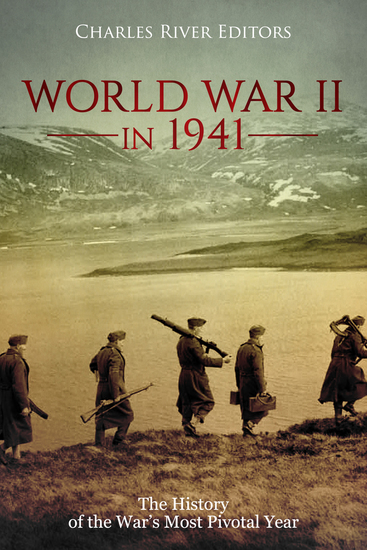
World War II in 1941 - The History of the War’s Most Pivotal Year - cover

World War II in 1941 - The History of the War’s Most Pivotal Year

Editors Charles River

Verlag: Charles River Editors

  • 0
  • 0
  • 0

Beschreibung

At the beginning of 1941, it was unclear whether the Allies would be able to remain in the war for much longer. British Prime Minister Winston Churchill had already immortalized the men of the Royal Air Force with one of the West’s most famous war-time quotes, but the potential of a German invasion of Britain still loomed. With the comfort of hindsight, historians now suggest that the picture was actually more complex than that, but the Battle of Britain, fought throughout the summer and early autumn of 1940, was unquestionably epic in scope. The largest air campaign in history at the time, the vaunted Nazi Luftwaffe sought to smash the Royal Air Force, but thankfully, the RAF stood toe to toe with the Luftwaffe and ensured Hitler’s planned invasion was permanently put on hold. The Allied victory in the Battle of Britain inflicted a psychological and physical defeat on the Luftwaffe and Nazi regime at large, and as the last standing bastion of democracy in Europe, Britain would provide the toehold for the June 1944 invasion of Europe that liberated the continent. For those reasons alone, the Battle of Britain was one of the decisive turning points of history’s deadliest conflict.
 
In the warm predawn darkness of June 22, 1941, 3 million men waited along a front hundreds of miles long, stretching from the Baltic coast of Poland to the Balkans. Ahead of them in the darkness lay the Soviet Union, its border guarded by millions of Red Army troops echeloned deep throughout the huge spaces of Russia. This massive gathering of Wehrmacht soldiers from Adolf Hitler's Third Reich and his allied states – notably Hungary and Romania – stood poised to carry out Operation Barbarossa, Hitler's surprise attack against the country of his putative ally, Soviet dictator Joseph Stalin.
 
Though Germany was technically Russia’s ally, Stalin had no delusions that they were friends.  Instead, he used this time to build up his forces for what he saw as an inevitable invasion.  First, on the heels of the German invasion of Poland in September 1939, Stalin had his troops invade and reclaim the land Russia had lost in World War I.  Next he turned his attention to Finland, which was only 100 miles from the newly named Leningrad.   He initially tried to negotiate with the Finnish government for some sort of treaty of mutual support.  When this failed he simply invaded.  While the giant Russian army ultimately won, the fact that little Finland held them off for three months demonstrated how poorly organized the bigger force was.
 
Stalin knew that if he could delay an invasion through the summer of 1941, he would be safe for another year, but Hitler began to plan to invade Russia by May of 1941.  Since military secrets are typically the hardest to keep, Stalin soon began to hear rumors of the invasion, but even when Winston Churchill contacted him in April of 1941 warning him that German troops seemed to be massing on Russia’s border, Stalin remained dubious. Stalin felt even more secure in his position when the Germans failed to invade the following May. 
 
What Stalin did not realize was that Hitler had simply overstretched himself in Yugoslavia and only planned to delay the invasion by a few weeks. Hitler aimed to destroy Stalin’s Communist regime, but he also hoped to gain access to resources in Russia, particularly oil.  Throughout the first half of 1941, Germany dug in to safeguard against an Allied invasion of Western Europe as it began to mobilize millions of troops to invade the Soviet Union.  Stalin even refused to believe the report of a German defector who claimed that the troops were massing on the Soviet border at that very moment. 
Verfügbar seit: 01.05.2025.
Drucklänge: 245 Seiten.

Weitere Bücher, die Sie mögen werden

  • ZEN - Sounds For Relaxation (XXL Bundle) - Music For Zen Energy Work Brainwave Sync Lucid Dreaming Healing - cover

    ZEN - Sounds For Relaxation (XXL...

    Music For Zen

    • 0
    • 0
    • 0
    ZEN - SOUNDS FOR RELAXATION is a carefully curated collection of healing ZEN Music designed to induce serenity and calm. This album features an array of soothing sounds and gentle melodies, making it an ideal companion for meditation, yoga, massage, energy work or relaxation. 
     
    Listeners are treated to a harmonious blend of natural elements like calming ocean waves, and whispering breezes, intertwined with soothing instrumental accents. Each track is crafted to transport you away from the hustle and bustle of daily life into a state of deep relaxation and peacefulness. 
     
    Ideal for those seeking a moment of tranquility or a soothing soundtrack for their relaxation routine, "ZEN - Sounds for Relaxation" provides a sanctuary of sound and healing. 
     
    The premium collection includes 28 unique tracks, each lasting between 8 and 120 minutes, with a total running time of over 22 hours!
    Zum Buch
  • Thirty Problems Concerning Creation - De Creatione Problemata - cover

    Thirty Problems Concerning...

    Menasseh Ben Israel, Seymour...

    • 0
    • 0
    • 0
    At his own expense, he self-published Thirty Problems Concerning Creation (De Creatione Problemata 30) from his home. This work aimed to restore the classical doctrine of creation and to address intricate philosophical and theological questions related to the creation of the world and faith. The present edition is the first translation of the Latin edition that was published in 1635, nearly 400 years ago. The thirty problems explore various questions, including the existence of a beginning of the world, the nature of the raw material, the origin of Moses' knowledge of creation, the universality of this knowledge, the duration of the world's creation, the existence of other worlds before ours, the direct emanation from God, the number of elements necessary for creation, the creation of souls and bodies, the creation of Paradise and Hell, the existence of Purgatory, the creation of demons and angels, the roundness of the sky, the final cause of the world's creation, and the alterability of the world if it is eternal. These problems invite deep reflections on the nature of existence and faith.
    Zum Buch
  • A Reading of the Inaugural Address of President John Adams - cover

    A Reading of the Inaugural...

    President John Adams

    • 0
    • 0
    • 0
    John Adams (October 30, 1735 - July 4, 1826), born in Braintree, Massachusetts, was an American Founding Father who served as the second president of the United States from 1797 to 1801. Before his presidency, he was a leader of the American Revolution that achieved independence from Great Britain. During the latter part of the Revolutionary War and in the early years of the new nation, he served the U.S. government as a senior diplomat in Europe. Adams was the first person to hold the office of vice president of the United States, serving from 1789 to 1797. The following is a reading of President Adams' inaugural address delivered on March 04, 1797.
    Zum Buch
  • Anwar As-Sadat: A short biography - 5 Minutes: Short on time – long on info! - cover

    Anwar As-Sadat: A short...

    5 Minutes, 5 Minute Biographies,...

    • 0
    • 0
    • 0
    Anwar As-Sadat, Egyptian president: Life and work in a short biography! Everything you need to know, brief and concise. Infotainment, education and entertainment at its best!
    Zum Buch
  • The Chinese Must Go - Violence Exclusion and the Making of the Alien in America - cover

    The Chinese Must Go - Violence...

    Beth Lew-Williams

    • 0
    • 0
    • 0
    In 1885, following the massacre of Chinese miners in Wyoming territory, communities throughout California and the Pacific Northwest harassed, assaulted, and expelled thousands of Chinese immigrants. The Chinese Must Go shows how American immigration policies incited this violence, and how this gave rise to the concept of the "alien" in America. 


    Our story begins in the 1850s, before federal border control established strict divisions between citizens and aliens—and long before Congress passed the Chinese Restriction Act, the nation's first attempt to bar immigration based on race and class. When this unprecedented experiment failed to slow Chinese migration, armed vigilante groups took the matter into their own hands. Fearing the spread of mob violence, policymakers redoubled their efforts to seal the borders, overhauling immigration law and transforming America's relationship with China in the process. By tracing the idea of the alien back to this violent era, Lew-Williams offers a troubling new origin story of today's racialized border.
    Zum Buch
  • Virtual Searches - Regulating the Covert World of Technological Policing - cover

    Virtual Searches - Regulating...

    Christopher Slobogin

    • 0
    • 0
    • 0
    A host of technologies—including digital cameras, drones, facial recognition devices, night-vision binoculars, automated license plate readers, GPS, geofencing, DNA matching, datamining, and artificial intelligence—have enabled police to carry out much of their work without leaving the office or squad car, in ways that do not easily fit the traditional physical search and seizure model envisioned by the framers of the Constitution. Virtual Searches develops a useful typology for sorting through this bewildering array of old, new, and soon-to-arrive policing techniques. It then lays out a framework for regulating their use that expands the Fourth Amendment's privacy protections without blindly imposing its warrant requirement, and that prioritizes democratic over judicial policymaking. 


    The coherent regulatory regime developed in Virtual Searches ensures that police are held accountable for their use of technology without denying them the increased efficiency it provides in their efforts to protect the public. Whether policing agencies are pursuing an identified suspect, constructing profiles of likely perpetrators, trying to find matches with crime scene evidence, collecting data to help with these tasks, or using private companies to do so, this book provides a template for ensuring their actions are constitutionally legitimate and responsive to the polity.
    Zum Buch