Rejoignez-nous pour un voyage dans le monde des livres!
Ajouter ce livre à l'électronique
Grey
Ecrivez un nouveau commentaire Default profile 50px
Grey
Abonnez-vous pour lire le livre complet ou lisez les premières pages gratuitement!
All characters reduced
The Victors of the Battle of Little Bighorn - The Lives and Legacies of Sitting Bull and Crazy Horse - cover

The Victors of the Battle of Little Bighorn - The Lives and Legacies of Sitting Bull and Crazy Horse

Editors Charles River

Maison d'édition: Charles River Editors

  • 0
  • 0
  • 0

Synopsis

Sitting Bull ensured he would become a legend at the Battle of the Little Bighorn, during which an estimated 2,000 Lakota and Cheyenne warriors inspired by one of his visions routed and then annihilated the 7th U.S. Cavalry led by George Custer. That disaster led the American government to double down on its efforts to “pacify” the Sioux, and by the end of the decade many of them had surrendered and been moved onto a reservation. Sitting Bull defiantly refused to surrender, instead heading with a smaller band into Canada and remaining exiled.
 
When he finally surrendered to the U.S. in 1881, he was a celebrity of sorts, and Sitting Bull went on to appear in Buffalo Bill Cody’s Wild West Show during the decade. Not surprisingly, his death was as controversial as his life; in 1890 Sitting Bull was killed on a reservation after plans to arrest him went terribly awry, leading to fighting in the aftermath that left over a dozen dead.
 
As he lay dying, Tashunke Witco, whose name is literally translated as “His Horse is Spirited” or “His Horse is Crazy,” refused to be placed on an army cot, and he insisted upon being placed on the floor. He had spent his life avoiding white people whenever possible, and after he died, his cousin Touch the Clouds pointed to the blanket covering the dead Chief’s body and said, “This is the lodge of Crazy Horse.”
 
Throughout his life, Tashunke Witco tried to live the life his people had enjoyed for centuries. He never signed a treaty with the U.S. government and was never photographed, largely because he wanted to avoid contact with the settlers encroaching further west upon Native American lands. By staying away from white settlements and military forts, he thus avoided the places where a photographer might be lurking. As the great Lakota leaders surrendered to the U.S. military or were killed, they became symbols of the qualities and character of their people. Red Cloud is often referred to as a symbol of Lakota concession. Sitting Bull is considered symbolic of Lakota spirituality. Crazy Horse, because he delayed surrender and never entered into treaty agreements with the U.S. military, became a symbol of Lakota resistance.
 
Crazy Horse may have fervently wished to avoid white settlers, but he’s a Native American icon today because of the inability to do so. Like Geronimo in the Southwest and Sitting Bull on the Plains, Crazy Horse was a chief who fought in several skirmishes against settlers and U.S. forces during the 1860s, and he became one of the most famous Native Americans in American history because of one fateful confrontation with whites: the legendary Battle of the Little Bighorn, during which an estimated 2,000 Lakota and Cheyenne warriors routed and then annihilated the 7th U.S. Cavalry led by George Custer. That disaster led the American government to double down on its efforts to “pacify” the Plains, and by the end of the decade many of them had surrendered and been moved onto a reservation. Like Sitting Bull, Crazy Horse tried to avoid surrendering for as long as he could, and both suffered a controversial death.  
Disponible depuis: 21/06/2025.
Longueur d'impression: 60 pages.

D'autres livres qui pourraient vous intéresser

  • Emotional Self-Care and Positive Affirmations for Black Women - A Guided Spiritual Journal for Self-Discovery and Eliminate Negative Thinking How to Raise Your Self-Esteem Confidence and Self-Love - cover

    Emotional Self-Care and Positive...

    Jorah San

    • 0
    • 0
    • 0
    Are you a black woman struggling with self-doubt and low self-esteem?  
    Do you feel like your experiences and perspectives are undervalued and underrepresented in society?  
    Are you tired of dealing with the constant stress and pressures of everyday life?  
    If you answered yes to any of these questions, then Jorah San's "Emotional Self-Care and Positive Affirmations for Black Women" is the perfect audiobook for you! 
    This audiobook is a guided spiritual journal specifically designed to address the unique challenges that black women face in their daily lives. With this audiobook, you can listen and engage with Jorah San's powerful affirmations, guided journal prompts, spiritual practices, and self-care strategies while you go about your day. 
    Jorah San's approach is rooted in the belief that black women deserve to prioritize their own mental and emotional health. With her guidance, you will learn to let go of self-doubt, build a positive self-image, and cultivate a deeper sense of self-love. 
    So, are you ready to prioritize your well-being and embrace your full power as a black woman?  
    Let "Emotional Self-Care and Positive Affirmations for Black Women" be your companion on your journey.  
    As Jorah San says, "We as black women deserve to live happy, healthy, and fulfilling lives. Let this audiobook be a tool to help you get there."
    Voir livre
  • A Relational Response to Climate Change - cover

    A Relational Response to Climate...

    Calum Samuelson

    • 0
    • 0
    • 0
    About Relationships and Climate ChangeThe challenge of climate change is one of the defining issues the world is facing at the start of the 2020s. It has mobilised a whole new generation of social activists, some of whom are going to extreme lengths to confront the public and especially political leaders with the threat that climate change makes to their future and the planet as a whole.Arguments about the causes of climate change are usually underpinned by the assumption that more human beings living on the planet are inevitably bad for the environment and climate. However, a careful biblical reflection on these issues yields a more nuanced and hopeful view, and this report seeks to stimulate fresh conversations about how best to respond to Climate Change now and in the future.
    Voir livre
  • Red Cloud’s War: The History and Legacy of the Only 19th Century War Won by Native Americans against the United States - cover

    Red Cloud’s War: The History and...

    Editors Charles River

    • 0
    • 0
    • 0
    In the summer of 1866, Colonel Henry B. Carrington set out from Fort Laramie to establish a series of forts along the Bozeman Trail with the goal of protecting migrants moving along the trail. The Bozeman Trail ran through the Powder River country, which included the traditional hunting grounds of Lakota, Cheyenne, and Arapaho peoples. Carrington had about 1,000 people in his column, of which about 700 were soldiers and 300 were civilians, likely soldiers’ families and migrants. 
    The ongoing hostilities, which included the notorious Fetterman's Massacre, ultimately convinced American officials to head back to the negotiating table with the Native Americans, and as a result, Red Cloud has often been labeled the only Indian chief to win a war against the Americans. After that, however, Red Cloud continued to lead his people to reservations first near the Black Hills and later westward after the Battle of the Little Bighorn. Though he was respected as a war chief, it was his political functions as a spokesman of the Oglala that truly allowed Red Cloud to leave his mark over the last several decades of his life. Whereas Sitting Bull and Crazy Horse suffered premature deaths, Red Cloud outlived the other important leaders of the Sioux until dying in 1909 at 87 years old. Near the end of his life, he reportedly said, “They made us many promises, more than I can remember. But they kept but one -- they promised to take our land...and they took it.” 
    Red Cloud’s War: The History and Legacy of the Only 19th Century War Won by Native Americans against the United States analyzes the seminal moments that brought about the war, the war’s most famous battles, and the aftermath.
    Voir livre
  • The Game of Life and How to Play it - cover

    The Game of Life and How to Play it

    Florence Scovel Shinn

    • 0
    • 0
    • 0
    Most  people  consider  life  a  battle,  but  it  is  not  a battle,  it  is  a  game. It  is  a  game,  however,  which  cannot  be  played successfully  without  the  knowledge  of  spiritual law,  and  the  Old  and  the  New  Testaments  give  the rules  of  the  game  with  wonderful  clearness.  Jesus Christ taught  that  it  was  a  great  game  of  Giving and  Receiving.  "Whatsoever  a  man  soweth  that  shall  he  also reap."  This  means  that  whatever  man  sends  out  in word  or  deed,  will  return  to  him;  what  he  gives,  he will  receive.
    Voir livre
  • Healing Way The: A Path to Recovery After Abuse - cover

    Healing Way The: A Path to...

    Lillie Mae Henley

    • 0
    • 0
    • 0
    In The Healing Way I share with you my journey through a life burdened by abuse. My hope is that my journey and all that I learned will be a catalyst for your own growth. If you are read¬ing this, I know you have the desire to live without the pain of abuse. You have the same desire to live a healthy life that everyone has. I also know you have more courage within than you think. And somehow the courage will give you the ability to take the risks necessary to change your life. By sharing my journey and all the things I learned, I want to bring you hope. Hope that you can recover from abuse and live a healthy, functional life. In this book, I write about behaviors and attitudes which will help you become a better person. I am not writing about being a good person. Nor am I saying you will become a person who meets others’ expecta¬tions. Becoming a better person means to me, and I hope it begins to mean to you:a person who is willing to learn new behaviors, become more self-aware, and see other perspectives of the pain deep within. The Healing Way talks about the complexities and dynamics of abuse. The behaviors and practices to learn to become a health¬ier person. Specific steps for healing and simple, human knowledge which we rarely learn from parents, teachers, or peers. I had to author this book, because I have experienced and seen the pain abuse brings to individ¬uals, our culture, and our world. From my heart, I hope The Healing Way will help you live a more fulfilling life. Rev. Lillie Henley
    Voir livre
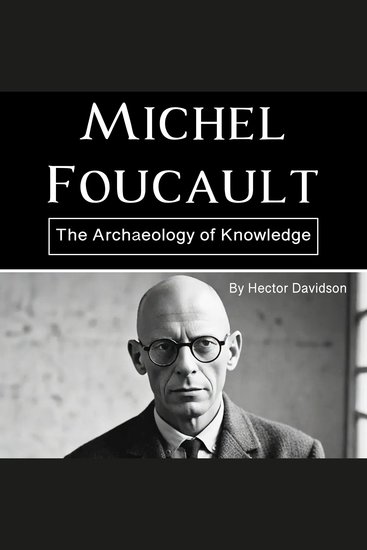
  • Michel Foucault - The Archaeology of Knowledge - cover

    Michel Foucault - The...

    Hector Davidson

    • 0
    • 0
    • 0
    Michel Foucault, a French philosopher, historian, and social theorist, is renowned for his critical exploration of power, knowledge, and social institutions. Born in 1926, Foucault’s work spans a range of disciplines, from philosophy to sociology, psychology, and political science. His intellectual journey reflects a unique approach to understanding human societies, focusing not on abstract metaphysical systems but on the structures that shape human behavior, knowledge, and institutions. 
    Foucault’s work is marked by a critique of the traditional ways of understanding the relationship between individuals and society. He challenged the dominant historical narratives and sought to uncover the deeper structures of power that influenced the development of knowledge. One of his central ideas was that knowledge and power are intimately connected—knowledge is not neutral but shaped by power relations that determine what is considered true or false. In this sense, his work was not just theoretical but deeply political, as it explored how systems of power create the conditions for knowledge and vice versa. 
    Foucault’s philosophy is often associated with his concept of "genealogy," a method he developed to investigate historical processes and the ways in which ideas, norms, and practices evolve over time. However, it is in his "archaeology of knowledge" that he makes his most significant philosophical contributions. The archaeological method is a way of analyzing the historical layers of knowledge and uncovering the deep structures that underlie our understanding of the world. Unlike traditional historiography, which tends to focus on narratives and individuals, Foucault's archaeology examines the discourses and institutions that create and maintain knowledge, highlighting the ways they shape and limit what can be known.
    Voir livre