Rejoignez-nous pour un voyage dans le monde des livres!
Ajouter ce livre à l'électronique
Grey
Ecrivez un nouveau commentaire Default profile 50px
Grey
Abonnez-vous pour lire le livre complet ou lisez les premières pages gratuitement!
All characters reduced
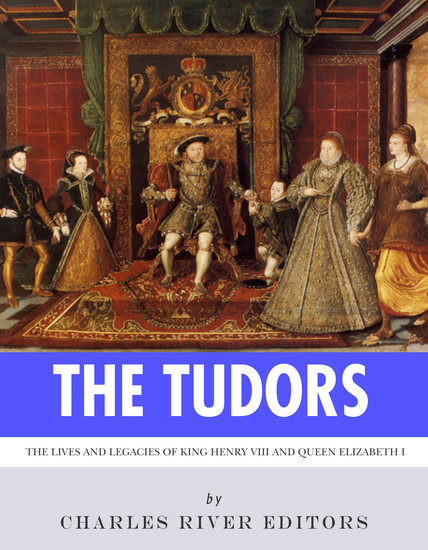
The Tudors - The Lives and Legacies of King Henry VIII and Queen Elizabeth I - cover

The Tudors - The Lives and Legacies of King Henry VIII and Queen Elizabeth I

Editors Charles River

Maison d'édition: Charles River Editors

  • 0
  • 0
  • 0

Synopsis

Over 450 years after his reign, Henry VIII is still the most famous and recognizable King of England, but it’s for all the wrong reasons. Though well regarded by contemporaries as a learned king and "one of the most charismatic rulers to sit on the English throne", he is best remembered today for his gluttony and multiple marriages, particularly the gruesome way in which he was widowed on more than one occasion. Naturally, that was the focus of the popular ShowTime drama series centered around his life, The Tudors.
 
Henry VIII will probably continue to be best known for beheading some of his wives, most notably Anne Boleyn, so it is somewhat fitting that his most decisive act came as a result of a marital mishap. Sharply at odds with the Catholic Church over his attempt to dissolve his marriage with Catherine of Aragon, Henry VIII ultimately broke with the Church and established the Church of England, which forever both the religious history of England and the social hierarchy of the nation and its empire. 
 
 Though the popular perception of his reign has taken hold, King Henry VIII did not start life in any of those ways. In fact, he did not even start life as heir to the English throne. And when he did come to the throne at the age of 18, King Henry VIII’s earliest monarchical years showed his promise as a quintessential renaissance, polymath Prince. Even on the religious front, Henry VIII started out believing in the essential Catholic theology, even after the Pope and the Vatican excommunicated Henry from the Catholic Church (until then, the undisputed political as well as theological leader of Christendom, from which monarchs often needed various forms of legitimacy).
 
When Queen Elizabeth II came to the throne in 1952, many commentators heralded the beginning of her reign as the second Elizabethan age. The first one, of course, concerned the reign of Henry VIII’s second surviving daughter and middle surviving child, Queen Elizabeth I, one of England’s most famous and influential rulers. It was an age when the arts, commerce and trade flourished. It was the epoch of gallantry and great, enduring literature. It was also an age of wars and military conflicts in which men were the primary drivers and women often were pawns.


Elizabeth I changed the rules of the game and indeed she herself was changed by the game. She was a female monarch of England, a kingdom that had unceremoniously broken with the Catholic Church, and the Vatican and the rest of Christendom was baying for her blood. She had had commercial and militaristic enemies galore. In the end, she helped change the entire structure of female leadership.
 
 Elizabeth was the last Tudor sovereign, the daughter of the cruel and magnificent King Henry VIII and a granddaughter of the Tudor House’s founder, the shrewd Henry VII. Elizabeth, hailed as “Good Queen Bess,” “Gloriana” and “The Virgin Queen” to this day in the public firmament, would improve upon Henry VIII’s successes and mitigate his failures, and despite her own failings would turn out to “have the heart and stomach of a king, and a king of England too”. Indeed, that was the phrase she would utter in describing herself while exhorting her troops to fight for England against the Spanish Armada.
 
 Elizabeth often has been featured in biographies that were more like hagiographies, glossing over her fits of temper, impatience and other frailties. It is fair to say, however, that she had also inherited her grandfather’s political acumen and her father’s magnificence, thus creating not just one of the most colourful courts in Europe but also one of the most effective governments in English history. It was an age of Christopher Marlowe’s and William Shakespeare’s flourishing creativity that still enhances English as well as comparative literature.
Disponible depuis: 27/06/2025.
Longueur d'impression: 58 pages.

D'autres livres qui pourraient vous intéresser

  • Hard Asks Made Easy: How to Get Exactly What You Want - cover

    Hard Asks Made Easy: How to Get...

    JD Laura Fredricks

    • 0
    • 0
    • 0
    How to ASK for what you want ~and get it! 
    Asking for anything can be difficult, but those hard asks—promotions, love, money, 
    help—the ones that have you thinking and rethinking in your head, biting your nails, 
    and finding excuses not to ask, require a planned and proven approach. Ask expert 
    Laura Fredricks understands the psychology of asking. She’s raised more than a billion dollars for 
    her clients, and in this, her most important book yet, she’ll walk you through the process, starting 
    with identifying what kind of asker you are. Laura comes from successful careers in industries 
    known for making the toughest and biggest asks—law and philanthropy—and now she’s sharing 
    that insider knowledge with you. In this book, she points out the devils that keep you from asking, 
    and she shares her Five Laws on Asking that will guide you through every ask, regardless of how 
    challenging, anxiety provoking, or downright scary. With Laura Fredricks as your ask expert, you’ll 
    be able to apply power asking to every aspect of your life.
    Voir livre
  • 100 Amazing Facts about Mexico - Secrets and Stories from the Heart of America - cover

    100 Amazing Facts about Mexico -...

    Marc Dresgui

    • 0
    • 0
    • 0
    Discover the mysteries and wonders of Mexico with "100 Amazing Facts About Mexico" – an exciting journey through the history, culture, and nature of a unique country! 🇲🇽 
    Have you ever wondered:How did ancient civilizations build such impressive pyramids without modern technology?What unique animals can only be found in Mexico?Why is the hidden beach of the Marietas Islands called "Playa del Amor"?What deep connection did the Maya have with the stars?Which endangered species are protected in Mexico's natural reserves? 
    Here’s why "100 Amazing Facts About Mexico" is the perfect book for your children:Fascinating facts: Each fact is selected to amaze and inspire while providing a deeper understanding of Mexico. You will uncover incredible natural phenomena, rare animals, and iconic archaeological sites.Fun learning: This book offers an easy-to-read format, perfect for young readers eager to explore the world through captivating information. Plus, an integrated quiz lets them test their knowledge while having fun!A window to the world: By discovering the history and culture of Mexico, your children will develop curiosity about other cultures, learning to respect and appreciate diversity.Inspiring content: This book doesn’t just list facts – it tells the fascinating story of a country through its myths, traditions, and natural treasures, encouraging exploration and reflection. 
    Give your children an unforgettable adventure through the wonders of Mexico with 100 Amazing Facts About Mexico. Whether it's to deepen their knowledge, ignite their curiosity, or simply introduce them to a fascinating country, this book is the perfect gift for all budding explorers!
    Voir livre
  • Effective Communication: Transform Your Arguments and Win Every Debate - "Elevate your debate skills with captivating audio lessons for persuasive arguments and confident delivery!" - cover

    Effective Communication:...

    Lucien Alderidge

    • 0
    • 0
    • 0
    Effective Communication: Transform Your Arguments and Win Every Debate  
    ⭐⭐ Simplified Guide & Explanations Included ⭐⭐ 
    Are you eager to enhance your career and solidify your expertise in impactful communication?  
    Looking for a comprehensive resource that equips you with everything you need to master conversations and debates?  
    Your search ends here! 
    This guide is your ultimate companion for deepening your understanding, applying your skills, and engaging in practical exercises. With this resource, you’re set for success. 
    Updated for modern communication strategies. 
    Key features of this enriched guide: 
    - In-depth insights about effective communication skills 
    - Comprehensive explanations of powerful strategies for impactful conversations 
    - Proven techniques for preparing and excelling in debates 
    What sets our guide apart is its thoroughness, essential for achieving your goals. Concepts are explored with clarity and depth, ensuring you gain a true understanding. 
    Please note that this guide is an independent resource and is not affiliated with any official communication body. 
    Crafted with a clear structure and straightforward language, our guide ensures smooth transitions between topics. Say goodbye to confusing jargon and welcome content that is clear, precise, and technically sound. 
    So, why wait? Click the BUY NOW button, secure your guide, and embark on your journey to communication success!
    Voir livre
  • Africa Is Not a Country - Notes on a Bright Continent - cover

    Africa Is Not a Country - Notes...

    Dipo Faloyin

    • 0
    • 0
    • 0
    So often, Africa has been depicted simplistically as a uniform land of famines and safaris, poverty and strife, stripped of all nuance. In this bold and insightful book, Dipo Faloyin offers a much-needed corrective, weaving a vibrant tapestry of stories that bring to life Africa's rich diversity, communities, and histories. 


    Starting with an immersive description of the lively and complex urban life of Lagos, Faloyin unearths surprising truths about many African countries' colonial heritage and tells the story of the continent's struggles with democracy through seven dictatorships. With biting wit, he takes on the phenomenon of the white savior complex and brings to light the damage caused by charity campaigns of the past decades. Entering into the rivalries that energize the continent, Faloyin engages in the heated debate over which West African country makes the best jollof rice and describes the strange, incongruent beauty of the African Cup of Nations. With an eye toward the future promise of the continent, he explores the youth-led cultural and political movements that are defining and reimagining Africa on their own terms. 


    Africa Is Not a Country celebrates the energy and particularity of the continent's different cultures and communities, treating Africa with the respect it deserves.
    Voir livre
  • Workplace NeuroDiversity Rising 20 - cover

    Workplace NeuroDiversity Rising 20

    Lyric Rivera

    • 0
    • 0
    • 0
    Having a supportive environment can be the difference between employee success and failure. When we supoport the diverse minds within an organization, everyone on the team benefits (because much of what is necessary for NeuroDivergent success, will benefit everyone in a company). 
      
    That's why I've written ths handy guide for you, to help empower other people and organizations to consider what they can do to support NeuroDivergent employees. 
      
    This book is designed to be read front to back, but is also organized in sections, to allow you to skip to your organizaton's specific problem areas (since every organization is unique). I've also included a handy glossary of terms at the back of this book.
    Voir livre
  • Great Schism and the Western Schism The: The History and Legacy of the Most Important Splits in the Catholic Church - cover

    Great Schism and the Western...

    Editors Charles River

    • 0
    • 0
    • 0
    For nearly a thousand years following its foundation, there was only one Christian Church. Centered in the city of Rome, the Church expanded and grew until it became the dominant religion in Europe and beyond. The early growth of the Church had been suppressed by the Romans until the Emperor Constantine became the first to convert the empire to Christianity, and from that point forward, the growth of the Church was inextricably linked with the Roman Empire, the most powerful military, economic, and political force in the ancient world. 
    However, once the Western Roman Empire collapsed, Rome’s preeminence was not a situation that was welcomed in Constantinople, now the center of the Byzantine Empire and a thriving and wealthy metropolis. After being sacked by outsiders, Rome had become a virtual ghost town, partially ruined and inhabited by a small number of hardy survivors, yet in the center of the crumbling city was the Vatican Borgo, the Palace of the Supreme Pontiff and the heart of the Church. In retrospect, it is easy to see that this was a situation that was bound to lead to conflict and disagreement, with the Greek-speaking Eastern Orthodox Church centered in Constantinople and being governed by Latin-speaking popes in a faraway city. 
    To many, the pope is the embodiment of godly love in its purest form. No matter the weather or the inconvenience, millions upon millions of fervid devotees brave the congested streets of their cities, all for the once-in-a-lifetime opportunity to welcome the beloved Vicar of Christ. However, the modern perception of the pope is a far cry from how things were just a couple of centuries ago. There was a time when the holiest men of the world were constantly at each other's throats, willing to go to any lengths to secure the coveted papal title. By the late 14th century, tensions within the Church reached its breaking point, resulting in the Western Schism, an infamous split of the Catholic Church.
    Voir livre