Begleiten Sie uns auf eine literarische Weltreise!
Buch zum Bücherregal hinzufügen
Grey
Einen neuen Kommentar schreiben Default profile 50px
Grey
Jetzt das ganze Buch im Abo oder die ersten Seiten gratis lesen!
All characters reduced
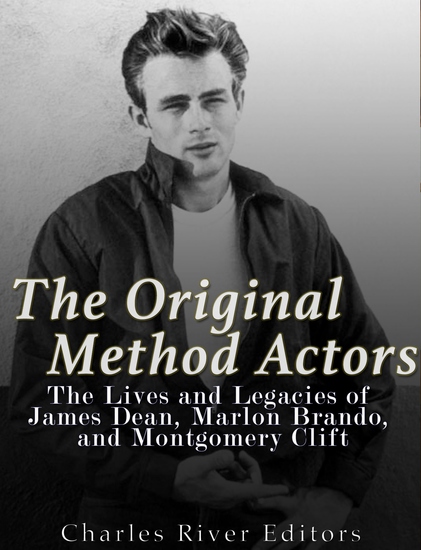
The Original Method Actors - The Lives and Legacies of James Dean Marlon Brando and Montgomery Clift - cover

The Original Method Actors - The Lives and Legacies of James Dean Marlon Brando and Montgomery Clift

Editors Charles River

Verlag: Charles River Editors

  • 0
  • 0
  • 0

Beschreibung

It would be no exaggeration to say that James Dean has been more mythologized than any other actor in history, a development due more to his off-screen personality and conduct than the films he actually starred in. Much of Dean’s appeal derives from his humble and ordinary origins, and audiences are drawn to the romance of the Indiana farm boy who catapulted to the top of the motion picture industry in a single year — the same year that would see him die.
 
Of course, James Dean remains well-known for being anything but humble and ordinary. As famous as his films are, Dean’s story is inextricably tied to his love for racing cars and his death in a high speed car crash. And though Dean was already wildly famous at the time of his death, there is no question that his death only enhanced his fame. One study found evidence of a “James Dean effect,” which concluded that a star’s popularity benefits if the star dies young instead of living longer and losing luster. By dying young, Dean actually ensured that his name would remain famous, and his appeal has transcended generations. 
 
Marlon Brando.  Few names in the acting profession evoke such a strong, almost visceral reaction.  Over the course of his long, prolific career, he was considered perhaps the greatest actor of the 20th century as well as one of the most complicated and misunderstood.  Uniquely able to be both emotionally charged and technically constrained in the same performance, he single-handedly changed the direction of not only the American style of acting, influencing successors such as Robert De Niro, Al Pacino and even Johnny Depp, but the acting profession on a global scale.  His iconic interpretations of characters such as Stanley Kowalski (A Streetcar Named Desire), Terry Malloy (On the Waterfront) and Vito Corleone (The Godfather) have been forever burned into the collective memory of film and theatre aficionados, scholars and critics for their immense passion, rage, love, defiance, vulnerability, cruelty and tenderness – basically, the full spectrum of the human condition.  With several Oscars and Golden Globes to his name, Brando’s contributions remain the gold standard of the acting craft, and the American Film Institute has listed him as the 4th greatest screen legend in history. 
 
Brando was one of his generation’s sex idols, its most versatile actors, and a political activist, but who was the person behind the legend?  What propelled a young man from the Midwest to become such a powerful, capricious and dominating force in the acting arena?  How was he able to penetrate the human condition, replete with all its multilayered emotional baggage, and convey its strengths, weaknesses and delicate nuances so successfully, often while plagued by his own personal tragedies and demons? 
 
In Edward Montgomery Clift, the public not only discovered an unusually gifted actor, but a persistent and stoical anti-authoritarian, an extreme non-conformist in a conformist age and a personal enigma who has remained the target of prying Hollywood reporting since his death. Described as the first “method” actor in Hollywood, he was to co-create and develop this lonely, unwilling and uncertain American hero, filled with deep personal ambiguities, a conflicting will, vulnerable and sensitive. In his eventual arrival to Hollywood following a lengthy period of resistance, he not only embodied this new male model, but inspired the next generation of fascinating characters who didn’t “fit in,” such as friends Marlon Brando and James Dean. He added to this screen persona a sexual dualism that, while not apparent on the surface, changed the way leading men were perceived by the late 1940s.
 
A first-rate stage actor, Clift approached Hollywood on his own terms, and permanently upset the ruling order of the studio-to-star system, in which long-term contracts guaranteed corporate ownership of the artist.
Verfügbar seit: 01.05.2025.
Drucklänge: 112 Seiten.
Weitere Bücher, die Sie mögen werden

  • Blood of The Samurai - The Legendary Battles - cover

    Blood of The Samurai - The...

    Jon White

    • 0
    • 0
    • 0
    The samurai way of life is guided by three core values - loyalty, honor, and respect. These principles are more than just words; they are the basis of a strict code of conduct that governs every aspect of a samurai's life. Loyalty is the foundation of the samurai's relationship with their lord. It is not just blind obedience but an unwavering sense of duty and honor that compels them to protect their lord at all costs. This bond is unbreakable and lasts beyond death. Honor is earned through acts of bravery and selflessness on the battlefield and maintained through strict adherence to the Bushido code. A samurai's reputation is built on their honor, and they will go to great lengths to protect it, even if it means sacrificing their own life.Respect is the currency of the samurai world, earned through martial prowess and deeds of valor. A respected samurai is a force to be reckoned with, their reputation preceding them wherever they go. Respect must be earned through actions demonstrating the samurai's worthiness of admiration and awe.For a Samurai, these values are not just aspirations but a way of life that defines who they are and what they stand for. With these guiding principles, a samurai is a skilled swordsman with a moral compass. Through the practice of these principles, the samurai become legends, their names remembered and revered for generations to come.
    Zum Buch
  • Augustus - Biography of Octavian the First Roman Emperor - cover

    Augustus - Biography of Octavian...

    Kelly Mass

    • 0
    • 0
    • 0
    Caesar Augustus, originally known as Gaius Octavius, was the first Roman Emperor and one of the most transformative figures in world history. Born into an affluent plebeian family, he belonged to an ancient and influential equestrian branch of the gens Octavia. His path to power began under extraordinary circumstances. Following the assassination of his maternal great-uncle, Julius Caesar, in 44 BC, Octavius was named in Caesar's will as his adopted son and successor. This inheritance not only granted him the prestigious name of Caesar but also gave him control over Caesar’s vast estate and the loyalty of his legions. These legions played a pivotal role in his rise to power, securing his place as one of the most powerful individuals in Roman history. 
    In the aftermath of Caesar's assassination, the Roman Republic was plunged into chaos, and Octavius, together with Mark Antony and Marcus Lepidus, formed the Second Triumvirate to avenge Caesar's death and secure their political dominance. This alliance, however, was marred by internal strife and competing ambitions. After their victory over Caesar’s assassins at the Battle of Philippi in 42 BC, the Triumvirs divided the Republic’s territories among themselves. Yet, the unity that had characterized their alliance quickly began to erode, as their personal and political ambitions led to inevitable conflict. Lepidus was soon sidelined, and in 36 BC, Antony’s support began to wane, leading to the climactic Battle of Actium in 31 BC. The defeat of Antony, coupled with the subsequent suicide of both Antony and his ally Cleopatra, left Octavian as the undisputed ruler of Rome.
    Zum Buch
  • Turn Around and Take a Bow! - cover

    Turn Around and Take a Bow!

    Mike Dixon, Anthony Cherry

    • 0
    • 0
    • 0
    Mike Dixon has been involved in the British music industry for over 40 years and has been Musical Director for more than twenty West End productions including, We Will Rock You, The Bodyguard, Grease, Aspects of Love, Joseph and the Amazing Technicolor Dreamcoat and Jesus Christ Superstar. His TV credits include six Royal Variety Performances, countless light entertainment series and Glastonbury with Shirley Bassey, as well as a huge number of high profile television and radio concerts. His career has taken him all over the world working with some of the most iconic artists of the 20th and 21st centuries, including Dame Shirley Bassey, Lord Lloyd-Webber, Leslie Bricusse, Sir Tim Rice, Don Black, Sir Elton John, Lionel Richie, Sir Tom Jones, Lady Gaga and Queen.  The book follows his journey as his exciting and eclectic musical career develops. From his early musical experiences in Plymouth, studying at Trinity College of Music, to conducting in the Royal Albert Hall, with plenty of humour along the way, it is a little peek behind the scenes into the world of entertainment from a unique, hands-on perspective.Turn Around and Take a Bow! My Musical Life - Written and read by Mike DixonForeword - Written and read by Anthony CherryEdited and Produced by Richard HeathcoteMastered by Jason FallonRecorded at Audio Shed, Hockley HeathTurn Around and Take a Bow! Theme (Opening and End Slate) - Written and performed by Mike DixonWhen I Saw You (End of Chapter 10 Love and Marriage) - Written and performed by Mike Dixon
    Zum Buch
  • Dr Mary Edwards Walker: The Life and Legacy of the Civil Rights Activist Who Became the Only Woman to Receive the Medal of Honor - cover

    Dr Mary Edwards Walker: The Life...

    Editors Charles River

    • 0
    • 0
    • 0
    In the process of becoming one of the most famous Americans of her era, Susan B. Anthony’s legacy has overshadowed many of her contemporaries who were also active in the fight for civil rights. Among them, few led as interesting or progressive a life as Dr. Mary Edwards Walker, who grew up in a family that encouraged every kind of pursuit for girls and provided an educational foundation that would propel Walker in many fields. In addition to becoming a surgeon, Walker and her family eschewed conventional dress styles in favor of being comfortable, doing so in an era that ensured she would be ridiculed for it. Undeterred, Walker’s work took her across enemy lines during the Civil War, leading to her arrest in the South and to her recognition as one of only eight civilians in American history to be awarded the Medal of Honor for rendering "valuable service to the Government, and her efforts have been earnest and untiring in a variety of ways."  
    	Although her legacy has not endured quite as much as some of the other activists who fought for civil rights in the late 19th century, she has been remembered and celebrated in the past few decades, including the unveiling of a giant statue of her in her hometown of Oswego, New York. She has also been commemorated with a stamp, and in the near future, a U.S. Army fort may be named after her in recognition of her service during the Civil War. 
    Zum Buch
  • Dangers of the Trail in 1865: A Narrative of Actual Events - cover

    Dangers of the Trail in 1865: A...

    Charles E. Young

    • 0
    • 0
    • 0
    "Embark on a harrowing journey across the untamed American West with Charles E. Young in 'Dangers of the Trail in 1865'. This gripping audiobook brings to life Young's autobiographical account of his perilous trek from New York to Denver. Set against the backdrop of a nation reeling from civil war, Young’s narrative is filled with encounters with Native Americans, outlaws, and the relentless forces of nature. Each chapter unfolds with vivid descriptions and heart-pounding moments, offering listeners a firsthand glimpse into the challenges and adventures of frontier life. Join Young as he navigates through this treacherous yet transformative era in American history."
    Zum Buch
  • Why Marianne Faithfull Matters - cover

    Why Marianne Faithfull Matters

    Tanya Pearson

    • 0
    • 0
    • 0
    First as a doe-eyed ingénue with “As Tears Go By,” then as a gravel-voiced phoenix rising from the ashes of the 1960s with a landmark punk album, Broken English, and finally as a genre-less icon, Marianne Faithfull carved her name into the history of rock ’n’ roll to chart a career spanning five decades and multiple detours. In Why Marianne Faithfull Matters, Tanya Pearson crafts a feminist account that explains the musician’s absence from the male-dominated history of the British Invasion and champions the eclectic late career that confirmed her redemption. 
     
    Putting memoir on equal footing with biographical history, Pearson writes about Faithfull as an avid fan, recovered addict, and queer musician at a crossroads. She’s also a professional historian unafraid to break from the expectations of the discipline if a “titty-centered analysis” or astrology can illuminate the work of her subject. Whether exploring Faithfull’s rise to celebrity, her drug addiction and fall from grace as spurned “muse,” or her reinvention as a sober, soulful chanteuse subverting all expectations for an aging woman in music, Pearson affirms the deep connections between listeners and creators and reveals, in her own particular way, why Marianne Faithfull matters.
    Zum Buch